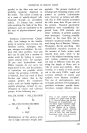
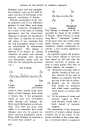
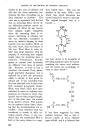
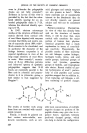
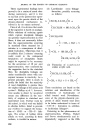
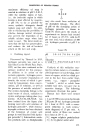
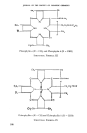
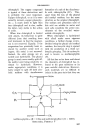
JOURNAL OF THE SOCIETY OF COSMETIC CHE•ilSTS These experimental findings have proved to be a centre, of much stim- ulating controversy, and it is true to say that at the present time agree- ment upon the precise details of the physico-chemical mechanisms in- volved is by no means universal. First of all, it is obvious that much of the argument is based on analogy. While solutions of reducing agents which rupture disulphide linkages can produce supercontraction in wool fibres, it does not necessarily follow tha, t the supercontraction occurring in stretched fibres steamed for 2 minutes is a consequence of disul- phide hydrolysis. Objections that it is unlikely that 2 minutes' steaming could result in the widespread breakdown of disulphides which might be expected to be necessary for the occurrence of 30 per cent supercontraction, were countered by the suggestion that in the stretched fibre, the disulphide linkages are under considerable stress with con- sequent increase in reactivity. As a general principle, there is much to justify the belief that the reactivity of wool dimlphides is greater than the sulphur linkage of the amino. acid cystine •8. Phillips et al. •9, however, were unable to detect by analytical means any difference in the reac- tivity of sulphur in stretched and unstretched wool. Further work by this school, in which wool was boiled in alkaline buffers, failed to provide any evidence to support. the forma- tion of - SNH - or - CH=N - link- ages. The action of boiling dilute alkalis on wool, according to these workers, is twofold in nature: Lanthionine cross • linkage formation, possibly occurring as follows' \ ,/ CH.CH2.S.S.CH.•,.CH -- CH.CH..,SH + HO.S.CH..,.CH b. \ CH.CHo. S.OH \ -- C=CH2+H.•O+S C=CH2 + SH.CH2.CH-- / \ / CH.CH2.S.CH2.CH ,/ (2) Formation of combined amino acrylic acid. x, ,•' CH.CH•.S.S.CH2.CH -- \ C=CH.., + H..,S + S + CH2=C / These conclusions are based on the isolation and identification of the constituents of hydrolysates of alkali treated wool. Nevertheless, some of the physico-chemical pro- perties of alkali treated wool seem to be better understood in terms• of -- CH-- N-- formation in addition to lanthionine linkages •ø. Returning to the phenomenon of supercontraction, Phillips, Rudall and Stoves simultaneously and in- dependently suggested at the 1946 168

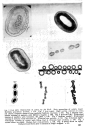
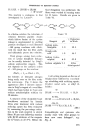
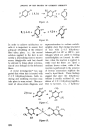
PROPERTIES OF KERATIN FIBRES Fibrous Proteins Symposdum that separation of hydrogen bonded pep- tides may play an important part in bringing about axial contraction of fibres. Later, two of Phillips' co- workers a• claimed that a more con- sistent view of the mechanism of supercontraction and set can be ob- tained if the emphasis previously placed on disulphide linkage reacti- vity is replaced by consideration of other factors which give stability to the wool macromolecule. In the present state of knowledge, stability of the keratin system results from an equilibrium between attractive forces of side chains and the stabilis- ing action of cross-linkages between polypeptides. Three main types of cross-linkage are involved, which in decreasing order of stability are, disulphides, salt linkages and hydro- gen bonds. In the absence of re- straining forces, the attraction of side chains, will cause folding of polypeptide chains. The equilibrium position achieved under any given conditions will depend on the num- ber and nature of the stabilising cross-linkages, and any factor affecting these would be expected to alter the equilibrium position of the polypeptide system and so the length o.f the fibre. Since an unstretched wool fibre neither extends nor contracts when steamed, it follows that the a-form of keratin, in which the polypeptide chains are partially folded, is a stable system. When wool fibres are stretched and steamed, however, X-ray examination shows that the a-form changes to the /•-form with unfolding of the main polypeptide chains. On releasing such a fibre in steam, the a-form does not re- turn, and the final equilibrium length of the fibres depends on the degree of re-orientation of polypeptides occurring in the extended state. If the stretched fibre is steamed for a short time, little re-orientation of the uncoiled polypeptides occurs and re- lease in steam permits folding of chair•s with consequent contraction in fibre length. Steaming of the stretched fibre for greater lengths of time, however, allows the main poly- peptides• to achieve new equilibrium positions in the extetnded state. Blackburn and Lindley have correl- ated the X-ray findings for wool with the work of Bunn and Garner ,•-ø on polyamides. The lat,ter investigators found that spreading of certain spots in the X-ray diffraction pattern resulted from the slipping past one another of layers of polypeptide chains in the /•-(extended) form. This spreading phenomenon is ana- 1ogou•,t to that occurring in the fi- photogaph of wool fibres stretched in steam, and suggests the possi- bility of slippage of the polypeptide chains during setting. On this view, supercontraction and setting of wool fibres are considered to arise as follow:•: When a wool fibre is stretched the polypeptide chains are uncoiled and take up the •-configuration. At the same time, the main chains are oriented in the direction of the fibre axis. Reduction of the adhesion be- tween chains, e.g., by the hydrating action of steam on hydrogen bonds 169
Purchased for the exclusive use of nofirst nolast (unknown)
From: SCC Media Library & Resource Center (library.scconline.org)