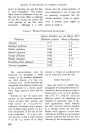
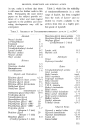
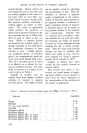
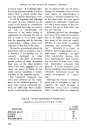
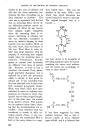
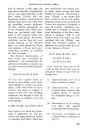
JOURNAL OF THE SOCIETY followed by washing overnight. The washed fibres were then treated with hydrogen peroxide as already des- cribed, when the reduction in work was found to be 30.7 per cent. Com- parison of the damage caused by the catalytic action of copper, nickel and cobalt was made by treating calibrated fibres for 17 hours at 22.2øC. with M/20 solutions of copper sulphate, nickel sulphate and cobalt acetate. After being washed for 24 hours, the fibres were placed in 6.25 per cent (v/v) of 100 volume hydrogen peroxide at pH 7 for 17 hours, at 22.2øC. Following a 24 hours' wash in running •vater, the fibres were stretched in distilled water. Table V summarises the results. TABLE V Copper Nickel Cobalt Catalyst Sulphate Sulphate Acetate reduction in work 49'3 21'4 2O'2 Blank -- 12.0 per cent OF COSMETIC CIIEMISTS 1 part ß 880 ammonium hydroxhydrogen 20 parts 20 volume peroxide, was stretched 40 per cent and set by boiling for •- hour in 2 per cent borax solution, only 15 per cent permanent set was obtained, cont.- pared with 25 per cent in the case of an unbleached fibre. tIydrogen peroxide is also used as a constituent of oxidation hair dyes, where p-phenylene diamine, alone or in association with amino-phenols, is oxidised on the fire to coloured bodies of the indamine, indophenol or phenazine type. Normally, the hydrogen peroxide acts primarily on the dyestuff intermediate and cause• negligible fibre degradation. For example, a fibre treated for 1 hour at 20øC. with: 0.25 g.m. p-phenylene diamine 0.25 g.m. Amidol 5.0 cc. 20 vol. hydro- gen peroxide 0.25 c.c. 880 ammonium hydroxide followed by 24 hours' wash, showed a reduction in work of only 2.7 per cent. per 100c.c. aqueous solution Presence of copper in the fibre therefore gives rise to four times the oxidative damage caused by uncata- lysed hydrogen peroxide, while nickel and cobalt give a result ap- proximately 1.75 times that obtained in the blank experiment. As m•ght be anticipated, attack by hydrogen peroxide impares the se•ting proper- ties of human hair, e.g., wh{,n a fibre which had been treated f•:r 1. hour at 28øC. with 5. Reducing Agents Reducing agents figure in cosmetic chemistry as depilatories and as assistants for low temperature per- manent waving. Thiol compounds are the reducing agents used and de- pend for their efficiency on the fact that in neutral or alkaline solution an excest• of a thiol compound, e.g., thioglycollic acid, reduces the disul- phide linkage in proteins: 172

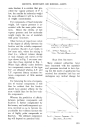
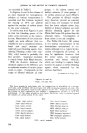
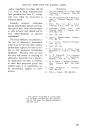
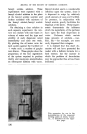
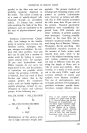
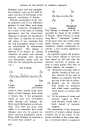
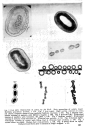
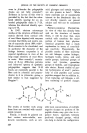
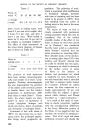
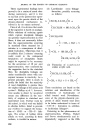
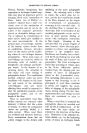
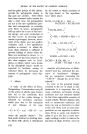
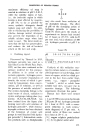
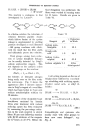
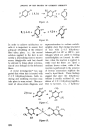
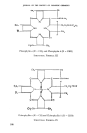
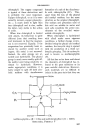
PROPERTIES OF KERATIN FIBRES R.S.S.R. + 2R'SH -- 2R.SH -{- R'.S.S.R' This reaction is analogous to that investigated by Lecher 3•' final elongation was performed, the fibres were washed in running water for 24 hours. Results are given in Table VI. NO b In alkaline solution the reduction oi cohesion between peptide chains which follows fission of the cystinc linkage is supplemented by swelling premure developed as each liberated --SH group combines with alkali, with the result that the fibre swells and ultimately passes into solution. Thiol groups arising from reduc- tion of cystinc disulphide linkages can be readily detected by Feigl's sodium azide-iodine reagent. This test depends on the catalytic action of --SH group,• on the reaction: 2NaN•,-t • 1:--- 2Nai + 3N: the bubbles of liberated nitrogen being easily seen on the fibre under the lnicroscope. Fig. 8 shows the appearance after 5 minutes immer- sion in Feigl's reagent of a wool fibre which had been boiled in 5 per cent sodium metabisulphite solution for 30 minutes. A measure of the disulphide bond breakdown sustained by keratin fibres after treatment with variou:i reducing agents has been estimated by measuring the percentage reduc- tion in the work required to stretch fibres 30 per cent following reaction with M/10 solutions of the reagents for 17 hours at 22.2øC. Before the TABLE \"I •/,• Reduction Reagent pH in Work Sodium meta- bisalphite 5.0 10.8 't'hiogly•)i•i• acid 1,0 16.2 __ . Sodium hydro- sulphite 6.0 Sodium sulphide 9.2 20.0 Fibrc disintegrated Cold setting depends on the use ot thioglycollate followd by cross-link- age rebuilding with oxidising agents, divalent metal salts, or alkyl di- halides: O 2R.SH ---- R.S.S.R. + H,.,,O Fe SO• 2R.SH ------- R.S.Fe.S.R + H.,,SO4 CH..,CI.z 2R.SH -- R.S.CIL,.S.R. + 2HC1 Formaldehyde and quinones also readily react with thiol groups to form new cross linkages aø, e.g. mg.a. 173
Purchased for the exclusive use of nofirst nolast (unknown)
From: SCC Media Library & Resource Center (library.scconline.org)