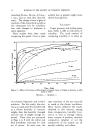
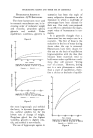
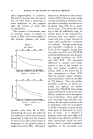
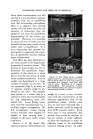
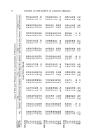
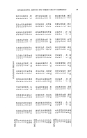
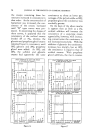
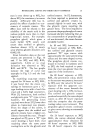
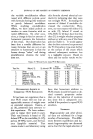
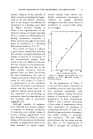
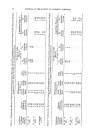
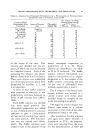
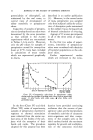
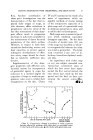
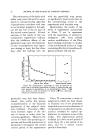
DEODORIZING PROPERTIES OF CHLOROPHYLL IN DENTIFRICES 3 their own dentifrice between the two days of the test, in their usual manner and at the usual time. All the above instructions were thoroughly followed. The subjects had the most diversified occupations. There were shipping clerks, secre- tarial and switchboard personnel, technicians, chemists, bacteriol- ogists, engineers, salesmen, and executives. All were very familiar with testing methods, understood fully the requirements of this study, and were most anxious to co-operate. V. TEST PROCEDURE The tests were conducted as fol- lows: Sample P, plain, was tested on the first and second test days, sample C, with chlorophyll added, on the third and fourth test days. An average of three subjects were tested on each test day, or an aver- age of six subjects a week. The initial mouth odor of each subject was first measured by means of the osmometer, and the odor threshold number of the initial odor thus de- termined. We believe the osmom- eter is well known to THE SOCIETY OF COSMETIC CHEMISTS, as the author demonstrated it at a previous meeting and also at meetings of other technical societies, and there- fore it shall not be described again. Each subject was then given a sterile toothbrush and a tube of each of the test samples. An amount of dentifrice weighing between 1 and 1.2 gs. was applied to the brush. This corresponds, in the chlorophyll tooth paste, to an amount of 1 to 1.2 ms. of active sodium copper chlorophyllin of 97 per cent purity. He brushed his teeth and rinsed his mouth during a total period of two minutes, measured by means of a stop watch. The odor threshold number was determined immedi- ately after brushing, under the same conditions as before. Odor meas- urements were also made one, two, and four hours after brushing of the teeth. All odor measurements were made in triplicate. VI. RESULTS In order to make easy the evalu- ation and interpretation of the re- suits, we will give here a r•sum• of our chart of odor threshold numbers. The smallest perceptible odor has an odor threshold number of 3.13. Numbers from 3.13 to 4.33, indicate traces of odors. Numbers from 4.55 to 5.87 indicate very slight odors. These numbers are always given with two decimals. Stronger odors are: from 6.0 to 8.2 slight odors, from 8.6 to 12.1 definite strong odors. From 13.0 to 26.0 very strong and objectionable odors and from 30.3 to 91.0, extremely strong odors. The initial odor threshold num- bers of the participants in the tests were as follows: males--from 6.0 to 14.0 with 16 different odor values and a greater proportion in the 7.0 to 9.5 range and the 13.0-14.0 range females--from 4.5 to 14.0, with 19 odor values and a greater proportion in the 10.1 to 12.1 range. There were various degrees in the

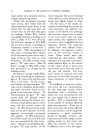
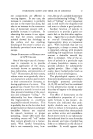
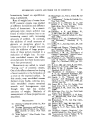
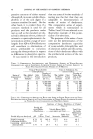
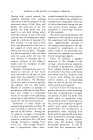
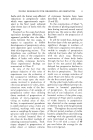
4 JOURN,A,L OF THE SOCIETY OF COSMETIC CHEMISTS removal of odors. In only one in- stance was i:here odor present after one hour as follows: One case of original OTN of 12.10 showed as much as 8.30 one hour after using the plain dentifrice. On the other hand, there was no trace of odor left one hour after using the chloro- phyll dentifrice. There were 25 cases of presence of odor after two hours with the plain tooth paste and only one after the same length of time with the chlorophyll, tooth paste. After four hours, 33 cases showed an OTN with dentifrice P and 13 with dentifrice C. Qualitatively, dentifrice P com- pletely removed mouth odors in 25 subjects for two hours and in 17 subjects for as long as four hours or respectively 50 and 34 per cent com- plete removal. Dentifrice C com- pletely removed mouth odors in 49 subjects for two hours and in 37 subjects for as long as four hours, or respectively 98 and 74 per cent complete removal. VII. CONCLUSIONS These results are based on close to lOO0 odor measurements made with the osmometer on both types of tooth paste. They demonstrate the superiority of the chlorophyll dentifrice over the plain dentifrice of the same formula, containing in- soluble sodium metaphosphate as a polishing agent, in ability to remove and retard the development of mouth odors. REFERENCES Burgi, E., Co•r.-BL f . Schweiz. •lertze, 46, 446 (1916). Dent. Med. IVochenschr., 48, 1159 (1922). Klin. ItZochenschr., 17, 789 (1930). Schweiz. Med. IVochenschr., 67, 1173 (1937). Ibid., 68, 483 (1938). "Das CMorophyll Mx Pharmakon,"Georg Thimme, Le{pz{g (1932). Grusk{n, B., •lm. f. Snrgery, 49, 53 (1940). Bowers, W. F., Ibid., 73, 37 (1947). Members who have not received Volume II, No. 3, please advise the Editor at once. The issue was printed in England and mailed from there.
Purchased for the exclusive use of nofirst nolast (unknown)
From: SCC Media Library & Resource Center (library.scconline.org)