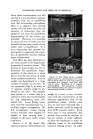
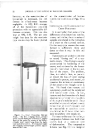
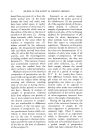
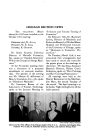
CHICAGO SECTION NEWS THE rOLLOWltaO officers elected for 1952 were installed at the October 1951 meeting: Chairman-elect, D. ATLAS, Treasurer, W. E. LIEB, Secretary, K. GRAHAM. Dr. Sylvia Kramer, Technical Director of Marcelle Cosmetics, Inc., spoke on "Lipstick Sensitivity Within the Concept of Allergic Reac- tions." At the November meeting there was a discussion of a proposed amendment on associate member- ship. The speaker of the evening was Mr. Maison G. deNavarre of Beauty Counselors, Inc., who spoke on "Substitute Materials." Dr. Lawrence Rosner of the Laboratory of Vitamin Technology spoke at the January Meeting on "Irritation and Toxicity Testing of Cosmetics." On February 12th, Dr. Rachmeil Levine, Director of Metabolic and Endocrine Research of Michael Reese Hospital and Professorial Lecturer of the University of Chicago, spoke on "Hormones in Cosmetics: Pro and Con." On Tuesday, March 11th, it was announced that arrangements had been made to record and transcribe the papers given at the meetings in the future. Mr. Gus Kass, Assistant •Research Director, Helene Curtis Industries, spoke on "Hair Coloring and Hair Coloring Preparations." All meetings were held at the Henrici Restaurant in the Merchan- dise Mart, the second Tuesday of the month. The April meeting is to be Ladies' Night with gifts for all the ladies present. PHOTO COURTESY AMERICAN PERFUMER Above are the 1952 officers of the Chicago chapter of the S. C.C.: chairman elec• Douglas Atlas, •rectsurer Wm. E. Lieb, Dr. Katherine Graham, secretary, and chairman George Kolar 77

BOOK REVIEWS SPECIFIC METHODS OF ANALYSIS, consulting editor Samuel E. Q. Ashley, pages 995-1118, Volume 53, Annals of the New York Academy of Sciences, New York, N.Y. 1951. Price $2.50. A cardboard covered reprint of portions of the Academy Annals deals with specific methods of anal- ysis, but they are all out of the present scope of the toilet goods in- dustry. It is a typical Academy publication, well printed and author- itative.--M. G. t)EN. P^P^IN, Consulting Editor M. L. Tainter pages 143-296, Volume 54, Annals of the New York Academy of Sciences, New York, N.Y. 1951. Price $3.00. Ten chapters or contributions with a foreword by M. L. Tainter and O. H. Buchanan constitute this typical Academy publication. It is a study of the proteolytic enzyme obtained from Carica Papaya, a useful tropical plant. Following a general description of the plant and the processing of its latex, the monograph includes an comprehensive review of the litera- ture on its therapeutic significance. The other papers or chapters are de- voted to a discussion of laboratory techniques. Hwang & Ivy's review of the literature is indeed thorough and the following comment to be made is not intended to convince the reader otherwise. But the authors did miss the scattered and indeed few references to the cosmetic use of both papain or the fresh latex from the fruit. At least one locally known cosmetic line offers papaya cosmetics in Florida. However the reference to its sensitizing proper- ties reminds one that Bromelin from fresh pineapple, another pro- teolyt!c enzyme, is also a sensitizer. It •s a well-done monograph, clearly illustrated, and definitely needed to fill a gap in the scientific literature on Papain and, by rela- tionship, papaya or pawpaw as it is also known.--M. G. dEN. T•E i\I^NUF^CTUP, E OF INTEP,ME- DIATES AND DYES, by G. H. Frank, M.Sc. (Leeds), F.R.I.C. Chemical Publishing Co., Inc., New York, N.Y., 1952. 177 pp. $4.00. This is a very brief discussion of d.ye manufacturing as done in Brit- ain. The plant and equipment are describedin outline. The author de- scribes the processes from the point of isolation from coal tar through the preparation of intermediates to the finished dyes. Emphasis is placed on preparation of intermedi- ates. Azo dyes, anthraquinone dyes, and sulfur dyes are described. The author does not mention that most of the more complex dyes are actu- ally mixtures of the several compo- nents produced in the reactions of the intermediates. Although this fact is well known in the industry, it is rarely mentioned in any publica- tions. From the standpoint of the chem- ist in the food, drug, or cosmetic field, the book will not indicate
Purchased for the exclusive use of nofirst nolast (unknown)
From: SCC Media Library & Resource Center (library.scconline.org)