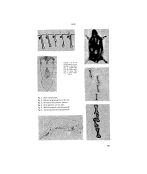
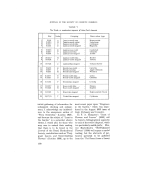
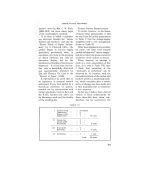
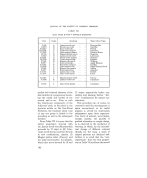
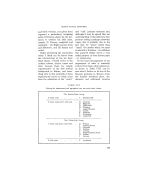
HAIR between habits of hair toilet and direction of hair growth has been observed in certain animals. In primitive marsupials such as the Banded Anteater and Tasmanian Devil, hair is directed from head to tail on the back and from spine to belly over the flanks. On the limbs hair growth is directed distally and post axially. This primitive hair pattern also occurs in a large number of less specialised higher mammals (Figure 3). It is well known, how- ever, that many animals show partings, whorls and reversals in certain areas of their bodies (Figure 4). Many factors have been invoked to explain these deviations from the primitive hair pattern. Kidd and Wood Jones 6 have shown that the direction of hair tracts is closely related to habits of posture, move- ment and toilet of the skin, and in many cases coincides with the direc- tion in which an animal combs or scratches its fur. While these appear to be simple functional causes, biologically it is interesting to note that the arrangement of the' hair tracts characteristic of any mam- malian species is definitely estab- lished in the fittus before birth, a condition which these two investiga- tors believe to be an example of the transmission of an acquired charac- teristic. HAIR STRUCTURE Two and sometimes three types of cell may be recognised in hair fibres. These are those of cuticle, cortex and medulla, the last of which is not always present. The overlapping cells which constitute the cuticle are arranged with their major axes along the length of the fibre. X-ray and optical stud/es show that the protein crystallites in the cuticle are not orientated parallel to the fibre direction and are in all probability randomly dispersed in the cuticle cell. Examination of wool in the electron microscope corifirmed this conclusion by showing that over a wide range of magnifications cortical cells exhibit a fibrous structure, whereas the cuticle cells are non- fibrous and amorphous. In all hairs the cortex consists of a mass of fibrillar cells which are fused together by an "intercellular medium." Meas- urements of birefringence, X-ray examination and special histochemi- cal tests carried out on single hairs plucked from the human head have confirmed and extended earlier micro- studies and point to the following zones in the formation of the cortex? (a) The bulb region. The protein is soft, isotropic, digestible by enzymes and dispersed by urea. It thus resembles the soluble proteins. Con- siderable amounts of protein appear to be present in the upper part of the bulb, but the X-ray pattern is diffuse. (b) The fibrillation zone at the constriction of the follicle. The protein becomes birefringent to the same degree as the final hair in a single stage. X-rays show that subsequent to this level the a-keratin (folded polypeptide) structure of the final hair is present. (c) The uncon- solidated, pre-keratinous zone. This zone and the next are characterised by a positive thiol reaction. The 159

JOURNAL OF THE SOCIETY OF COSMETIC CHEMISTS structure, although fully oriented, is still unstable. Urea rapidly dis- solves it moderate temperatures lead to disorientation with a fall in birefringence, but without a con- traction in the longitudinal direction of the shaft. After heating, the zone yields a disoriented Jg-pattern. The zone can be stabilised by the intro- duction of artificial cross-linking. (d) The zone of consolidation. Hard- ' ening becomes detectable about half- .way along the pre-keratinous region and is thereafter progressive. Above a fairly definite level the protein only swells in urea, is not digested b• enzymes, and is not disoriented at 90 ø C. Heating to a higher tempera- ture causes disorientation with a contraction in'length. (e) The fully hardened hair. Cortical cells are here elongated and show birefring- ence indicative of molecular orienta- tion and crystallinity, while the sulphur is chiefly in the form of cystine disulphide linkages which bridge adiacent polypeptide chains. These linkages confer considerable stability upon the fibre, which, in the fully keratinised state, has been likened to a vulcanised protein. Nevertheless, under certain condi- tions, the cystine disulphide linkage is very labile, a phenomenon which is discussed later in this paper. Cortical cells constitute the bulk of the fibre substance in human hair, and are regarded as the seat of such physico-chemical properties as stress/ strain characteristics and supercon- traction. As a result of the X-ray and physico-chemical. investigations of the Leeds school of workers, it is now accepted that the more highly organised regions of normal, un- stretched hair consist of incom- pletely extended polypeptide chains cross-linked by salt and cystine disulphide linkages, to form sheets or grids, such grids being held together by the attraction of secondary van der Waals forces. Other linkages involve hydrogen sharing between imino- and carbonyl-groups. The nature of the fold in the polypeptide chains is not at present fully under- stood. For a consideration of views of Astbury, together with the critic- isms of later workers, reference should be made to an earlier paper in this Journal. 8 Medulla cells present interesting departures from the above types. The walls of the air-filled cells contain little, if any, cystine, and the keratin is in the •-form. A lipo-protein- sterol complex is also present? and is doubtless responsible for the great resistance to attack by alkali shown by medulla cells. HXSTOLOGIC^L EXAmNATXON OF H_ax• The value of microscopic examina- tion as a basis for fibre classification has long been recognised. In general, the identification of fibres is based on the results of macro- and micro- examination. The histological exam- ination proper consists of three parts, • viz.: (1) Study of cuticle, cortex and medulla as revealed by trans- verse sections. (2) Examination of longitudinal sections with special reference 160
Purchased for the exclusive use of nofirst nolast (unknown)
From: SCC Media Library & Resource Center (library.scconline.org)