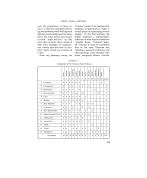
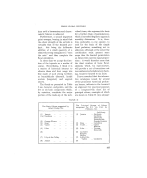
SIMPLE FLORAL PERFUMES accepted nomenclature to describe such unions, a foundation is at least prepared for the understanding of the more balanced versions of the triads. How far my own versions of such end-points are accep{able, how- ever, must be left to the opinion of other workers in this field. Never- theless, I should like to conclude this essay into what I think are the fundamentals of elementary floral combination by quoting from the last paragraph of the Naarden News for June 1953, which says ' "... the composing of a perfume is an art, or in other words, it is based upon human feelings, of which it is a medium of expression." SELECTED FLORAL ODOURS (A) HONEYSUCKLE. The Wood- bine or Woodbind is sometimss re- ferred to in the older herbals as Caprifoly, from the natural order Caprifoliace•e, this "goat's-leaf" as- sociation being also observed in the French and German names for this plant, namely, chivr•feuille des bols and Geissblat. Although there are many varieties to be encountered, the perfume is a very elusive note to capture, but as this is really a night- scented flower, I would' select the Lonicera japonica as a general repre- sentative of the series simulating the fragrance of the flower by a carefully proportioned blend of jas- rain, neroli and rose, and etherealis- ins with tuberose and cassie. Inci- dentally, for those who care to read further, W. H. Hudson, in "Hamp- shire Days," has some very interest- ins impressions upon the nocturnal fragrance of the honeysuckle. (K) CERINTHE. From honey- suckle to honey is but a short step to simulate the neroli-rose backing of the former and accentuating with appropriate phenylacetates and ren- dering the note slightly violet and cenanthic, is a fairly simple tech- nique. Such a procedure is my impression of the cerinthe--the name signifying honeycomb in Greek, but more obviously so in the Fren•h-- lg rndlinet. The anglicised form is derived from the Itahan Cerinta, in which country it is a very com- mon plant, having attractive purple flowers with a yellow tube-like receptacle laden with the fragrant honey juice--hence the name, in the older English herbals, of the Great Honeywort. (Q) FREESIA. Not all the freesias exhibit a pleasant fragrance, some varieties having an odour not unlike that of the knotted figwort (scrophu- laria nodosa) which shares with certain South African flowers, such as those of the Stapelia hirsuta, a complex indoloid scent resembling decaying meat. The conservatory freesia which does, however, find fayour seems to be the F. refracta but, bearing in mind that it is a member of the N.O. Iridea•, one can seek something from the violet for the base of the con- ventional perfume, as well as from the lily, as other species include the lotus and the Ixias and similar dwarf gladiolea• there is also somewhat of a honeyed-rose background, so that the build-up proceeds along a 195

JOURNAL OF THE SOCIETY OF COSMETIC CHEMISTS rose-violet-lilac facade, but embel- lished with a trace of peach lactone and propyl butyrate to achieve the characteristically fruity apricot-plum topnote. (T) CYCLAMEN. This name is also of Greek origin, signifying cir- cular, in alluding to the roundness of the leaves or the roots. We have by now probably become accustomed to the usage of "cyclamen aidehyde" which undoubtedly closely ap- proaches the fragrance of the Persian cyclamen but, bearing in mind that the simple old-fashioned flower is of Austrian origin and a member of the primrose family, it is agreeably sur- prising to note that, if the green notes of violet, lilac and muguet are accentuated and backed with a little tuberose and a trace of vanilla and peach, the resulting aroma is a very close simulation of the more delicate fragrance of the Cyclamen (J) TO•ACCO-FLOWEn. Itisinter- esting to note that the Nicotiana tabacurn belongs to the N.O. ace• (Latin: solanum •- comfort), which group contains many soothing and narcotic plants, but in common with the evening primrose, night- scented stock, jasmin and honey- suckle, it is with the approach to dew point in the cool of the evening that these peculiarly ethereal and almost anazsthetic fragrances are liberated. Without doubt, the jasmin element is very prominent in the build-up of this perfume, but I think that if the tonal elements are kept simple, the results are far better than those which include among many com- ponents some organic chemicals of particularly harsh odour. For instance, in the tobacco-flower motif, I think both the lilac and lily are necessary components to the jasmin, and if in these bases the terpineol content is replaced with cyclamen aidehyde, the result is a good simulation of the ethereal fragrance of the living flower, ob- served under appropriate conditions. Furthermore, if to the above base, when finalised, a little labdanum, clary sage or mimosa is added, the warmer and oriental note of the N. acurninata, more familiar as Latakia, shows a pleasing alternative. (D) MAgNOLiA. Although it would appear from the literature that most impressions of the fragrance of the M. grandifora are based upon ylang, I find in some of the earlier horti- cultural texts an agreement upon a • basic lily-of-the-valley odour. Jasmin is again an essential and, if the cyclamen-mu•met base, as used for the nicotiana, is supplemented by neroli with a slightly balsamic undertone, such a compound, when diluted with spirit and sprayed, develops a note very similar to the characteristic, Iinden-ylang fragrance of the distance-wafted perfume of the magnolia in full bloom. (}3) LABURNUM. This readily comes to the mind as an elegant tree, drooping its golden chain (or rain) of bloasoms, which are practically odourless. The Latin name of this tree would appear to be derived from the "hour of labour," an allusion to the habit of the leaflets closing by 196
Purchased for the exclusive use of nofirst nolast (unknown)
From: SCC Media Library & Resource Center (library.scconline.org)