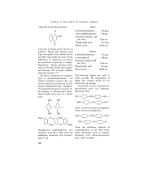
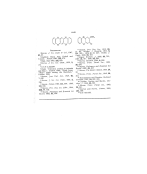
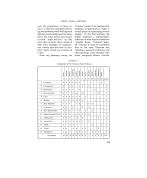
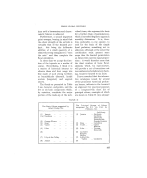
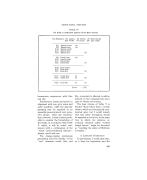
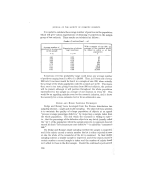
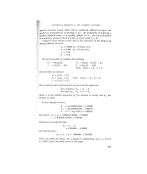
SIMPLE FLORAL PERFUMES item until a harmonious and charac- teristic balance is achieved. Furthermore, a second important point emerges, bearing in mind that the odour strength of the extraits is virtually that of the finished pro- duct this being the deliberate addition of a small quantity of a relatively strong osmophore to "turn the note" and thus complete the floral simulation. In these days we accept the func- tion of the topnote as a matter of course. Nevertheless, I think it is a matter of historical interest to observe when and how usage was first made of such strong fortifiers as benzaldehyde (almond), linalyl acetate (bergamot) and eugenol (dove). The florals as presented in Table I are, however, end-points, and the five or six basic components which, by variation, constitute the major portion of the make-up of the indi- vidual items, also represent the basis for a further chain of permutations, which if extended begins to approach unwieldy dimensions. It is, there- fore, preferable, in my opinion, to seek for the basis of the simple floral perfumes, something not so elaborate, although at the outset the combination must present more scope than the limited permutation on three items used in equal propor- tions: it would therefore seem that the ideal number of basic floral- elements which, by equi-mixture, will provide a set of transitions not too cumbersome for laboratory check- ing, would be limited to six units. I have remarked that the informa• tive catalogues issued by several of the prominent American perfum- ery houses, indicate in the foreword an alignment for practical purposes of a comparatively short list of principal odours, examples of which are shown in Table II (my arrange- TABLE II The Basic Odours suggested by Albert Verley, Inc (1) Jasmin ............ (la) Oardema ............ (2/ Orange Flower (3) Rose ... (4) Violet ... (5) Lilac ...... (6) (7) Lily-of-the-Valley (8) Ambre ...... The }'rircipal Groups of Odours recognised by E.I du Font de Nemours, Inc. S•b-Group. (1) Jasmin ... Gardenia Gardenia Sweet-pea Honeysuckle Orange blossom (3) Rose ...... Carnation (4) Violet ...... Cassie Mimosa {5) Lilac ...... Syrmga Hyacinth (6) (7) Lavender Foug•re Chypre Lily-of-the- Y alley ... Cyclamen 185

JOURNAL OF THE SOCIETY OF COSMETIC CHEMISTS ment), but it will be observed that the grouping suggested by the E.I. du Pont de Nemours Company also includes secondary items of similar basic tonality. It is upon such a listing that several versions of simple floral foundations can be based and, more- over, easily modified or altered in accordance with the perfumer's per- sonal inclination, but because I believe that the arbitrary "tempera- ture scale" which we accept--some- what loosely, perhaps--in describing certain odours as having a warm quality, others being regarded as cool, green or fresh, to be of far greater importance in perfumery composition than is generally real- ised it will be noted that I have divided my list of basic florals into two groups: (3) Jasmin (13) Violet (5) Neroli (9) Rose (warm) (17) Lilac (21) Lily (cold). Note: (The numbers in brackets refer to the position which I have allocated these blossom odours in a more elaborate 24-unit "floral spec- trum," to be considered in a conclud- ing paper upon "Compound Floral Perfumes." Meanwhile, these in- dices serve as a useful check when positioning the permutations.) Here I should like to pay tribute to two of the most informative papers I have on my file, namely, the con- tributions of Ruemele, the first upon "Variations of the Chypre Frag- rance" which appeared in the P.&E.O.R. for May 1.050, and the second entitled, "The Jasmin-Rose Bouquet and its Development" (ibid, March 1.051), because from here onwards in this present article, my approach to the "mechanics of per- fumery" would have tended to appear merely as an enlargement of the three-fold component scheme as already outlined by the above- mentioned author. I have also noticed with consider- able interest that, in many of the more detailed perfumery catalogues, there is no hesitation in describing the nature of compounds and bou- quets listed under a fancy name or serial number, as such data affords the potential user ample guidance and aids the selection of a blend suitable for a particular class of product. For instance, such de- scriptions as "a jasmin-lily-rose com- plex, with a lifting top-note," or "a floral French-type bouquet based on lily, lilac and rose, slightly aldehy- dic," are very helpful, as the per- fumer can at once recognise the pleas- ing tonality of such harmonious combinations. Upon reflection, however, it would seem that there should be an almost endless series of three-fold permuta- tions, though strangely enough the useful list is much shorter than one might imagine and several restrictive features are encountered. THE COLOUR-BLENDING ANALOGY The first is incongruity*. For instance, I doubt whether a complex of rose, lilac and violet would find * or what Cerbeland has called "olfac- tory incompatibility ".-.-Editor. 186
Purchased for the exclusive use of nofirst nolast (unknown)
From: SCC Media Library & Resource Center (library.scconline.org)