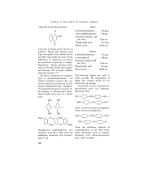
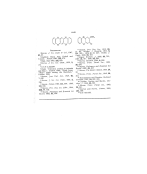
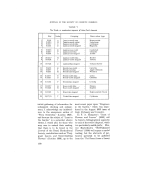
PIGMENTS as a whole this class of pigment is relatively non-bleeding in oils and waxes and is generally more resistant to attack by organic solvents than other organic pigments. The salt-forming metals in the case of these red toners is generally calcium or barium (much less fre- quently manganese or strontium). There appears to be very little published information on the toxicity of barium salts of these dyestuffs, although from personal contact with manufacturers of cosmetics we know that they are frowned upon. We were rather surprised, however, the first time we were informed, that even barium sulphate is viewed askance for no other reason than that barium and its salts are listed as poisonous materials. As outsiders to the indus- try we should have thought that the feeding of barium meal to patients immediately before abdominal X- ray photographs are taken would have been sufficient proof that this material is innocuous. Before leaving this section there is one point of terminology which might with advantage be clarified this concerns the use of the name permanent. A great many pigments appear in literature under this name, as, for example, Permanent Red 2B, or Permanent Red R, or Permanent Orange G. It should be clearly understood that, in this connection, the word "permanent" is merely a trade name and does not indicate a property of the pigment. The second type of toner, i.e., the dye acid complex, covers pretty well the whole spectrum except the yellow-orange range. They are of greater interest to the printing-ink maker and so far as the present authors are aware are not used in your particular industry at all. However, it is, perhaps, of interest very briefly to mention that the property which lends them greatest importance is their very high-staining power and, so far as the red pigments are concerned, their pleasing variety of tint on reduction, although when highly reduced they are not particu- larly fast to light. They are fairly good in their resistance to acid and alkali and generally possess negligible or no bleed in oils and waxes. They are, however, rather inclined to bleed in oxygen--containing organic sol- vents, a defect which limits their use in many fields. PIGMENT DYESTUFFS Coming now to pigment dyestuffs we enter a field which is expanding almost daily and, if we include the phthalo-cyanines in this class, one which covers the whole spectrum except the violet. The three chief factors which have led to the great diversity of this class of pigments are: (1) That certain compounds con- raining active hydrogen atoms can be substituted for naphthols--this discovery increased the colour range available. (2) That in certain cases diamines such as benzidine or substituted benzidines can be tetrazetised and coupled to give pigment dyestuffs with certain markedly improved properties. 147

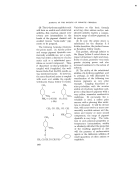
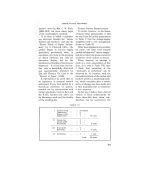
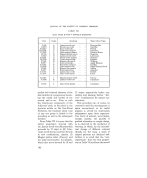
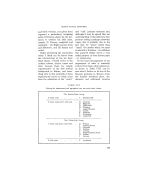
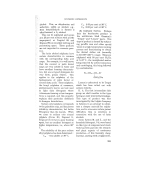
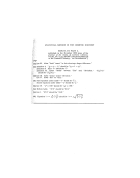
JOURNAL OF THE SOCIETY OF COSMETIC CHEMISTS (3) That [•-hydroxy naphthoic acid will form an anilide and substituted anilides--this reaction placed over twenty new intermediates in the hands of the pigment chemist and enabled various "tailor-made" pig- ments to be prepared. The following formulae illustrate the points made. (1) All the yellow and orange pigment dyestuffs com- mercially available use, not a naph- thol, but either a derivative of aceto acetic acid or a substituted pyro- zalone as second component. Thus if diazotised m-nitro-p-toluidine is coupled with [•-naphthol, the well- known Itelio Fast Red RL results, as was mentioned earlier. If, however, the same diazotised amine is coupled with aceto acer anilide the equally well-known Hansa Yellow G results. CH• CH• NH•+.O.N.OH N--N.C1 +Hcl q- CHq. CO. CH,,. CO. CH. CH• •l XNO, N N CH •.CO.CH.CO.CH.NIt./ Variations on this basic formula involving other amines and/or sub- stituted anilides enables a compre- hensive range of yellow pigments to be prepared. (2) If, now, the amine above is substituted by the diamine 3:3 dichlor benzidine, the product known as E. enzidine Yellow results. This product, although inferior to the Hansa Yellow G noted above in respect of fastness to light and clean- liness of colour, possesses very much greater staining power and also increased resistance to the action of solvents. (3) The utility of the substituted anilides of [•-hydroxy naphthoic acid is, perhaps, as well illustrated by consideration of the following two maroon pigments as any other example. Coupling di•zotised m- nitro-p-toluidine with the m-nitro anilide of [•-hydroxy naphthoic acid, gives a deep maroon pigment with a very yellow, somewhat unattractive undertone. If, conversely, the o- toluidide is used, a rather paler maroon with a pleasing blue under- tone is obtained. It will be obvious that, with some twelve or more com- mercially available amines and dia- mines and twenty or more second components, the range of pigment dyestuffs is very large. The varia- tion in such physical properties as temperature concentration, acidity or alkalinity will affect the properties of the resulting pigments'as also w/11 the presence of surface-active agents or the deliberate addition of small quantities of other amines or naphthols. 148
Purchased for the exclusive use of nofirst nolast (unknown)
From: SCC Media Library & Resource Center (library.scconline.org)