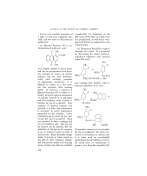
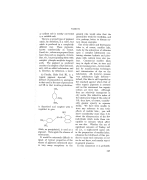
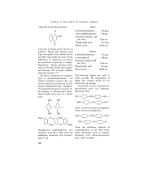
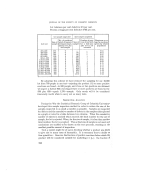
PIGMENTS or sodium salt is merely converted to a suitable salt. There is a second type of pigment which, by definition, is a toner, but which is produced in a completely different way. These pigments, lmown commercially as Consol, Fanal, etc., colours are prepared from basic dyes such as magenta, victoria blue, etc., by precipitating them with complex phospho-molybdo-tungstic acids. The pigment so produced consists of a complex of dye and acid, only, with no added substratum, and is, therefore, by definition, a toner.. (c) Finally, Helio Red RL is a typical pigment dyestuff. The method of preparation is analogous to that used in the case of permanent red gB in that m-nitro-p-toluidine: CH3 1 .•, --NO, 1 NH• is diazotised and coupled with naphthol to give HO /N_--N_ •/---• / / NO• which, as precipitated, is used as a pigment. Note again the absence of substratum. It would be extremely difficult to speak of typical properties of the classes of pigments mentioned since so very many exceptions to the general rule would arise that the generalities would be worthless, and it is, perhaps, better to discuss cer- tain chosen examples. One of the oldest and best known lakes is, of course, madder lake, made by the adsorption of alizarine upon a complex substratum con- taining alumina hydrate and phos- phate with calcium irons also pre- sent. Commercial madder lakes vary in depth of hue, in tone and also in s raining power--factors modi- fied by manufacturing techniques and concentration of dye on the substratum. All, however, possess very satisfactory light fastness--. indeed, this lake is still regarded as the standard against which that of other organic pigments is assessed and on this assessment few organic colours are more fast. Although they are relatively transparent in oily media (the refractive index of the substratum being of the order of 1.5), they have, of course, consider- ably greater opacity in aqueous media. We have been unable to trace any reference to any toxic effects of madder lake you will know considerably more than I do about the idiosyncracies of the few individuals which make them sus- ceptible to irritants which affect no one else. Whether the use of significant amounts of Turkey red oil (i.e., a sulphonated castor oil), in the preparation of madder lakes, enhances the likelihood of this pro- duct to cause such irritation or not we do not know, and merely report its general presence. In this connection it is probably 145

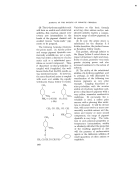
JOURNAL OF THE SOCIETY OF COSMETIC CHEI•ISTS worthy of note that many pigments are now produced in presence of, or subsequently treated with, surface active agents which are undoubtedly adsorbed upon the surface of the pigment particles. There are so many of these surface-active agents available commercially that it would not be possible, within the scope of this paper, to give any real informa- tion about them except to say that the majority probably belong to one of the three following types: (a) sulphonated alcohol, petroleum extract or castor oil (b) alkyd naphthalene sulphonic acids (c) quaternary ammonium com- pounds Their very general use in industry proves that they are perfectly safe to handle--whether there is a minor- ity upon whom they act as irritants we cannot say. T• EOSINES The eosines are also worthy of special mention since they are unique in being precipitated as lead salts usually in the presence of some lead sulphate. The undertone of these lakes is often modified by adsorption upon them of a small quantity of one of the Rhodamines. The colour of the lake depends very largely upon the quality of the dye from which it is produced. Several samples of (allegedly) the same dye will give quite different products, particularly so far as brightness of the finished lake is concerned. They are, of course, much yellowet in colour than the madder lakes, and in your indus- try must suffer severe restrictions in use because of the presence of lead-- their relatively poor light fastness also curtails their use. The author spent some time about fifteen years ago endeavouring to prepare eosine lakes of improved light fastness and reduced toxicity. Some progress in the first aim was achieved by the use of thallium as salt-forming metal this, however, did not reduce toxicity, and because of the high price of the metal the work was not continued. Very many other lakes are known and produced commercially both from acid dyes by the process dis- cussed, or from basic dyes by an analogous process using a different substratum, e.g., calcium phosphate. Most of them possess the disadvan- tage of very poor light fastness, although it would be wrong to assume, and a grave fault on our part if we have conveyed the impres- sion, that of the various commercially available lakes only madder lakes possess good light fastness. With the exception of Pigment Green B, which is the iron salt of •-nitroso-•mapthol and pigment green 3B its simple modification, the toners of the metal-salt type, i.e., that typified by Permanent Red 2B, belong to the scarlet-crimson- maroon colour range. Here, again, such properties as fastness to light, resistance to attack of acids and alkalies vary so widely that no general comment can be made. One point is of interest and that is that 146
Purchased for the exclusive use of nofirst nolast (unknown)
From: SCC Media Library & Resource Center (library.scconline.org)