STATISTICAL METHODS IN THE COSMETIC INDUSTRY' PART II By A. W. MIDDLETON, B.Sc., Ph.D., F.R.I.C.* IT I$ proposed in this article to study sampling systems which deal with the presence or absence of an attribute of the individhals comprising the popula- tion. For this purpose an analysis of the prophetic patch test is a good example of the use of the Poisson distribution, of the sampling system developed by Dodge and Romig, of sequential analysis and of the probit method of analysis. At the same time, some useful discussion might result. Various aspects of the identification of the cause of a contact dermatitis, with particular application to cosmetics, have been described by L. Schwartz, • J. L. Morse/H. A. Shelanski" and E. J. Moynahan 4 in earlier issues of this Journal. Schwartz • has also described a prophetic patch test in which 200 subjects are given a patch and/or a use test, to enable an opinion to be formed of the likelihood of the product under test being a sensitising or secondary irritant. If there are no positive reactions among the 200 subjects, the product is considered safe for a more extensive use test among 1,000 more subjects. Moynahan 4 describes a similar test when 200 subjects are patch tested' should there be no positives--or should there be one positive, in which case a further 200 are tested, and should there then be no further positives--the product is considered safe for commercial development. Should there be 2 or more positives in the first 200, or one or more in the second 200, the product is rejected. These techniques are sampling techniques in which a sample ,is taken representing (we hope) the whole of the population likely to use the product, and the suitability of the product for use by this population is judged from the reactions of the sample. POISSON DISTRIBUTION Where a small number of reactions is expected from a large population, the expectation "e" of any given number of reactions is given by the appro- priate term of the Poisson Series. 6 Thus, if the average number of positives to be expected in any given sample is "m," the expectation of obtaining no positives is e7 m, of obtaining one positive me-m/1 !, two positives m•e-m/2!.. * Chesebrough Manufacturing Co., Ltd., London. 225

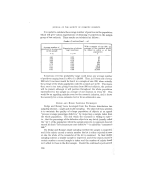
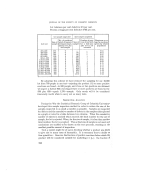
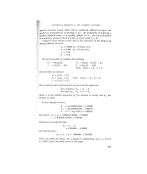
JOURNAL OF THE SOCIETY OF COSMETIC CHEMISTS It is useful to calculate the average number of positives in the population which will give various expectations of obtaining 0 positives in the sample group of test subjects. These results are tabulated as follows ß Number cf reactions found... nil Average number of With a sample of size 200, an positives to be expected Expectation of obtain- average of one positive would in the sample ing 0 reactions be found in every n of the population , . 4.61 0.01 43 3.00 0.05 67 2.30 0.10 87 1.00 0.37 200 0.70 0.50 285 0.11 0.90 1,818 0.05 0.95 4,000 0.01 0-99 20,000 0 reactions over this probability range could mean any average number of positives ranging from 1 in 43 to 1 in 20,000. Thus, in 10 tests out of every 100 tests 0 reactions would be found in a sample of size 200, when actually the average of the whole population could be as much as 1 in 87. This means that, once in ten tests giving 0 reactions from 200 test subjects, the product will be passed, although it will produce throughout the whole population represented by the sample an average of one reaction in every 87. This would be an appalling mistake even for the cosmetic industry, and it shows the necessity for a more extensive test or for an alternative one. DODGE AND ROMIG SAMPLING TECHNIQUE Dodge and Romig' have developed from the Poisson distribution two sampling schemes ß single and double sampling. The object of these schemes is to maintain the quality of a large population of objects at an agreed "process' average percentage defective" by inspecting a sample taken from the whole population. The risk which the consumer is willing to take-- i.e., that the percentage of the defective objects in any batch (usually called the "lot") of the population which the sample purports to represent does not exceed his limit "lot tolerance per cent defective"--is called the "consumer's risk." By Dodge and Romig's single sampling method the sample is inspected, and if the rejects exceed a certain number the lot is either rejected at once or else the whole of the remainder of the lot is examined. In their double sampling scheme a smaller sample is inspected, and if the rejects exceed a certain number a second sample is taken and the number of rejects found in it added to those in the first sample. Should the combined rejects exceed 226
Purchased for the exclusive use of nofirst nolast (unknown)
From: SCC Media Library & Resource Center (library.scconline.org)