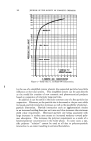
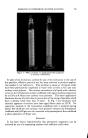
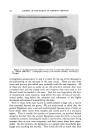
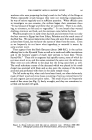
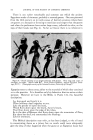
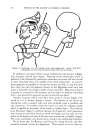
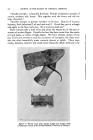
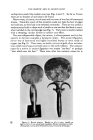
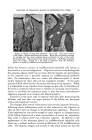
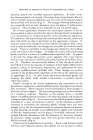
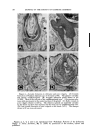
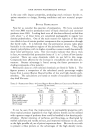
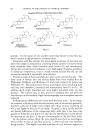
THE COSMETIC ARTS IN ANCIENT EGYPT 171 planation for the brilliantly red-dyed hair on the mummy of a royal lady of the 18th Dynasty (14th century B.C.) than that it was dyed with henna. I cannot discover anyone's guess as to why palms of hands and soles of feet should be dyed red except vanity, and I do not quite see how the prac- tice serves vanity. Perhaps the light colored palms of a dark-skinned people did not appeal to them as quite pleasant or decent. Nor do I know why finger and toe nails might have been dyed, but then I do not know why that is done in the present day either, so perhaps the reason in antiquity was just as obscure. Of course, one must always remember that there may have been some primitive, perhaps religious or superstitious, reason ini- tially for many a practice of this sort, but if so we have no idea what it was. Hairdressing and wig making must have been an industry of large scale in ancient Egypt, for the Egyptians were addicted to the most elaborate wigs of many curls and braids (see Fig. 4). The wigs have been analyzed and, contrary to statements sometimes made, they never consisted of animal hair or wool but only of human hair with an occasional introduction of something like palm fiber. Analysis also shows that they were coated with beeswax to keep the elaborate curls in place. Frequently, although perhaps not always, both men and women shaved their heads and wore wigs. Men probably commonly shaved their heads just as modern Egyptian men do. At least priests, as we have said, always appear with shaven heads and without wigs. In the beautiful make-up chest of a 12th Dynasty (20th century B.C.) princess along with the other necessities there were two hammered bronze razors and the whet stones or slip stones on which to sharpen them. The box and its contents are in the Metropolitan Museum of Art in New York. Ancient Egyptian men were always clean shaven. On ceremonial oc- casions the Pharaoh wore a false beard and in some depictions of him one can see the strap by which it was held in place. The statues of the gods also show them wearing false beards similarly fastened but their beards were braided and curved outward at the end whereas the king's beard was straight. It may be of some interest to cosmetic chemists to consider some of the numerous guaranteed recipes which the ancient Egyptian physician--for this came within the province of the physician--prescribed to be used in a cosmetic manner. These are found recorded in a so-called medical papyrus and, like the remedies for ailments of all sorts, were no doubt accumulations of observations and experimentation and lore transmitted over generations before they were put down in writing. These particular recipes are taken from one text, Papyrus Ebers, which was written in the 16th century B.C. Its recipes and remedies are not to be taken as the best representatives of the medical and surgical knowledge of the ancient Egyptians as we know it from other remarkably objective and astute compilations.

172 JOURNAL OF THE SOCIETY OF COSMETIC CHEMISTS There are in this papyrus numerous remedies prescribed for diseases of the eyes but one that may serve as an example is "for not letting a hair grow in the eye after it has been pulled out: Incense ground with dung(?) of a lizard blood of an ox blood of an ass blood ooe a pig blood of hound blood of a goat black eye-paint and green eye-paint. Grind finely together with this blood and apply to the place of this hair after it has been pulled out, and it will not grow." There are also numerous remedies for skin and scalp troubles. It is strange that a people so addicted to wigs as were the ancient Egyptians should plague the physician for recipes to stop their natural hair from grow- ing gray or to stop it from falling out as well as to cause their gray poles to become as black as youth again or to cause their fallen locks to grow again, but this they did to judge from the number of recipes recorded for these purposes. For example: A remedy "to cause the hair of a bald-headed person to grow: Fat of a lion, fat of a hippopotamus, fat of a crocodile, fat of a cat, fat of a serpent, fat of an ibex. Mix together and anoint the head of a bald person there- with." Another remedy to make the hair grow, prepared for Shesh, the mother of his majesty the King of Upper and Lower Egypt Tety, deceased: Paw of a hound, date seeds, hoof of an ass. Boil thoroughly in oil in a pot and anoint therewith." One can understand the magical thinking that lies behind such recipes as the following which are intended to stop grizzling and to turn graying locks raven black again. Perhaps the ancient Egyptians were prone to become gray early in life. The section dedicated to this laudable end in the papyrus begins so: "The beginning of remedies to prevent graying and to treat the hair: Blood of a black calf boiled with oil. Anoint therewith." "Another (remedy): Blood from the horn of a black ox boiled in oil. Anoint therewith." These recipes clearly depend upon the magical transfer of some of the blackness of the calf or ox to the hair of the user. In the case of other rec- ipes such as the following the magic is not obvious if it is present at all: "Another (remedy): Horn of a gazelle boiled in oil in a cauldron. Mix with oil and anoint the head of the man or woman therewith." There are equally good recipes for concoctions which will cause the hair to fall out. These were no doubt for the use of a woman against another hated woman, perhaps another wife of her husband or a prospective one. They are on a par with the potions one could use to make a person fall in or out of love with oneself. There are recipes for darkening the white scar left by a burn or for re- moving the scars left by wounds or a beating. One recipe for darkening the
Purchased for the exclusive use of nofirst nolast (unknown)
From: SCC Media Library & Resource Center (library.scconline.org)