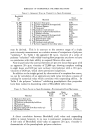
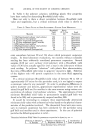
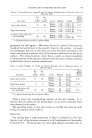
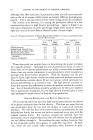
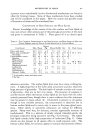
BIOCHEMISTRY OF SEBUM 213 TABLE 4--TsE PROBABLE AVERAGE COMPOSITIOlg Or PURE HUMAlg SEBUM Per Cent Free fatty acids 5 Glycerides 50 Waxes 20 Squalene 10 Branched hydrocarbons 5 Sterols Cholesterol (free) 1 Cholesteryl esters 4 Other sterols 1 Other substances 4 all species but that most are present only in minute traces. Human sebum, for instance, contains traces of lanosterol, lathosterol and 7-dehydrocholes- terol. Further work with radioactive tracers and study of the composition of the sebum of other animals will enable the complete detailed pathway to be fully elucidated. PROBABLE COMPOSITION OF HUMAN SEBUM It is now possible to summarize and predict the most likely composition of pure human sebum. The available evidence indicates that the composi- tion of sebum is approximately that shown in Table 4. If this predicted composition is compared with the results of the analysis of the carefully collected scalp soaks obtained by Nicolaides and Foster (23) it can be seen that, provided skin surface and hair lipid samples are collected from pre- viously defatted sites of skin with high sebaceous activity, relatively pure sebum is obtained. SUMMARY 1. Present knowledge of the composition of the skin surface and hair lipids of man and certain animals has been reviewed. Details of the com- position of human epidermal lipids are also described in order that the extent of contamination of human surface lipids by those from the epidermis can be assessed and the composition of pure human sebum deduced. 2. Biochemical mechanisms involved in sebaceous activity are dis- cussed. These include the biosynthesis of the long chain compounds, the formation of the free fatty acids and the pathway of sterol synthesis in the skin. 3. From the data presented the composition of pure human sebum is predicted. Part of the work described in this paper was supported in part by the Research and Development Division, Office of the Surgeon General, Department of the Army, under contract # DA-49-007-MD-411 and by the Public Health Grant E-1444(C2). The author also wishes to express his indebtedness to the inspiration first by Prof. A. Wormall and Dr. R. M. B. MacKenna and more recently by Dr. Stephen Rothman.

214 JOURNAL OF THE SOCIETY OF COSMETIC CHEMISTS REFERENCES (1) Reinertson, Ri' P., and Wheatley, V. R., Presented at the Ninth Annual Meeting of the Society of Investigative Dermatology, June 1958, for subsequent publication in 5 t. Invest. Dermatol., 32, 49 (1959). (2) Sobel, H., 7. Invest. Dermatol., 13, 333 (1949). (3) Weitkamp, A. W., Smiljanic, A.M., and Rothman, S., 5 t. Am. Chem. Soc., 69, 1936 (1947). (4) James, A. T., and Wheatley, V. R., Blochem. jr., 63, 269 (1956). (5) Wheatley, V. R., and James, A. T., Ibid., 65, 36 (1957). (6) Brown, R. A., Young, W. S., and Nicolaides, N., Anal. Chem., 26, 1653 (1954). (7) Boughton, B., and Wheatley, V. R., Blochem. jr., in press. (8) Lorincz, A. L., and Stoughton, R. B., Physiol. Revs., 38, 481 (1958). (9) Wheatley, V. R., Am. Perruiner dromat., 68, 37 (1956). (10) Wheatley, V. R., and Reinertson, R. P., 7- Invest. Dermatol., 31, 51 (1958). (11) Boughton, B., and Wheatley, V. R., to be published. (12) Popjfik, G., Blochem. Soc. Symposia (Cambridge, Engl.), No. 9, 37 (1952). (13) Rothman, S., "Physiology and Biochemistry of the Skin," Chicago, University of Chica go Press (1954), p. 316. (14) Nicolaides, N., and Wells, G. C., 7. Invest. Dermatol., 29, 423 (1957). (15) Wheatley, V. R., Blochem. 7., 58, 167 (1954). (16) Rickerrs, C. R., Squire, J. R., and Topley, E., Clin. Sci., 10, 89 (1951). (17) Rothman, S., Smilj anic, A.M., Shapiro, A. L., and Weitkamp, A. W., jr. Invest. Dermatol., 8, 81 (1947). (18) Nicholaides, N., and Rothman, S., Ibid., 24, 125 (1955). (19) Boughton, B., MacKenna, R. M. B., Wheatley, V. R., and Wormall, A., Blochem. 5t.,66, 32 (1957). • (20) Popifik, G., Nature, 180, 681 (1957). (21) Srere, P. A., Chaikoff, I. L., Treitman, S.S., and Burstein, L. S., 5 e. Biol. Chem., 182, 629 (1950). (22) Brooks, S.C., and Baumann, C. A., Ibid., 227, 329 (1957). (23) Nicolaides, N., and Foster, R. C., 5 t. Am. Oil Chemists' Sod., 33, 404 (1956). CHICAGO CHAPTER NEWS EDWARD P. MORRISH, vice-president of Firmenich, Incorporated, spoke on "Original Research, A Life-Line For Cosmetic Chemists Operating Under the New Pending Cosmetic Regulations," at the February 10th meeting. The address featured a discussion of the relationship of the new Food Additive Law, the new proposed Color Law and the pending two new cosmetic regulations to the work of the cosmetic chemists, stressing the importance of original research by the suppliers of components of cosmetics, including aromatic chemicals and perfumes, in view of the virtual elimina- tion of the "unknown ingredients" of cosmetics by the stringent new regula- tions. Mr. Morrish pointed out that the cosmetic chemist will assume a much more significant role in the marketing of cosmetic products, as there will have to be proof of safety as well as definite proof of results. On March 10th M. J. Heifernan from E. I. du Pont de Nemours and Co. (Inc.), engineering department, discussed "Aerosol Hair Preparations." Mr. Heifernan graduated from the University of Minnesota where he
Purchased for the exclusive use of nofirst nolast (unknown)
From: SCC Media Library & Resource Center (library.scconline.org)