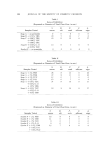
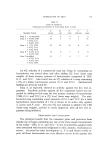
FLORA OF SCALP AND DANDRUFF 129 Since this "threshold level" varies for each individual, it is difficult to establish a definite scurf weight which can be used as a separation crite- rion. It is conceivable that in a future study there might be a subject with no visible exfoliation which would have a scurf weight higher than an individual with visible exfoliation. The reason for this is that the lipid content of scurf varies from individual to individual and is affected by environmental factors of humidity and temperature (48). It has often been noted in our work that large quantities of scurf may weigh con- siderably less than smaller quantities because of visible differences in oiliness. Relationship of Resident Flora to Dandruff As can be seen in "Results," the average number of microbial species per individual (Table VIII) is higher and the prevalence of specific groups of organisms (Table IX) is uniformly greater on the scalps of persons with dandruff than on those persons without dandruff. How- ever, from these results a definite etiologieal relationship between the microbial flora and dandruff cannot be made. It is very difficult to prove a definite microbial relationship. There are at least four possible reasons for this difficulty. First, it is possible to have more than one etiological factor (11) in dandruff production even though the physical appearance of excessive desquamation is the same. These factors might be related to or in- dependent of each other. It can be postulated that the contributing factor in one subject is different from that in a second subject while the combination of both is the etiological factor in a third subject. Our re- search suggests that there is a relationship between microorganisms and certain cases of dandruff. This raises the often asked question of whether dandruff is the result of microbial invasion or whether the microbial invasion is brought about by the presence of abundant scurf which serves as a source of nutrient. It is our belief that both questions can be answered affirmatively. Some dandruff problems are the result of microbial invasion, and by eliminating the flora, the dandruff problem can be eliminated (8). It is also believed that once dandruff is established an increase in the micro- bial flora will follow. This increase in microbial flora may contribute further to the dandruff•ondition as an additional factor regard•qs of original etiology. Thus, a self perpetuating cycle betwecrt scurf produc- tion and the microbial flora is established.

130 JOURNAL OF TIiE SOCIETY OF COSMETIC CHEMISTS If one assumes that the microbial flora is the cause of certain dandruff problems, then why are these members of the flora found on one scalp and not on another ? One logical answer is that the nutritional environ- ment on some scalps is favorable for the growth of certain microorga- nisms. If the presence of a favorable nutritional environment of the scalp is related to the metabolism of these individuals, it can be hy- pothesized that the scalps of these persons are predisposed to dandruff- producing microbial attacks. These suggested metabolic factors are: hormonal inbalance imparied metabolism and nutrition dietary in- discretions, as excessive carbohydrate and lipid intake increased nervous tension and biochemical changes of the cutaneous scalp (11). Other metabolic factors reported by Spoor (49, .50) are: the condition of the epidermis which may be a function of the individual's genetic makeup, his sex, age, and race and the amount and quantity of the sebum pro- duction. It is felt that more work on the specific resident microbial flora of subjects known to have a dandruff condition should be conducted, particularly those which respond to treatment by antimicrobial agents. This would better establish a cause relationship between specific resident organisms and dandruff. More work should also be done on the rela- tionship of dandruff to one's metabolic activities. A second factor which makes it difficult to establish a causal relation- ship is that microorganisms are continuously being added to and removed from the scalp by numerous external agents such as combs, hands, rain, hats, air, and soot. This uncontrolled addition and removal of micro- organisms explains some of the variations in our work as well as the fluctuations in bacterial plate counts noted by VanderWyk and Roia (8) and by Van Buskirk (10). A third factor is that there is a substantial time interval between the appearance of an increased microbial flora and a measurable increase in the production of scurf. This lag was noted by VanderWyk and Roia (8) after the application of an antimicrobial mixture had been stopped. The immediate return of high bacterial counts of microorganisms on the scalp was not accompanied by a significant increase in scurf weight until three weeks later. Our work also indicates that a longer presampling period of perhaps two to three weeks is necessary in order to permit the scalp to reach a balance between the increase in microbial flora and scurf production. We believe that a more conclusive relationship between scurf production and microbial isolates could be shown if this procedure were carried out.
Purchased for the exclusive use of nofirst nolast (unknown)
From: SCC Media Library & Resource Center (library.scconline.org)