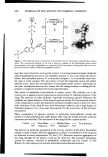
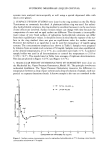
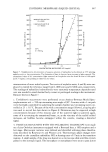
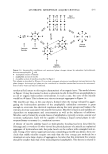
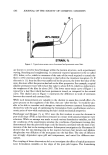
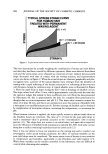
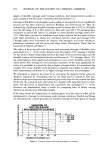
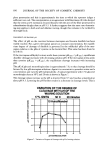
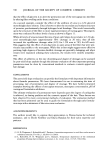
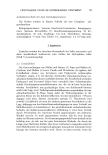
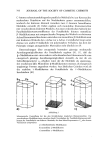
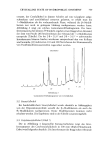
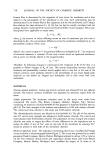
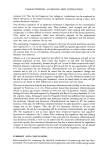
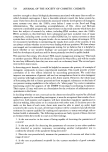
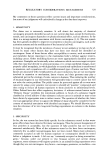
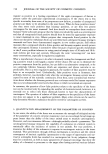
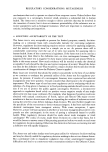
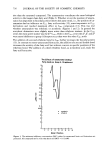
660 JOURNAL OF THE SOCIETY OF COSMETIC CHEMISTS cl © H/• 0 HYDROPHILIC Ii . ii or chorge-beormg heod OLEOPHILIC or hydrocorbon group Figure 1. The surfactant cation of nafoxidine hydrochloride may be represented schematically as shown above. The conventional formula on the left is drawn to compare to the Hirschfelder model shown photographed on the right. Amphiphiles are commonly divided into regions of hydrophilic (•) and of oleo- philic (if) characters which are linked by amphiphilic (c-') layers. meet the usual criteria for such specific activity. It is a long-chained aromatic (diphenyl dihydronaphthalene) derivative, the oleophilic portion, 9, of a cyclic amine salt (pyrro- lidine), the hydrophilic portion, •, as described in Figure 1. It is essentially water solu- ble only in acidic solution. The salt ionizes to form the long-chain cation and simple chloride anion. Since the concentration of protonated amine cation is dependent on the ionic equilibrium between free amine and the charged amine, a striking pH de- pendency is expected and has been found experimentally. The cation of nafoxidine hydrochloride is surface active. The chloride ion is the counter-ion or gegenion and is important as an electrolyte in colloidal solutions of the drug. The presence of other additives, especially electrolytes, greatly influences the solubility and phase behavior of the drug in aqueous media. If a hot saturated solution of the compound is cooled, the deposition of liquid crystalline states is observed. Alco- holic solutions of the drug do not show anisotropic behavior and a high degree of hydration appears to be a necessary prerequisite for the occurrence of the lyotropic mesophases. Phase examination of aqueous systems of nafoxidine hydrochloride reveals the presence of thermodynamically stable phases other than the mobile isotropic solutions (monomer and miceliar). The dissolution of the drug follows a typical profile: Crystal ) Neat Phase ) Middle Phase • True Solution H20 (Smectic) H20 (Nematic) H•O The kinetics of molecular association in the reverse reaction of the above dissolution scheme is quite complex. Miceliar aggregation in dilute concentrations of the drug can be followed at lower temperatures (25 and 37øC). However stepwise aggregation of the drug through all the phases could not be observed. The lyotropic mesophase system for aqueous solutions of amphiphilic compounds used by Luzzati (1) and Winsor (2) were employed to describe nafoxidine hydrochloride behavior.

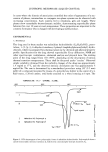
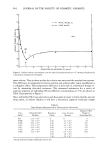
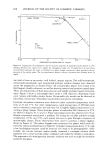
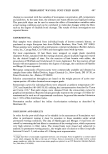
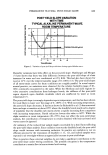
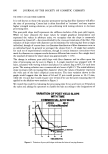
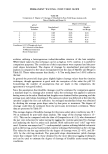
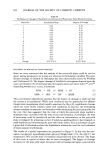
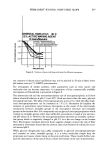
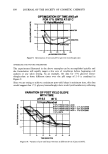
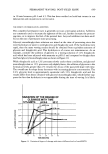
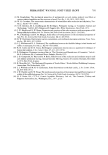
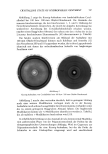
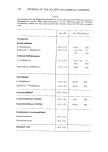
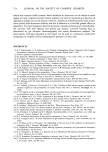
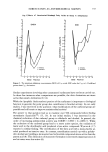
LYOTROPIC MESOPHASE (LIQUID CRYSTAL) 661 In cases where the kinetics of association controlled the order of appearance of a suc- cession of phases, intermediate or conjugate two-phase systems can be observed with increasing concentration. Such systems led to emulsions, gels and lyogels. These phases show remarkable thermodynamic stability, demonstrating reproducible phase behavior for over l0 years at room temperature. These properties are important to the cosmetic formulator who is charged with developing a stable product. EXPERIMENTAL A. MATERIALS The drug used in these studies was nafoxidine hydrochloride (C29H3202NCl), pyrro- lidine, 1 -{ 2-[p-( 3,4-dihydro-6-methoxy-2-phenyl-l-naphthyl)phenoxy]ethyl}-hydro- chloride, which was prepared for pharmaceutical use by chemical and physical property profile. Specifications for the drug showed reproducible X-ray diffraction, NMR and other spectroscopic confirmation, elemental analysis and physical data. The melting point of the drug ranged from 169-189øC, depending on the description of various thermal transition temperatures. These shall be discussed under "results." Observed simple solubility (obtained from the turbidity change) of the drug was approximately 1.4 mg/ml at 37øC, and the observed intrinsic dissolution rate was approximately 4 mg/cm2/hr. The rate is determined by a standardized procedure using 3/8" (9.5 mm) pellet of a compound mounted by means of a polyethylene holder in the center of a 4- fluid-ounce, (120-ml) amber, oval bottle attached to a wheel rotating at 6 rpm. The TEMPERATURE (øC) - CHROMEL: ALUMEL 12_0 ø 150 ø 180 ø T soil _ i 186.•iq 3• solid ! •'• liquid crystal ]' Nafoxidine HCI Polymorph c• 13 Nafoxidine HCI Polymorph /• Tm = 176.6 ø Figure 2. DTA thermogram of two polymorphic forms of nafoxidine hydrochloride. Polymorph fl shows a crystal-mesomorphic (smectic) transition, T•c followed by a mesomorphic-isotropic transition, Tm.
Purchased for the exclusive use of nofirst nolast (unknown)
From: SCC Media Library & Resource Center (library.scconline.org)