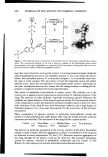
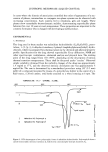
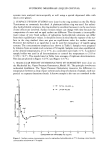
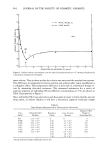
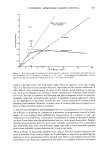
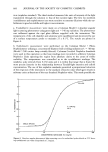
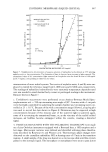
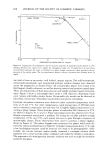
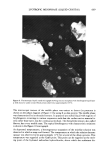
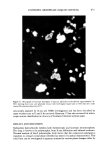
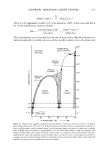
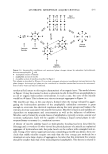
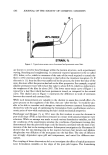
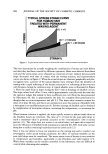
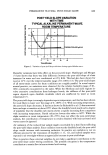
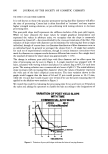
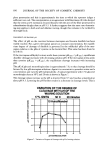
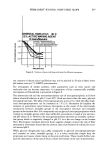
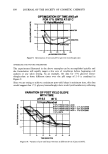
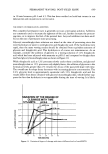
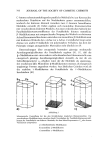
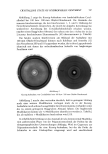
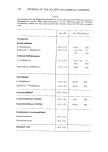
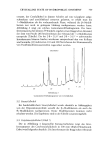
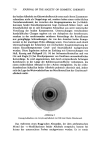
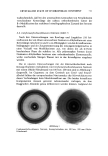
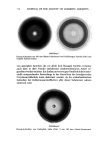
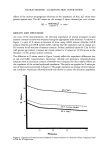
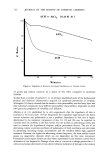
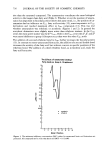
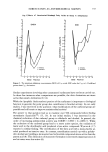
678 JOURNAL OF THE SOCIETY OF COSMETIC CHEMISTS The temperature dependence of surface tension has been described (10) as resulting from the influence of two factors. One is the vapor pressure of the substance the 3' falls as the saturated vapor pressure rises. The other factor is the increase in the thermal motion of molecules in the liquid phase which leads to increased intermolecular distance the surface tension falls as the temperature rises. This was observed in solu- tions of nafoxidine hydrochloride. The Ionic Equilibrium of the Amine Hydrochloride plays a role in the miceliar equilib- rium. The observed solubility of total nafoxidine species can be represented by the following scheme. [Naf' HC1]•ond [C1-] + [Naf' H +] Km •I In Naf' H +] [Naf]sond Ks. •__Ka, [Naf]•s• + [Ha•)] [HOH] ==• [Mixed Micelie] where [Naf]tota• = [Naf]baso + [Naf' H +] + [n Naf' H +] The observed pH of a saturated solution of nafoxidine hydrochloride was 4.6. This can be calculated for appropriate pKa values at 25øC to give an apparent solubility value of 0.7 mg/ml. This value coincides with the measured cmc values. For a given molarity, the concentration of free nafoxidine base present in the solution may be affected by back hydrolysis and as such may exert some effect on the drug solubility (miceliar properties). Buffering to a suitable pH range may diminish the extent of free-base contribution. The solubility of free nafoxidine base in water is calculated to be 0.011 mg/ml at 25øC. The free base may act as an impurity in the nafoxidine hydrochloride solutions (miceliar and otherwise). The Miceilar Molecular Weight was seen to increase at a second critical concentration as observed in the light scattering studies. This is shown in the equilibrium diagram in Figure 14 as the conversion to the middle phase. The miceliar units of the phase, consisting of amphiphilic nafoxidine molecules associated in a fluid, reform into parallel cylindrical threads with the external polar groups (W) surrounded by water. This liquid crystalline middle phase formed many conjugate solutions for nafoxidine hydrochloride. Winsor (2) has discussed this equilibrium in detail. The turbidimetric data shown plotted in Figure 8 show tl•e observed phase change which represented the onset of visible turbidity, seen in micrograph, Figure 11, of the middle (nematic) phase. The texture of this phase has been described by Rosevear (3) and its structure was determined by Luzzati (1). It is formed by a set of indefinitely long cylinders, regular, two dimensional hexagonal array, and separated from one another by water. The onset of turbidity may be interpreted as a cloud point (not in the terms of nonionic surfactants that experience an increase in miceliar weight with increased temperature). This can be justified inasmuch as a phase separation occurs to form a coacervate in this region. This was described by Langmuir (11) as unipo!ar coacervation when two kinds of micelies were mixed. Phase separation in surfactant solutions normally occurs on heating for nonionic and on cooling for ionic surfactants. Thus the Krafft point ob-

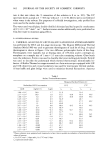
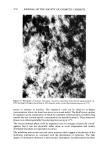
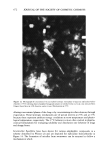
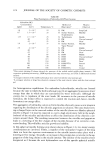
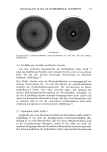
LYOTROPIC MESOPHASE (LIQUID CRYSTAL) 679 served for nafoxidine hydrochloride corresponds to the classical case for ionic amphi- philes. Light scattering studies for cationic micelles that form coacervates have pre- viously been reported (12) for systems with both zero and low electrolyte added. The Neat (Smectic) Phase of nafoxidine hydrochloride is observed only in very high concentrations of drug. The kinetics of formation of this phase are such that it was not easily observed in systems in which the crystalline drug was only partially hydrated. This phase could be produced by concentrating the viscous isotropic gel phase by evaporation or by cooling a supersaturated isotropic solution of drug. Micrographs in Figures 12 and 13 showed the texture of phases prepared by cooling to 25øC. Due to the kinetics of phase formation of the neat phase, there is some uncertainty associated with the phase boundaries for this phase, shown in Figure 9. This phase could not be produced in the concentration range below 65 mol % by the cooling method. Similarly, the stepwise aggregation of micelies in the evaporation method did not produce a neat phase that stayed anisotropic above 125øC. For this reason the ki- netics of phase formation complicates the phase diagram, and is reflected in the multiple equilibria scheme in Figure 14 by showing various possible phase transforma- tions between the three lyotropic mesophases observed, The Viscous Isotropic Mesophase for nafoxidine hydrochloride always appeared with the presence of either the middle or neat phases. If centrifuged, the neat phase always set- tled down as the dense pearlescent bottom layer. A scheme for lyotropic paracrystalline phases different from the scheme in Figure 14 has been proposed by Small and Bourges (13), in which they describe the transition to a cubic liquid-crystal phase as the viscous isotropic phase. This phase is described as a face-centered cubic structure with three-dimensional long-range ordering. It was observed in the stepwise hydration of the crystalline solid as intermediate between the neat and middle phases. Small and Bourges report that under the polarizing microscope this phase appears isotropic, but, if bubbles are trapped within it, they are angularly deformed and do not become spherical with time. This was not observed for the viscous isotropic phase of nafoxidine hydrochloride. APPLICATIONS TO FORMULATION s•:v, tsc•:tm^L coss•r)•R^• •oss Having established that nafoxidine hydrochloride is an association colloid when in aqueous solution, the pronounced surface activity and miceliar aggregation observed are not entirely surprising when the structure of the molecule is considered. The cmc ranges observed are typical for ionic surfactants. The effects of chemical structure or miceliar and liquid crystal behavior have been reviewed by Usoltseva and Chistyakov (14). These authors give a detailed description of the effect of aromatic moieties, espe- cially those joined in thepara-position and the tendency for form mesophases. The cosmetic chemist should be aware that factors other than impurity can lead to de- partures for the usual, well defined solid-isotropic liquid transition or solubility- turbidity phenomena. Sometimes supposedly impure pharmaceutical or cosmetic in- gredients are apt to be discarded as inseparable mixtures simply because they exhibit lyotropic or thermotropic mesomorphism with which the formulators are not familiar. The reformulation of components based upon results of stability studies often dictates
Purchased for the exclusive use of nofirst nolast (unknown)
From: SCC Media Library & Resource Center (library.scconline.org)