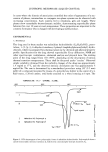
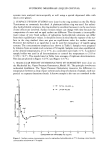
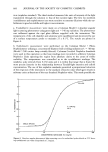
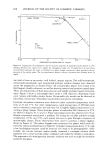
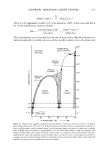
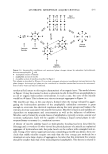
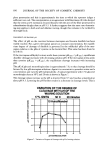
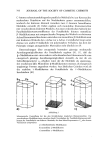
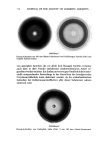
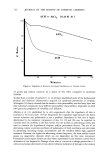
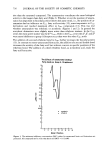
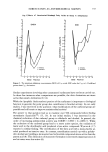
676 JOURNAL OF THE SOCIETY OF COSMETIC CHEMISTS the excess turbidity which results with increased concentration of the amphilile above the cmc. This would explain the changes observed in Figure 8. Poland and Seheraga in- terpret this as evidence of an increase in the most probable micelle size. The thermodynamics of micelle formation have been reviewed by Hall and Pethica (9). Their treatment is a refinement of the standard treatment of mass action vs. phase- separation models inasmuch as they introduce the small-system thermodynamic ap- proach as applied to mixed micelies. The mass-action model has often been used suc- cessfully to predict cmc values. However at higher surfactant concentrations and in multicomponent or solubilized systems this model becomes limited in application. Since micelles are not arranged in a fixed stoichiometry, a multi-species approach to miceliar equilibria has also been used in the treatment of micelles as reaction products of surfactants and water. The occurrence of lyotropic mesophase domains in amphi- phile-water systems is not readily explained by the mass action model. The phase separation model for micelle formation considers the cmc as the maximum concentration of molecular dispersion of the surfactant. Micelles are treated as a separate phase, often the justification based on ultra-filtration studies and the fact that the concentration of the surfactant monomer appears constant above the cmc. However apparent phase heterogeneity and electro-inequality (especially for surface layers of charged micelies, ionic surfactants) make a strict thermodynamic treatment of micelles as a phase somewhat difficult. This criticism of the phase model, which altogether is much better for concentrated surfactant systems than the mass-action model, has been the limiting reason for a strict thermodynamic approach to micelliza- tion through an entire concentration profile. The treatment of micelle formation by small-system thermodynamics considers a general macroscopic system of multicomponent solutions and multicomponent micelies. Hall and Pethica (9) also consider the thermodynamics of mixed small systems and regard their overall treatment as chiefly speculative, awaiting experimental verification. In general, this small-system approach to micellization is very similar to the phase-separation model except that the solvent is considered to be in excess and therefore ignored. The assumption is therefore made that the small systems are so dilute in the solvent that they do not interact. For assimilation of this treatment into systems where lyotropic mesophases occur, however, several difficulties arise. Micelles are in kinetic as well as thermodynamic equilibrium with the molecularly dis- persed surfactant. It is generally accepted that micelles can occur well below the cmc and also that micelles cannot exist alone as a phase above the cmc without the presence of monomers in solution. The lamellar micelle in particular (shown as a McBain micelle in part of the neat phase of Figure 14), though often represented to the contrary, de- pends very critically on the presence of a solution phase for its "sandwich" or bimolecular leaflet structure. Micellization and demicellization occur throughout a surfactant solvent system at all concentration levels. Thus, depending on the overall concentration of the amphiphile in the entire system, it is best to refer to the most probable micellar size as the best representation of the structure. Most probably a statistical concentration of many micelles and micellar fragments (trimer, tetramers, etc.) occur in equilibrium with the recognized miceliar size and structure. The existence of a liquid crystal mesophase in these micellar systems helps in under- standing the various anomalous phase characteristics. Being a mesophase thermody- namically, its structure is found to be uniform and homogeneous throughout its

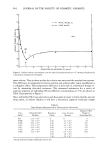
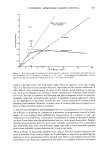
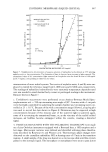
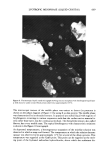
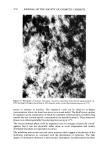
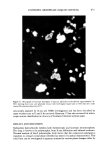
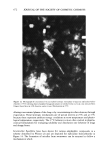
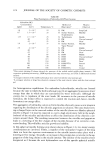
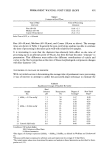
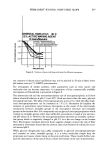
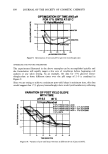
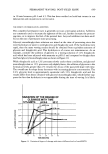
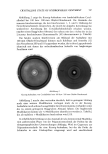
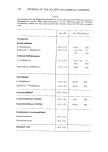
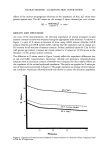
LYOTROPIC MESOPHASE (LIQUID CRYSTAL) 677 domain under specified temperature and concentration conditions. As such, either the phase-separation model or the small-system thermodynamic approach offers the same convenience for lyotropic mesomorphism in concentrated surfactant systems. Fewer discrepancies due to solvent interplay, miceIlar size distribution and multicomponent participation (mixed micelies) are associated with accepting the lyotropic mesophase as a separate phase. The origin of the ambiguous term liquid crystal originated because traditionally these compounds were discovered by their unique optical properties. Thus, while they behaved as solids optically, the compounds had the flow properties of liquids. The optical properties of lyotropic mesophases are still a principal means of identifying the phase transformations and texture. Roseyear (7), in a previous presentation before the Society of Cosmetic Chemists, described the liquid-crystal texture of surfactant meso- phases. Critical Micelle Concentrations were measured in these investigations by several methods. A comparison of observed cmc values is listed in Table IV. The methods selected are commonly employed for cmc determinations they were, however, espe- cially significant because of their pharmaceutical implication. Both surface activity (as it may affect drug solubility, dissolution and solubilization) and optical properties (as they affect product appearance, stability and spectrophotometric measurements of product performance, i.e., dissolution) are significant physical properties which are designed and controlled in product formulation. A reasonable agreement was found for cmc values determined by the various methods. Tyndallmetric values at 25øC ap- pear a little higher (1.2 mg/ml) than the other methods. This may be explained by the high light-scattering shown by the isotropic solution itself (observed to be about 95% transmission in Figure 6). The surface tension plots in Figures 3 and 4 show a minimum commonly encountered in such cmc determinations. The descending portion of the curve below the cmc can be explained by impurity adsorbed by surface while the ascending portion of the minimum after the cmc and before the plateau is explained by impurity being solu- bilized by the micelies. The ring method itself may be a contributor to this minimum. In the measurement of y values, the true minimum equilibrium value may not be reached. This is evident in the aged-solution values shown in Table I and Figures 3 and 4. Table IV Observed Critical Concentrations for Nafoxidine HC1 Aqueous Solutions CMC Value Measured, mg/ml Temperature, øC Method 0.70 25 Surface Tension 0.83 37 Surface Tension 0.92 37 Vapor Pressure 1.2 25 Ty ndallmetric 0.75 25 Nephelometric A 0.68 25 Nephelometric B 0.7 25 Turbidimetric 1.35 • 25 Turbidimetric Represents a second critical concentration in which anisotropicity is observed and a phase change appears.
Purchased for the exclusive use of nofirst nolast (unknown)
From: SCC Media Library & Resource Center (library.scconline.org)