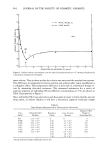
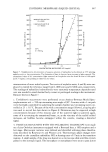
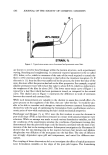
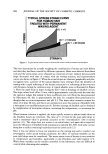
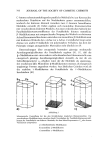
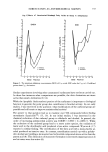
J. Soc. Cosmet. Chem., 29, 685-701 (November 1978) Permanent waving: utilization of the post-yield slope as a formulation parameter DAVID W. CANNELL and LINN E. CAROTHERS Redken Laboratories, Canoga Park, CA 91303. Received September 12, 1977. Presented at An nual Scientific Seminar, Society of Cosmetic Chemists, May 1977, Montreal, Canada. Synopsis The stress-strain curve for keratin had previously been utilized to assess the action of cosmetics on the hair. The POST-YIELD SLOPE of this curve has been correlated with changes occurring to the disulfide bonding under PERMANENT WAVING conditions. The evaluation of this mechanical PARAMETER can be re- lated to the time of processing, rate of penetration of rnercaptan and the level of disulfide cleavage. It can further be utilized to assess the effects of formulation variables such as concentration, pH, structure of the mercaptan and formulation additives. The ease of this technique can save the chemist considerable time in optimizing a PERMANENT WAVE FORMULATION. INTRODUCTION The stress-strain relationship for keratin fibers has been widely studied and the various regions of the stress-strain curve correlated with changes in the molecular conforma- tion (1). When a hair fiber is stretched at a constant rate of elongation, three distinct regions appear, as shown in Figure 1. In the Hookean region of the curve (AB), the stress is linearly related to the strain until an extension of approximately 2%, when the fiber begins to yield as the crystalline •-helices begin to unfold. This yield process continues until about 30% extension where the stress rapidly increases during the so- called post-yield region (CD) until the fiber breaks at 40-50% extension. While the details of changes in molecular conformation in the post-yield region are still under debate, it is generally accepted that the disulfide-rich matrix surrounding the microfibrils is becoming involved. The high disulfide content and thus the high degree of cross-linking in this amorphous matrix are resisting further extensions with a sub- sequent increase in stress. Many workers have investigated keratins which have been partially reduced and alkylated to obtain varying disulfide levels, and shown that the modulus (the slope) of the post-yield region decreases with decreased disulfide content (2-4). The change in mechanical properties of human hair has often been utilized to assess the effect of varying cosmetic treatments on the fiber, particularly cosmetic treatments that 685

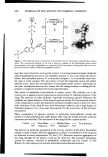
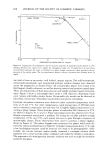
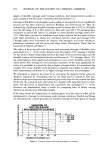
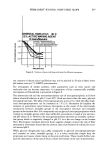
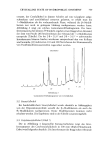
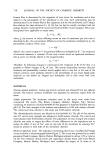
686 JOURNAL OF THE SOCIETY OF COSMETIC CHEMISTS D E 20% INDEX --.. STRAIN, % Figure 1. Typical stress-strain curve ofuntreated and permanent waved hair. are known to involve bond breakage within the keratin structure, such as permanent waving, bleaching and straightening. A commonly reported parameter is the so-called 20% Index, or I20, which is a measure of the ratio of the work required to stretch the fiber to 20% extension after a treatment to that before the treatment was given (5). If this ratio is 1.0, then the fiber was unaffected by the process the lower the value of the ratio, the more effect the process has had on the fiber properties. For example, a typical alkaline permanent wave will reduce this value to about 0.8 (6), which is a reduction in the toughness of the fiber by about 20%. The lower stress-strain curve of Figure 1 is typical for a hair fiber which has been permanent waved, as compared to the normal curve. The shaded area in Figure 1 represents the difference in work of extension between the treated and untreated hair. While such measurements are valuable to the chemist to assess the overall effect of a given process on the toughness of the fiber, they are "after-the-fact." It would be valu- able to be able to correlate such changes to variations between cosmetic formulations themselves with the goal of optimizing the formulation from a performance and eco- nomic point of view while maintaining the hair's initial mechanical vroperties. Hamburger and Morgan (7), in 1952, were the first workers to note the decrease in post-yield slope (PYS) as hair fibers remained in contact with typical permanent wave solutions. While no attempt was made to study various formulation variables, nor did the conditions of the experiments simulate the conditions of permanent waving, they demonstrated that the post-yield slope could be linearly correlated with the time of im- mersion of the hair in the waving solution. Subsequent investigations by Herrmann (8) showed that the rate-limiting step in the reaction between hair keratin and alkaline thioglycolate was diffusion of the mercaptan into the hair fiber. The time of diffusion was strongly dependent upon pH and temperature, and varied for different mer- captans. The coupling of these observations led us to investigate the effect of typical permanent wave formulation variables on the slope of the post-yield region. The formulating
Purchased for the exclusive use of nofirst nolast (unknown)
From: SCC Media Library & Resource Center (library.scconline.org)