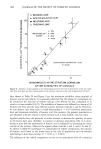
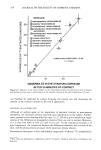
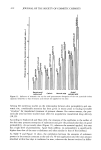
366 JOURNAL OF THE SOCIETY OF COSMETIC CHEMISTS reagent diffuses into the cuticle, the protein lying under the epicuticle dissolves, even- tually causing the epicuticle to lose its adherence to the substructure. As the solubility of the protein increases with treatment, an osmotic pressure is generated which results in the formation of sacs. If the degraded protein is of high enough molecular weight, it will not diffuse through the epicuticle. As the reaction proceeds further, however, the molecular weight of the protein decreases so that protein segments are able to diffuse through the epicuticle, causing the AllwiSrden sacs to fiatten. The osmotic active sub- stances of the cuticle have been found to contain more than half of their sulfur in the form of cystine, whereas only 10 percent of the sulfur is in this form in the degradation products which have passed into the solution. This suggests that the presence of cystine is important in keeping protein chains large enough to inhibit their passage through the epicuticle. WEIGHT LOSS The reaction of halogens with keratin fibers has been found to cause considerable weight loss (2,6,20,22,48-50). As a function ofpH, the weight loss has been found to reach a minimum between pH 4 and 7, where sometimes even a slight increase in weight has been seen (2,22). Maximum weight loss has been observed in the acid region, below pH 4 (2,6,22,50). These differences in weight loss have been attributed to differences in the extent of disulfide bond oxidation and peptide bond cleavage. In the acid region, extensive peptide bond cleavage and disulfide bond oxidation have been noted, which could be expected to lead to considerable weight loss. Between pH 4 and 7, where peptide bond cleavage is low but oxidation of cystine is high, a small loss of material due to the former could be expected to be compensated for by the latter, i.e., by an uptake of oxygen by the disulfide group. In the alkaline region, peptide bond cleavage is extensive, but there is very little cystine oxidation. This combination can be expected to result in a net weight loss which, however, will be less than expected in the acid region. MECHANICAL PROPERTIES Changes in tensile properties have been used to determine the extent of structural damage produced by halogenation in keratin fibers (45,49,50,55,58,59,79- 84). Gen- erally, strength and elongation decrease with increase in halogen treatment (30,49,50,59,84). Nondestructive methods for studying the effect of halogen treat- ments on tensile properties also have been used which examine the change in the amount of work (2,12, 18,55,80,82) or force (58,81) required to extend a wet fiber by a given length. These measurements have been carried out over a range of extensions (15-30 percent). The work or force required to stretch the fibers is greatly reduced after acid and neutral chlorination treatments. There is less change in these values with chlorination in the alkaline region. The changes in work seen by Houff et al. (82) are related to the amount of cystine converted to cysteic acid. CONCLUSIONS The distinguishing characteristic of the reaction of halogens with keratin fibers is that the reaction depends strongly on pH. The rate of diffusion of halogens in keratin fibers

REVIEW OF CHLORINE-HAIR INTERACTION 367 is dependent on the form in which the halogens are present, which is determined by the pH of the solution. Once the halogen penetrates into the fiber, the reaction proceeds in a fashion similar to those found in amino acids and simple peptides. In the acid and neutral regions, cysteic acid is the main oxidation product. In the alkaline region, C-S bond fission results in the formation of lanthionine. Evidence indicates that peptide bonds are cleaved at all pH levels. Changes from these reactions occurring in the chem- ical, physical, and mechanical properties of the fibers can be explained in terms of disulfide bond oxidation and peptide bond cleavage. Although the literature cited in this paper does not pertain directly to hair, the infor- mation presented should serve as a useful body of knowledge in light of which the chlorine-hair interaction can be examined. Basic reactions will most likely remain the same, but the extent of reaction, and consequently the extent of effects on fiber proper- ties, may be different. There is, thus, a need for research which focuses on conditions more specific to the chlorine-hair interaction. Variables which should be studied in- clude chlorine concentration, pH of the solution, temperature of the solution, time of exposure, and the combination of chlorination with popular cosmetic and care treat- ments. REFERENCES (1) (2) (3) (4) (5) (6) (7) (8) (9) (10) (11) (12) (13) (14) (15) (16) S. R. Trotman, The use of aqueous solutions of chlorine and bromine for the production of unshrink- able finish on knitted woolen goods, J. Soc. Chem. Ind., 52, 159-164T (1933). M. Harris and D. Frishman, Some aspects of the chlorination of wool to produce shrink resistance, Am. DyestuffReptr., 37, P52-56 (1948). P. Alexander, D. Gough, and R. R. Hudson, Reaction of oxidizing agents with wool. 3. The influ- ence of the morphology on the rate of reaction, Biochem, J., 48, 20-27 (1951). L. Shapiro, Shrinkage control of wool by wet chlorination, Am. DyestuffReptr., 37, 376-381 (1948). D. Frishman, L. Hornstein, A. L. Smith, and M. Harris, Reaction between wool and active chloride, Ind. Engng. Chem., 40, 2280-2284 (1948). A. Kantouch and S. H. Abdel-Fattah, Oxidation of wool with chlorine and some chlorinated com- pounds, Appl. Polym. Syrup., 18, 317-323 (1971). H. Zimmerman, Felt resistant wool by wet chlorination, Am. DyestuffReptr., 36, 473-475 (1947). R. C. Landwehr and D. Stigter, A simple and qualitative electrophoretic technique for fibrous mate- rial, Text. Res. J., 44, 45-47 (1974). J. R. McLaughlin and W. S. Simpson, "Rate Studies of the Chlorination of Wool," in Fibrous Pro- teins: Scientific Industrial and Medical Aspects, D. A.D. Parry and L. K. Creamer, Eds. (Academic Press, New York, 1980), Vol. 2, pp. 213-225. P. Alexander, D. Gough, and R. F. Hudson, The reaction kinetics of wool with chlorine solutions. II. Diffusion within the fibre, Trans. Faraday Soc., 45, 1109- l 118 (1949). J. R. McLaughlin, Liquid-layer diffusion during chlorination of wool, J. Text. Inst., 70, 214-216 (1979). P. Nordom and N. W. Bainbridge, A laboratory study of dry chlorination of wool at atmospheric pressure. I. Conditions of treatment, J. Soc. Dyers Colour., 84, 26-29 (1968). A. Kantouch and S. H. Abdel-Fattah, Oxidation of wool with chlorine and some chlorinated com- pounds, Kolor. Ertes, 14, 2-9 (1972). I. J. O'Donnell and E. F. Woods, The preparation of wool protein solutions, Proc Intl. Wool Text. Res. Conf., Aust., B, 48-55 (1955). P. Alexander and R. F. Hudson, Wool--Its Chemistry and Physics (Reinhold Publishing, New York, 1954), pp 271-281. H. Vom Hove, The processes in the reaction of halogens upon wool, Angew. Chem., 47, 756-762 (1934).
Purchased for the exclusive use of nofirst nolast (unknown)
From: SCC Media Library & Resource Center (library.scconline.org)