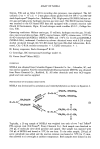
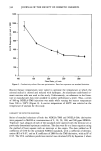
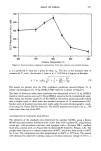
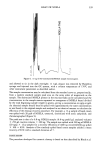
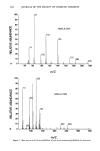
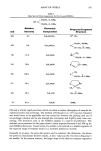
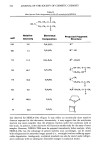
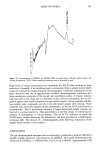
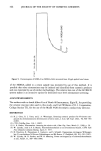
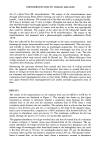
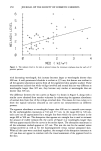
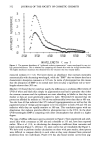
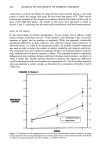
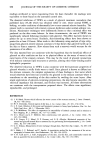
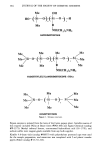
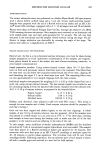
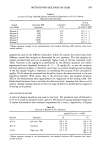
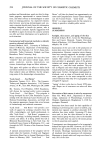
338 JOURNAL OF THE SOCIETY OF COSMETIC CHEMISTS 2500 2000- 1500 - 000- 500- •"• NDELA-TMS • .... ___•' •5Do/iLcA•f•d• rice Limits Error Ba rids •.''''' •5 i i I I 0 100 200 300 400 500 ng NDELA Figure 5. NDELA derivatives standard response. beam current of 150 •a, and an acceleration voltage of 4 kv. The spectra (Figure 7) match previously published spectra for these derivatives (26,35). Elemental composi- tions obtained from high-resolution data on the major ions in the spectra are given in Tables I and II. DERIVATIZATION AND ANALYSIS A) Bis-(O-trimethylsilyl)NDELA. The 50-mL round-bottom flask containing the sample residue from the cleanup procedure was removed from the desiccator and 125 •L of dry pyridine and 125 •L of BSTFA were added. The flask was stoppered and gently shaken to dissolve the extracted traces of NDELA but not so violently as to disperse the reac- tion mixture into droplets on the flask wall and stopper. The flask was placed in an oven at 70øC for 60 min to complete the formation of NDELA-TMS. The flask was allowed to cool, a 1-•L aliquot was removed with a 1-•L Hamilton syringe and injected into the GC system operating at a 145øC column temperature and instrument conditions as described earlier. A sample of a hand lotion with undetectable NDELA was spiked with 100 ppb NDELA, extracted, and derivatized to yield NDELA-TMS. Due to a long baseline settling time encountered in this analysis, the derivatized sample extract was chromatographed with a column temperature of 130øC to give a longer retention time (Figure 8). This sample chromatogram demonstrates the applicability of the method to a different sample matrix. For the accurate application of the method, it is necessary to first establish chromatographic conditions applicable to anticipated sample matrices and then construct standard response curves under identical conditions. 13) 13is-(O-acetyl)NDELA. The flask containing the sample residue was removed from the desiccator, and 125 •L of dry pyridine and 125 •L acetic anhydride were pipetted into the flask. The flask was stoppered and gently shaken to dissolve the extracted traces of NDELA. The stoppered flask was placed in an oven at 70øC for 15 min, removed,

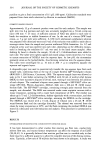
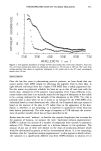
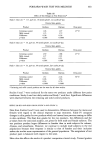
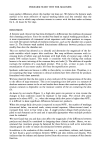
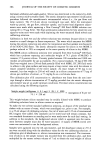
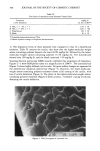
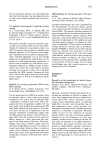
ASSAY OF NDELA 339 •7.! :, \ •..• Figure 6. 10 ng bis-(O-trimethylsilyl)NDELA sample chromatogram. and allowed to sit in the dark overnight. A 1-1zL aliquot was removed by Hamilton syringe and injected into the GC system, with a column temperature of 170øC and other instrument parameters as described earlier. The sample concentration may be calculated from the standard curve or, proportionally, from a tandem standard sample peak area on the same order of magnitude as the sample. The derivatized NDELA present in the reaction flask can be calculated and the concentration in the sample matrix expressed as nanograms of NDELA found divided by the total beginning sample weight in grams, giving a concentration in ng/g or ppb. An identical sample should then be spiked with approximately the same concentration as was found in the original sample and analyzed in an identical manner to calculate the efficiency of the cleanup recovery procedure. For example, a 12-g sample of hand cream was spiked with 20 ppb of NDELA, extracted, derivatized with acetic anhydride, and chromatographed (Figure 9). The peak area is that of a 0.8-ng NDELA sample: (0.8-ng peak/ltzL analyzed volume) X 250-tzL reaction volume = 200 ng. The sample was spiked with 240 ng of NDELA (20 ng/g X 12-g sample) for a recovery efficiency of (200 ng recovered/240-ng spike) x 100 = 83%. Analysis of five similarly spiked hand cream samples yielded a mean recovery of 81% with a standard deviation of 7. DISCUSSION The procedure developed for cosmetic cleanup is based on that described by Black et al.
Purchased for the exclusive use of nofirst nolast (unknown)
From: SCC Media Library & Resource Center (library.scconline.org)