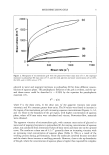
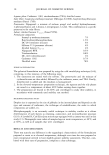
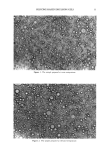
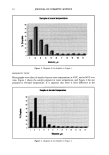
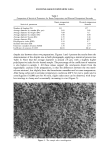
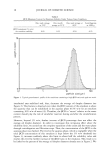
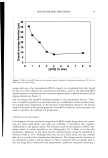
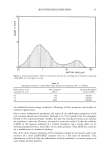
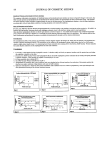
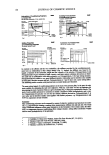
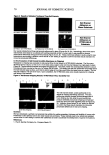
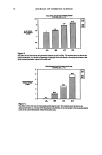
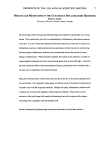
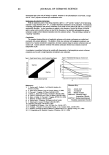
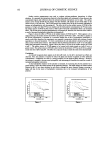
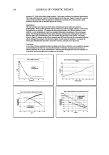
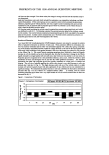
[3CD-STABILIZED EMULSIONS 19 4O 35 • 30 2 •20 =15 ,•1o o o 1 2 3 4 5 6 7' 8 9 [I•CD] (% w/w) Figure 2. Effect of the [3CD ratio on the average droplet diameter of emulsions containing 30% w/w of water after one-week storage. assume that up to this concentration, [3CD is mainly in a complexed form that should be the active form. Beyond the concentration threshold, a part of the additional [3CD should remain as a solid because the continuous aqueous phase is already saturated in free oligosaccharide (see Figure 3). One can assume that the [3CD threshold depends on the complexation kinetics. There- fore, it should be possible to exceed this limit by a modification of the interfacial area, the emulsification temperature, or the duration of the blending. However, the present work was focused on the general properties of the [3CD emulsions, and no attempt was made to optimize the conditions of preparation. PARTICLES IN THE SOLID PHASE Centrifugation of these emulsions prepared with [3CD usually brings about the separa- tion of a lower solid phase, even when the emulsifier is introduced after complete solibilization in the aqueous phase. The formation and the precipitation of [3CD com- plexes, which is widely described in the bibliography (9), is likely to be the only explanation. Moreover, we did check that the solid precipitate cannot be solubilized in deionized water at 25øC. Although these facts are not a direct proof, one may consider that this is a proof of the complexation phenomenon. The average particle diameter in the solid phase is about 1 pm (see Figure 4). This is consistent with a secondary peak in this size range that is observed in the granulometric profiles of emulsions containing a

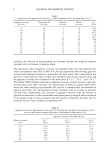
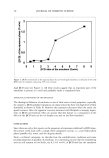
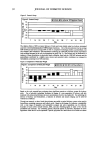
20 JOURNAL OF COSMETIC SCIENCE Q. •3 o 1,5 0,5 0 1 2 3 4 5 6 7 8 9 •CD ratio of the emulsion (%wlw) Figure 3. [3CD concentration in the aqueous phase of a one-week-aged emulsion as a function of the total [3CD ratio of emulsions containing 30% w/w of water. high [3CD ratio (see Figure 1). All these results suggest that an important part of the emulsifier is present as a solid and probably under a complexed form. RHEOLOGICAL PROPERTIES OF THE EMULSIONS The rheological behavior of emulsions is one of their most critical properties, especially for cosmetics. [3CD-stabilized emulsions are characterized by their very high level of flow threshold, as shown in Table II. However this parameter decreases when the strain rise speed increases. Also, the apparent viscosity measured with Helipath is strongly depen- dent on [3CD concentration. One can assume that this feature is a consequence of the effect of the [•CD ratio on the oil droplet size and on the flow threshold. CONCLUSION Since there are only a few reports on the properties of emulsions stabilized by [3CD alone, the present work deals with a simple three-component system, i.e., pure hydrocarbon phase (paraffin oil), water, and the oligosaccharide. From a technical viewpoint, we describe here the emulsification conditions and some peculiar properties of paraffin oil emulsions. It is interesting to note that the emulsifying activity still remains at low levels, say 0.2-0.5 w/w%, of [•CD and that the emulsions
Purchased for the exclusive use of nofirst nolast (unknown)
From: SCC Media Library & Resource Center (library.scconline.org)