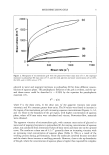
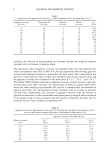
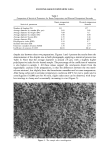
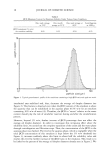
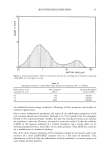
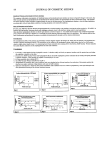
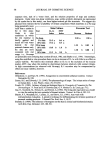
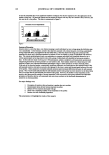
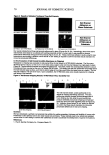
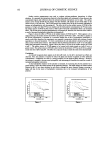
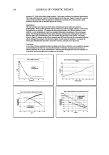
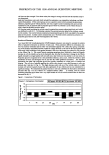
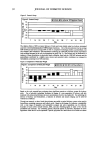
[3CD-STABILIZED EMULSIONS 21 10. o o,1 1 lO pc•rticle size { j_tm } Figure 4. Typical granulometric profile of the bottom obtained by centrifugation of emulsions containing a high [3CD ratio and aged one week. Table II Rheological Properties of One-Week-Aged Emulsions Containing 30% v/v of Water [3CD content of the Flow threshold emulsion (% w/w) (N/m 2) Helipath Brookfield viscosity (CPS) 0.4 540 80,000 1.5 650 160,000 5.0 2000 500,000 can withstand various storage conditions. Advantage of these properties can be taken in industrial applications. From a more fundamental standpoint, the origin of the stabilization properties of the cyclic oligosaccharide are still unclear. Shimada et al. (7,10) consider that the complexes formed at the triglyceride/water interface decrease the interfacial tension and stabilize the emulsion in this way. However, we noted in a previous work (14) that the addition of [3CD in the aqueous subphase of a triolein monolayer has a strong effect on its rheological properties but a weak effect on its surface pressure. Thus, [3CD also could act via a modification of interfacial rheology. One of the most amazing properties of the emulsions studied in the present work is the existence of a solid paraffin-[3CD complex even at a low ratio of emulsifier. This phenomenon could also help the stabilization of these emulsions--a known property of some highly divided powders.

22 JOURNAL OF COSMETIC SCIENCE Although precipitation is the main method to isolate the complexes, this phenomenon has never been described in [3CD-containing emulsions or linked to the possible method of stabilization. Therefore, we plan to further examine this problem in the near future this could help to widen the uses of [3CD in industrial applications. REFERENCES (1) P.J. Sicard and M. H. Saniez, "Biosynthesis of Cycloglycosyltransferase and Obtention of Its Enzy- matic Reaction Products," in Cyc/odextrim a,d Their I,d•striM Uses', D. DuchSne, Ed. (Editions de Sant6, Paris, 1987), pp. 75-103. (2) Sunstar KK, JP Pate,t 09038253, 25 August 1990. (3) Kanegaoeuchi Chemical Industry Co, JP Pate, t 63248433, 14 October 1988. (4) Takeda Chemical Industries,JP Pate,t 88041541, 17 August 1988. (5) Kanebo KK, JP Pate,t 55092702, 14 July 1980. (6) Kobayashi Kosei KK, JP Pate, t 87031681, 9 July 1987. (7) K. Shimada, Y. Ohe, T. Ohguni, K. Kawano, J. Ishii, and T. Nakamura, Nippo, Shok•hi, Kogyo G•kk•ishi, 38, 16-20 (1991). (8) K. Shimada, K. Fujikawa, K. Yahara, and T. Nakamura, J. Agric. Food Chem, 40, 945-948 (1992). (9) J. Sjetli, Cyc/odextri, Tech,o/ogy (Kluwer Academic Publishers, Dordrecht, Germany, 1988), pp. 1-185, 307-334. (10) K. Shimada, K. Kawano, J. Ishii, and T. Nakamura, J. FoodSci., 57, 655-656 (1992). (11) Sansho Seiyaku KK, JP Pate,t 63208510, 30 August 1988. (12) D. DuchSne, F. Glomot, and C. Vautrin, "Pharmaceutical Applications of Cyclodextrins," in Cyc/o- dextrins' and Their Industrial Uses, D. Duch•ne, Ed. (Editions de Sant•, Paris, 1987), pp. 75-103. (13) R.J. Bergeron, D. M. Pillor, G. Gibeily, and W. P. Roberts, Bioorg. Chem., 7, 263-271 (1978). (14) S. Laurent, M. G. Ivanova, D. Pioch, J. Graille, and R. Verger, Chem. Phys'. Lipids, 70, 35-42 (1994).
Purchased for the exclusive use of nofirst nolast (unknown)
From: SCC Media Library & Resource Center (library.scconline.org)