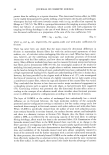
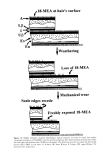
d. Cosmet. sci., 50, 23-47 (January/February 1999) Human hair cuticle' Biologically conspired to the owner's advantage j. A. SWIFT, Department of Textiles and Fashion, De Montfort University, The Gateway, Leicester, LE1 9BH, England. Accepted for publication December 15, 1998. Synopsis The structure, chemistry, and physical properties of the human hair cuticle are reviewed, and the role of the covalently linked fatty acids, notably 18-methyl eicosanoic acid (18-MEA), contained therein, is discussed. Differential friction in hair is considered, and it is argued that this property normally facilitates the parallel alignment of hairs on the scalp and aids the rejection of macroscopic scalp surface detritus, to the owner's benefit. The hair seems to possess a natural process of surface repair that, by the gradual mechanical attrition of cuticle, aids in the retention of the hair's differential frictional behavior and in the retention of the associated benefits. INTRODUCTION 18-MEA in mammalian keratin fibers has recently been the subject of an excellent review by Dr Les Jones and the late Dr Don Rivett (1). This is taken with other relevant information (notably hair frictional behavior) in reaching the conclusion that 18-MEA is naturally and uniquely conspired to the well-being of the owner's hair. The structure, chemistry, and physical behavior of all mammalian keratin fibers and their cuticular layers are similar [with the exception of animals bearing quills (2)]. In this respect, it was thought not unreasonable for some of the information presented here to be culled from research on other animal fibers (notably sheep's wool) as being of direct relevance to the present considerations of human hair. The overall conclusions are as applicable to these other fibers as they are to human hair. GROSS STRUCTURE OF THE HAIR CUTICLE The central core, or cortex, of human head hair is covered by thin cellular sheets of cuticle that overlap each other from root to tip along the fiber (cf. Figure 1). Each sheet is approximately 0.5 pm thick and roughly 60 pm square, with rounded corners. They are wrapped circumferentially, either abutting each other or with some overlap, pre- senting the appearance in transverse section of a series of continuous layers. In a Iongi- 23

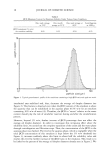
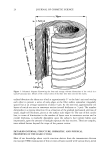
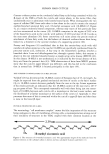
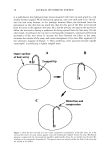
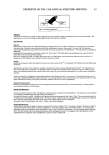
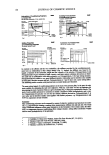
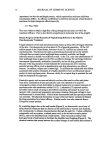
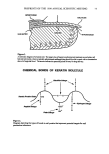
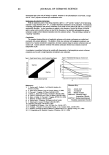
24 JOURNAL OF COSMETIC SCIENCE 0• c. c.70•m g o g g c.O'5•Jm .50 Figure 1. Schematic diagram illustrating the form and average relevant dimensions of the cuticle in a typical Caucasian hair. Details of the central cortex of the fiber have been omitted for clarity. tudinal direction the sheets are tilted at approximately 5 o to the hair's axis and overlap each other to present a series of scale edges at the fiber surface somewhat irregularly spaced but at an average separation of about 5 pm. At the root-end, approximately ten layers of cuticle are seen in transverse section (overall thickness ca. 5 pm). The number diminishes in a tipwise direction (3) as a function of the gradual mechanical attrition of small, single-cell thickness, pieces at the surface scale edges (4). The rate of this cuticle loss, in terms of diminution in the number of layers seen in transverse section and in overall thickness, is markedly dependent upon the subject's hair toiletry habits and, importantly, upon the amount of sunlight exposure the hair receives. These are complex, inter-related factors beyond the scope of the present review. DETAILED INTERNAL STRUCTURE, CHEMISTRY, AND PHYSICAL PROPERTIES OF THE HAIR CUTICLE Most of our knowledge about cuticle structure derives from the transmission electron microscope (TEM) examination of thin sections of hairs stained with various heavy-metal
Purchased for the exclusive use of nofirst nolast (unknown)
From: SCC Media Library & Resource Center (library.scconline.org)