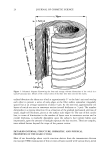
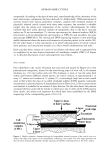
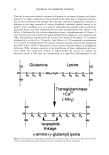
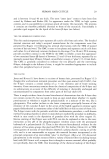
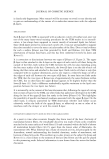
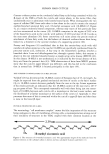
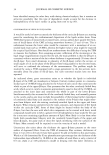
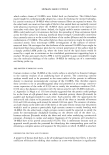
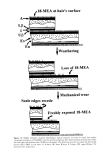
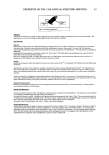
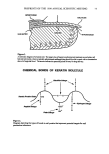
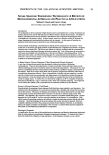
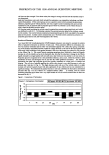
HUMAN HAIR CUTICLE 31 Current evidence points to the covalently linked fatty acids being contained within the [•-layers of the CMCs of both the cuticle and cortex where, in the native fiber, they undoubtedly exist in admixture with loosely bound lipids. What distinguishes the two types of cellular CMC from each other is that those in the cuticle contain the unusual methyl-branched saturated fatty acid, 18-methyl eicosanoic acid (18-MEA) (cf. Figure 4), as a major covalently bound component, whereas only traces of this particular fatty acid are encountered in the cortex (39). 18-MEA comprises in the region of 50% w/w of the bound fatty acids in the cuticle, with palmitic (C16:0) and oleic (C18:1) acids as the next most abundant (39). Some controversy still exists about the precise mode of attachment of these fatty acids, but the balance of chemical evidence favors their being linked via a thioester to the cysteine residues of a supporting protein (40). Protrey and Ferguson (41) established that in skin the anteiso-fatty acids with odd numbers of carbon atoms (as is the case for 18-MEA) are specifically synthesized from the precursor amino acid, isoleucine. A key step in the biosynthetic pathway involves a branched-chain 2-oxo acid dehydrogenase but, through a genetic defect, this enzyme is absent in the rare inherited disorder known as maple syrup urine disease (MSUD) (42). In this disease 18-MEA is not synthesized, as is indicated by the virtual absence of this fatty acid from the patient's hair (43). TEM observations of hairs from MSUD patients show that the cuticle's upper [•-layer was defective, and this has led to the conclusion that in normal hair 18-MEA is located principally in this layer (44). THE NUMBER OF MONOLAYERS OF 18-MEA IN HAIR Valldorf (45) has determined the 18-MEA content of European hair of 25-cm length. As might be expected from the gradual mechanical attrition of cuticle at the hair's surface (4), its 18-MEA content decreases gradually from the root to the tip. Linear regression of his results provides an indication that the 18-MEA content of the root end is 407.9 lag per gram of hair. This corresponds reasonably well with there being just one mono- layer of 18-MEA between each cuticle cell, a monolayer at the hair's outer surface, and the likelihood of a further monolayer at the surface of the cortex (cf. Appendix 1). One presumes that most of this is contained within the cuticle's upper [•-layer and that there is none in the lower [•-layer. PHYSICAL PROPERTIES OF 18-MEA The terminology "cell membrane complex" creates the false impression of this structure being analogous to the cell membranes of living cells, a misinterpretation arising out of their similarity of structure in the TEM, coupled with their common location at the ' ' 2.39 nm ,,,CH2 CH2 CH2 CH2 CH2 CH2 _CH2 CH2 .CH2 ....COOH H3C CH CH 2 CH2 CH2 CH2 CH2 CH2 CH2 CH2 I CHa 18-methyl eicosanoic acid Figure 4. The structure of 18-methyl eicosanoic acid. The approximate length of the molecule from the anreiso-terminus ro the carboxyl carbon is shown and was calculated by Jones and Rivert (1).

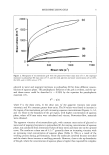
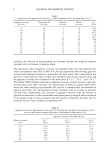
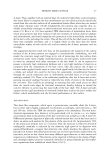
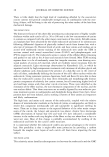
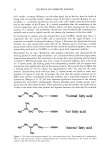
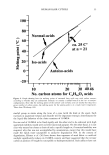
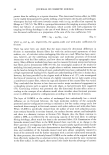
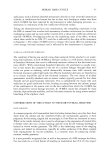
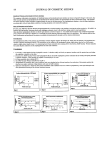
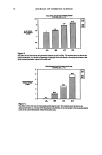
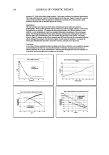
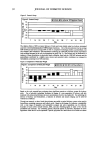
32 JOURNAL OF COSMETIC SCIENCE cell's surface. A major difference, on the other hand, lies in the fact that the lipids of living cells are laterally mobile, whereas those of the hair's cuticular lB-layers are im- movably (i.e., covalently) anchored at one end to the cell's surface proteins and possibly also to the surface of the 8-layer. It is indeed remarkable that the membranes of the cuticle's pregenitor cells in the hair follicle, which will have possessed all the charac- teristics of a "normal" cell membrane, should have been biochemically transformed so radically and at such a tightly specific site during the formation of the hair shaft. In attempting to explain why the unusual fatty acid, 18-MEA, should have been in- corporated into the cuticle's CMC and so specifically into the upper lB-layer, it is pertinent to consider its physical behavior. Figure 5 illustrates the distinction between normal-, iso-, and anteiso-fatty acids. One of the striking aspects of having a methyl group located three carbon atoms from the free end of the saturated aliphatic chain of an anteiso-fatty acid such as 18-MEA, is its effect upon local segmental mobility. Remarkable for its time, Weitkamp (46) isolated, identified, and characterized the melting points of a wide range of normal-, iso-, and anteiso-fatty acids from degras (fatty extracts from sheepskin). For convenience, his results have been replotted and are shown in Figure 6. Weitkamp found that, over a range of saturated aliphatic fatty acids of up to 31 carbon atoms, the melting points for corresponding normal- and iso-isomers were similar but were significantly less for the anteiso-isomers. He reported that 18-MEA had a melting point of 55.6øC, which was approximately 20C ø less than for the other isomers. Anteiso-fatty acids with less than 13 carbon atoms are liquid at room tem- perature (cf. figure 6), and this encourages the view that the anteiso-terminus of 18- MEA must exhibit considerable molecular mobility and a liquid-like behavior. In this connection, Menger et al. (47,48) have reported significant reductions in the melting temperatures of synthetic phosphatidyl cholines attendant upon methyl groups intro- duced near the alkyl chain termini. Their argument is that the methyl side chains induce a kink in the main chain that permits the segment between the kink and the terminal CH2 CH2 H3 C•* *CH•' *CH2 ...... COOH 'Normal' fatty acid CH3 I CH CH 2 H3 C/ •CH•" *CH2 ...... COOH 'Iso' fatty acid CH2 CH2 H3 C•' *CH" 'CH2 ...... COOH 'Anteiso' fatty acid I CH3 Figure 5. The distinction between normal-, iso-, and anteiso-fatty acids. The normal-acid is unbranched. The iso- and anteiso-acids contain a methyl branch that is located respectively on the second and third carbon atoms from the end of the lipid chain.
Purchased for the exclusive use of nofirst nolast (unknown)
From: SCC Media Library & Resource Center (library.scconline.org)