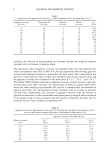
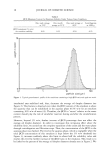
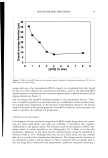
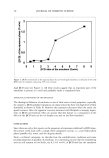
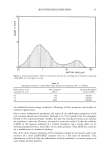
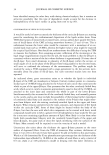
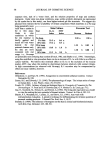
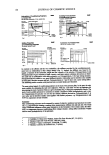
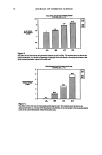
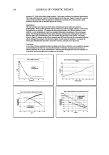
6 JOURNAL OF COSMETIC SCIENCE Table I Composition and Apparent Viscosity ('q'4.2) of Microemulsion Gels at the Shear Rate of 4.2 s -• Isopropyl myristate Polysorbate 80 Glycerol Water qq'4.2 (% w/w) (% w/w) (% w/w) (% w/w) (Pa s) 32 48 4 16 46.5 3O 46 5 19 56.8 28 42 6 24 103.2 26 40 7 27 111.8 24 36 8 32 110.1 20 30 10 40 56.8 25 37 19 19 3.8 24 36 2O 2O 4.1 23 35 21 21 5.4 22 34 22 22 4.5 21 33 23 23 4.3 2O 3O 25 25 4.1 swelling, the viscosity of microemulsion gel decreases because the molecule cohesion decreases with an increase of aqueous phase. The maximum value of apparent viscosity was obtained when the total glycerol-and- water concentration was close to 40% w/w, for all preparations with varying glycerol- to-water and isopropyl myristate to polysorbate 80 mass ratios. This concentration was selected to determine the values of shear rate and shear stress on the upward curve, and the apparent viscosity was calculated at the shear rates of 4.2 s -•, 34 s -•, and 136 s -• The results (Table II) show a decrease in apparent viscosity, with an increase in glycerol- to-water mass ratio. This is because the concentration of water in aqueous phase deter- mines the water swelling of polysorbate 80, and for a constant total concentration of glycerol and water, the concentration of water decreases with an increase in glycerol- to-water ratio. Additionally, this decrease in apparent viscosity with the increase in glycerol-to-water ratio, at the concentration of aqueous phase giving the most viscous gel in all systems, leads to the conclusion that the presence of glycerol decreases the po- tentiality for the water swelling of polysorbate 80. Table II Apparent Viscosity of Microemulsion Gels with the Total Glycerol and Water Concentration of 40% w/w and the Constant Isopropyl Myristate to Polysorbate 80 Mass Ratio of 4:6 Apparent viscosity at the shear rates of: Glycerol-to-water 4.2 s -• 34.1 s -• 136.0 s -• ratio (Pa s) (Pa s) (Pa s) 0:10 172.0 72.5 21.3 1:9 137.6 63.9 16.0 2:8 110.1 50.3 13.7 3:7 99.8 36.2 12.8 4:6 68.8 25.1 7.9 5:5 41.3 8.5 4.2 6:4 17.2 3.8 1.0

MICROEMULSION GELS 7 ACKNOWLEDGMENTS The authors wish to express their thanks to the State Scholarship Foundation of Greece for the scholarship provided to C. A. Ayannides. REFERENCES (1) D. Artwood, "Microemulsions" in Colloidal Drug Delivery Systems, J. Kreuter, Ed. (Marcel Dekker, New York, 1994), pp. 31-71. (2) M. Trotta, S. Morel, and M. R. Gasco, Effect of oil phase composition on the skin permeation of felodipine from o/w microemulsions, Pharmazie, 52, 50-53 (1997). (3) G. Ktistis and I. Niopas, A study on the in-vitro percutaneous absorption of propranolol from disperse systems,.]. Pharm. Pharmacol., 50, 413•418 (1998). (4) J. L. Parra, J. J. Garcia Dominguez, F. Comelies, J. Sanchez, C. Solans, C. Pelejero, and F. Balaguer, Use of microemulsions as vehicles for nucleophilic reagents in cosmetic formulations, Int..]. Cosmet. Sci., 7, 127-141 (1985). (5) H. L. Rosano, J. L. Cavallo, D. L. Chang, and J. H. Whittam, Microemulsions: A commentary on their preparation,.]. Soc. Cosmet. Chem., 39, 201-209 (1988). (6) S. E. Friberg, Micelies, microemulsions, liquid crystals and the structure of stratum corneum lipids,.]. Soc. Cosmet. Chem., 41, 155-171 (1990). (7) J. L. Zatz and G. P. Kushla, "Gels" in Pharmaceutical Dosage Forms: Disperse Systems, H. A. Lieberman, M.M. Rieger, and G. S. Banker, Eds. (Marcel Dekker, New York and Basel, 1989), Vol. 2, pp. 495-510. (8) T. X. Viegas, A. H. Hikal, and A. B. Jones, Percutaneous absorption of bendroflumethiazide from gel and membrane controlled gel systems: An in vitro and in vivo study, Int..]. Pharm., 152, 165-178 (1997). F. Dreher, P. Walde, P. L. Luisi, and P. Eisner, Human skin irritation studies of a lecithin micro- emulsion gel and of lecithin liposomes, Skin PharmacoL, 9, 124-129 (1996). F. Dreher, P. Walde, P. Walther, and E. Wehrli, Interaction of a lecithin microemulsion gel with human stratum corneum and its effect on transdermal transport, J. Controlled Release, 45, 131-140 (1997). C. Provost and R. Kinget, Transparent oil-water gels: A study of some physiochemical and biophar- maceutical characteristics. Part I. Formation of transparent oil-water gels in the 4-component-system of Eumulgin B3, Cetiol HE, isopropyl palminate and water, Int..]. Pharm., 44, 75-85 (1988). C. Provost, H. Herbots, and R. Kinget, Transparent oil-water gels: Study of some physicochemical and biopharmaceutical characteristics. Part 3: Viscosity and conductivity measurements, Pharm. Ind., 50, 1190-1195 (1988). D. Artwood and G. Ktistis, A light scattering study on oil-in-water microemulsions, Int. J. Pharm., 52, 165-171 (1989). D. Artwood and A. T. Florence, Surfactant Systems (Chapman and Hall, London, New York, 1983), pp. 519-524. A. Martin, P. Bustamente, and A. H. C. Chun, Physical Pharmacy, 4 'h ed. (Lea & Febiger, Philadelphia, London, 1993), pp. 456-457. (9) (10) (11) (12) (13) (14) (15)
Purchased for the exclusive use of nofirst nolast (unknown)
From: SCC Media Library & Resource Center (library.scconline.org)