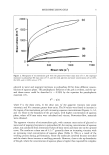
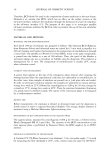
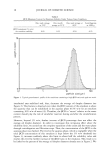
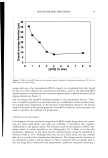
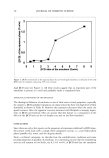
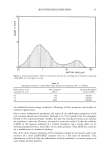
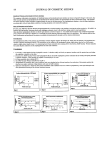
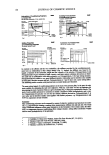
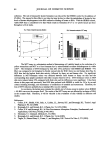
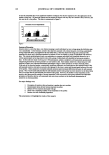
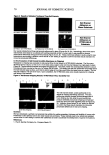
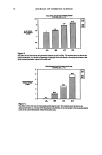
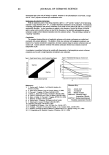
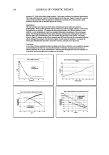
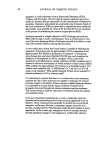
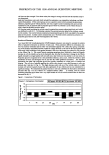
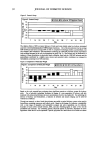
66 JOURNAL OF COSMETIC SCIENCE It must be noted that there were significant numbers of subjects who did not respond at all to the application of the probes to their face. Of particular interest arc the number of subjects who say tbey have sensitive skin, however, did not react at all to the probes. This data is summarized in Figure 3. lOO 75 25 o Figure Percent of non-responders 54 ? 11 BP LA Chlor Sensitive ßNon-Sensitive I 1. Perception of sensitive skin and reaction to probes does not correlate. 2. Questionnaire items did not forecast reactions to probes. 3. Balsam of Peru reactions decreased with age 4. There was a surprising number of non-respondcrs to the probes 5. Results were not climatically dependent This presentation will highlight the results of this research. Our major findings were: Summary/Discussion Sensitive skin is a term that has a very distinct meaning to each individual, but over a large group the definition may vary considerably. In the literature, sensitive skin has been assessed with a facial sting test, involving a potentially strong irritant like lactic acid applied to the naso-labial fold. It has been shown that sting tests conducted with materials like lactic acid, chloroform/methanol or balsam of Peru can identify a group of individuals with sensitive skin. The current epidemiological study was undertaken to compare individuals who classified themselves on a written questionnaire as having sensitive skin with a group of individuals self-classified as having non-sensitive skin. In this multi-site study involving over 1000 participants, subjects completed a self-assessment questionnaire categorizing themselves as having sensitive or non-sensitive skin. Each subject underwent a facial sting test with solutions of lactic acid, chloroform/methanol and halsam of Peru to assess sensitivity to these chemical probes. With each of the chemical probes, a statistically, significant difference was found between the responsiveness of the serf-assessed sensitive skin and non-sensitive skin groups for the time to onset and the peak grade achieved for each of the probes. Other parameters evaluated indicated statistical and directional differences between the serf-assessed groups. The overall results indicated that the self-assessed sensitive skin group was more sensitive to the facial sting tests on average than the self-assessed non-sensitive skin group. However, the number of non-responders in the sensitive skin group and the number of strong responders in the non-sensitive skin group indicates that individual perception of sensitive skin by self-assessment may not always conform to the functional determination of sensitivity to chemical probes.

PREPRINTS OF THE 1998 ANNUAL SCIENTIFIC MEETING 67 ADDITIVES FOR WATER-BASED NAIL POLISH Mitchell Schlossman, Consultant West Orange, New Jersey Introduction and Discussion: There are four components of organic coatings- Binders. Solvents, Pigments, and Additives. Each component serves a different function: Binder- Polymer (resin) and crosslinker both react to form crosslinked networks. Solvent- To provide proper application and alter certain properties. Pigment- To provide color and enhance other properties. Additives- To control application and protective properties. Depending upon the content and binder/solvent make-up, nail polishes are classified into the following three categories: (a) Solvent-Borne- Low solids (binder) content high solvent content high volatile organic content. (b) Water-Borne- Binder/crosslinker dispersed in water low volatile organic content. (c) Latex-Synthesized polymer particles are suspended in water: low volatile organic content. The main types of polymers used in water-based nail polish formulations are Aqueous Polymer Dispersions and Water Soluble Polymers. Aqueous dispersions of water insoluble polymers are frequently prepared by aqueous emulsion polymerization, in which case they are generally described as emulsion polymers or latexes. Such polymers are mainly based on water insoluble comonomers such as methyl methacrylate, butyl acrylate, styrene, vinylidene chloride these polymers have a low degree of water solubility. Water soluble comonomers such as acrylic acid, methacrylic acid, are often present at low concentrations for reason of adhesion, colloidal stability or cross- linkability. Water-soluble polymers that give genuine water solutions over a broad pH range are rarely used as binders for aqueous nail polish because of the obvious problems of water sensitivity of the final product. Even after cross-linking they are rarely .successful in eliminating this problem. Instead, they are often used as additives, chiefly thickeners, colloidal stabilizers and pigrhent dispersants. Main examples are homopolymers of ethylene oxide, acrylic acid, methacrylic acid, polyvinyl alcohol and
Purchased for the exclusive use of nofirst nolast (unknown)
From: SCC Media Library & Resource Center (library.scconline.org)