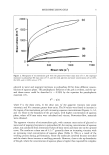
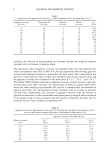
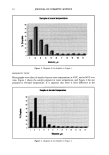
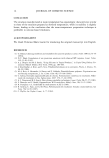
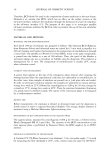
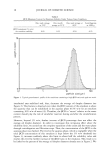
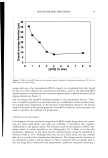
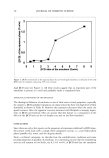
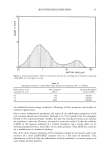
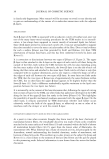
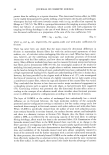
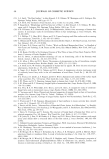
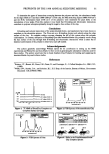
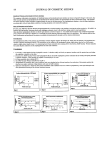
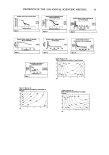
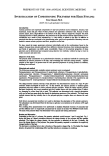
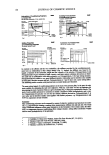
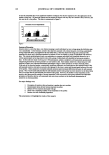
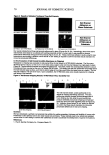
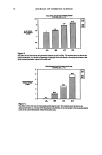
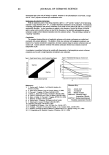
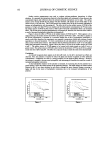
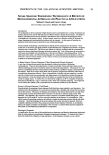
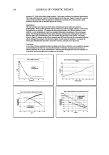
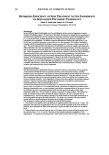
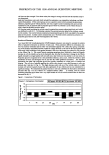
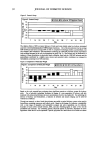
76 JOURNAL OF COSMETIC SCIENCE % OF INm•. N•. WEI•11' Figure 3. NAIL SWELUNG IN ITRA FORMULATION9 (4• HRS, 32C. n- 3 ) 3.18 STO 1.5 • • AVG 1.5 The effect of NAC end urei as nnil penetration enhencer on nail swelling. The humbert nbove the bars are the enhancement factor, i.e., the ratio of percentage weight gain in the nail sample in the testing formulation to that in the control formulation withont NAC end/or urea. ITRACONAZOLE PARTITION!NO iNTO NAIL (48 HRS. 3 C, n- 3 ! 8 1=3 STD •3.8 •VO 48.9 • ,.o ,, ß ß 8 (rag g) 3 I A E3 C• Figure 4. The effect of NAC end urea on in•.onamle paffitionin• into nail. The numbers above the bets are the enhancement lictor, i.e., the ratio of the itraconazole concentration in the nail sample in the testing formulation to that in the control formulation without NAC and/or urea.

PREPRINTS OF THE 1998 ANNUAL SCIENTIFIC MEETING 77 MOLECULAR MECHANISM IN THE CUTANEOUS INFLAMMATORY RESPONSE Daniel N. Sauder University of Toronto, Toronto, Ontario, Canada Our knowledge of basic biology and immunobiology have expanded exponentially over the last decade. This is particularly true with our understanding of inflammatory and immune reactions in the skin. It is now evident that epidermal and derreal cells play a pivotal role in immune and inflammatory reactions. Epidermal keratinoeytes participate in these reactions by synthesizing and secreting pro-inflammatory mediators and cytokines that activate the cascade of events leading to inflammation. While intimately regulated, this system can be altered by a number of external applied substances as well as environmental agents such as ultraviolet light. Ultraviolet light has a profound effect on the normal immune ftmction, particularly such as resident cells in the skin such as Langerhans cells and keratinoeytes. Being the outermost barrier of the human body, the skin is the first to encounter substances from the environment. Once exposed to these agents, an intricate series of biochemical mechanisms is initiated to deal with the exogenous materials. Multiple cell types, inflammatory mediators and cytokines are involved in the regulation of this cutaneous response. This process involves activation of the initial target cell, namely the keratinocyte as well as immune cells, antigen- presenting cells, Langerhans cells and dendritic cells. Recent development in pharmacologic interventions directed to the skin have relied on
Purchased for the exclusive use of nofirst nolast (unknown)
From: SCC Media Library & Resource Center (library.scconline.org)