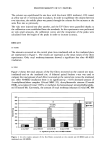
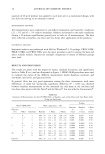
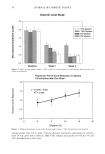
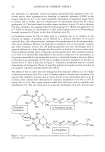
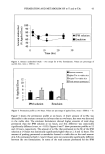
56 JOURNAL OF COSMETIC SCIENCE polymer drawdown film on the white section of the 3B opacity chart to that on the black section. Coefficient of friction. The coefficient of friction for polymer over polymer was measured on an Instrumentors slip/peel tester (SP-101A) under a 250-gram load per the procedure described in ASTM D1894. A film of 2.5" by 2.5" was cut from the Leneta chart and taped onto the sled. The remaining film on the same Leneta chart was taped on the platform. The horizontal sliding speed was set at 6"/rain, and all measurements were taken at controlled temperature and humidity. The frictional force was recorded as the platform traveled to the left. The measurements were repeated three times for each polymer, and the standard deviation was less than 0.005. Microscopic examination. The surfaces of the drawdown films were examined in a Hitachi S-570 scanning electron microscope (SEM) using an accelerating voltage of 15 KV after depositing a thin Au/Pd conductive coating. Both topographic and phase images were collected on a Digital Instruments D-3000 Nanoscope Ilia AFM in a tapping mode using a 100 pm silicone cantilever tip operating at -245 kHz. RESULTS AND DISCUSSION GLOSS Gloss depends not only on the material properties but also on process variables. A number of factors, such as index of refraction, viscosity, thickness, and film drying environment (i.e., temperature and humidity), can affect gloss. The thickness of dried films and the film-drying environment have to be carefully controlled. In this study, the wet-film thickness was controlled by the gap of the drawdown applicator while the dry-film thickness was determined by the solution concentration. Diminution of gloss arises primarily from surface imperfection and roughness. This causes light to be reflected at angles slightly offset from the specular angle. It has been found that the detection of minor imperfections is more sensitive at low incidence angles. The polyquaternium-10 samples all formed glossy films, with their 60 ø gloss readings higher than 70. Therefore, it is more appropriate to compare the 20 ø readings for such high-gloss films. Figure 1 shows the 20 ø gloss readings of cationic polymer films air-dried in the con- trolled temperature and humidity lab. It was noted that the gloss is not dependent on the molecular weight or cationic substitution of polyquaternium-10. The four polyquaternium-10 films all gave gloss values higher than 45, confirming shiny, glossy surfaces from the visual inspection. In contrast to smooth, shiny polyquaternium-10 films, guar (H/H) formed a hard, grainy film. A low-gloss reading of 12 was obtained on the guar films as a result of the roughness. Guar (L/H), a hydroxypropyl guar hydroxypropyl trimonium chloride, formed a shinier and more transparent film than guar (H/H). However, the result on guar (L/H) only represents approximately half the gloss of polyquaternium-10 films. The 3B Leneta chart control substrate as supplied is sealed with a high-gloss coating as shown by the data in Figure 1. A higher gloss value of cationic polymer film indicates that the polymer enhances the shine of the substrate. To the contrary, a low-gloss

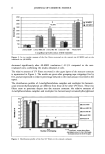
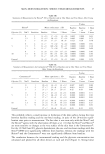
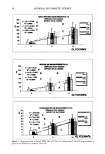
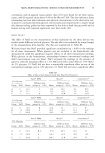
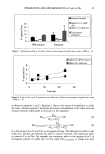
CATIONIC POLYMERS 5 7 60 50 40 10 0 PQ10 PQ10 PQ10 PQ10 Guar Guar (L/H) (M/H)(M/M)(M/L) (H/H) (L/H) Figure 1. 20 ø gloss of polyquarternium-10 and cationic guar films. control polymer film dulls the substrate. The fact that polyquaternium-10 samples have a higher gloss than the control surface means that these polymers improve the gloss of the Leneta surface. Gloss values of both cationic guar films are significantly lower than that of the control surface, suggesting that cationic guar materials dull the substrate chosen in this study. Figure 2 compares the gloss readings of 1.0% coacervate gels with those of polymer films. The gloss of a coacervate gel is lower than that of the corresponding neat polymer. This result strongly suggests that the cationic polymer is responsible for shine, and the incorporation of SDS decreases gloss. The gloss reduction is probably due to the non- homogeneity of the binary system. Gloss is a function of surface smoothness and the refractive index of the material. The lower gloss of coacervate films may result from increased surface roughness or decreased refractive index. Because the coacervate gels are slightly surfactant-deficient (Table II), there is a distribution of unbound SDS and free polymer throughout the film. The non-uniform distribution can negatively contribute to surface roughness, thus decreasing the gloss. Streaming potential experiments have demonstrated a positive zeta potential of hair in the presence of polymer and surfactant (15,16). Thus, the slight positive charge of the coacervate gel may more realistically represent what actually deposits and remains on hair. The polyquaternium-10 coacervates also produced a higher gloss than the cationic guar coacervates. As in the neat polymer films, the guar (H/H) coacervate presented the least shine among all cationic materials. An important conclusion emerges from Figure 2 that polyquaternium-10 provides better gloss than the cationic guars whether the polymer deposits as neat polymer or in the coacervate form. A higher gloss value indicates a higher surface quality of deposited polyquaternium-10 films. The gloss results of cat-
Purchased for the exclusive use of nofirst nolast (unknown)
From: SCC Media Library & Resource Center (library.scconline.org)