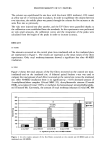
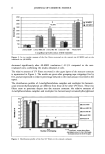
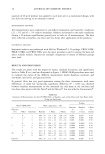
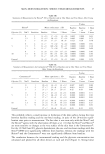
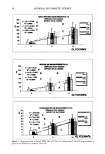
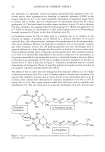
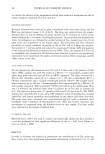
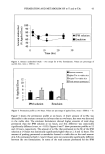
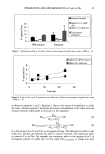
6 JOURNAL OF COSMETIC SCIENCE 450 400 350 3OO ß •- 250 • 200 •50 •00 50 0 -42'30% __ , _ -- Uvinu1539T UvinulMBC95 UvinulMC80 Uvasorb HEB Tinosorb M $ :significant (p0,05)versus 0 MED irradiation [] 0 MED [] 40 MED Figure 2. In vivo results: amount of the five filters recovered on the control site (0 MED) and on the irradiated site (40 MED). decreased significantly after 40-MED irradiation (-42.3% compared to the non- irradiated site), confirming the results obtained in vitro. The relative amount of UV filters recovered in the upper layers of the stratum corneum is represented in Figure 3. The results are given after grouping tape strippings five by five, and are expressed in relative percentage (related to the total amount recovered in the tapes). The distribution profiles of 4-methylbenzilidene camphor and methylen bis benzotri- azoyl tetramethylbutylphenol are different from those of the other UV filters. These two filters seem to penetrate deeper into the stratum corneum: the relative amounts of 4-methylbenzilidene camphor and methylen bis benzotriazoyl tetramethylbutylphenol 90 80 70 60 50 40 30 20 10 0 1-5 • ...... ,:...,.....'...%,.:i :::::!:::::i:::ii:: • ..... .: 55555 ?--':'-:"-':g• i::::i:::::::!? , ....... ....... ..= 6-10 Number of stripping El Uvinu1539T BUvinul MBC 95 rlUvinul MC 80 IUvasorb HEB -E3Tinosorb M 11-18 significant versus others filters -decreased amount in the 5 first tapes, -increased amount in the 6-10 tapes Figure 3. Distribution profile of the five UV filters in the stratum corneum.

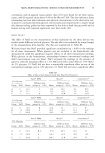
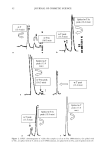
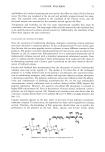
PHOTOSTABILITY OF UV FILTERS 7 are significantly lower than the ones of the other filters in the five first tapes and significantly higher in strippings six through ten. DISCUSSION Chemical sunscreen agents are generally aromatic compounds that protect the skin from UV light by absorbing incident photons. This absorption can lead to irreversible or reversible photochemical reactions. In the first case, the filters are transformed in pho- toproducts that are usually not absorbing UV. In the second case, the molecules isom- erize. This latter reaction leads to a stationary equilibrium. The UV absorption is stabilized when this equilibrium is reached and the system stays efficient against UV radiation. Assessment of the photostability of sunscreen agents is a major concern for the deter- mination of the efficacy of a sunscreen (1), especially when irreversible photochemical reaction has occurred. Indeed, if the UV filters contained in a sunscreen are degraded by UV light, they become inefficient and the protection decreases (decreased SPF). Several publications describe the photochemical behaviour of UV filters after UV irra- diation (1). Most are in vitro methods, such as those described by Vanquerp et al. (5) and Schwarzenbach and Bertschi (6), who worked on sunscreen diluted in organic solvents. With the present in vivo method combining tape stripping with HPLC, the UVB filter 4-methylbenzilidene camphor was found photostable with 4% degradation after a 40- MED exposure, confirming the 4.4% obtained in vitro (results not shown) and suggest- ing that this filter remained efficient throughout the exposure. Concerning octyl me- thoxycinnamate, a loss of 42.3% was found with the in vivo technique (41.1% with the in vitro one). Therefore, it can be concluded that octyl methoxycinnamate is not stable under sunlight. In 1988 Deftandre and Lang (7) assessed the photostability of sunscreen agents by using quartz plates and a solar simulator. They performed a kinetic study based on spectrometric assessments, evaluating the evolution of different UV filters' absorption upon time exposure. This technique allowed them to differentiate reversible photoreactions from irreversible ones. With photo-unstable products they induced a constant decrease of the absorption spectrum with time exposure. Conversely, in the case of photoisomerizable compounds, they observed a degradation of the absorption at the beginning of the exposure followed by stabilization. Octyl methoxycinnamate and 4-methylbenzilidene camphor, two UVB filters tested in the present study, had this latter behavior, and the authors concluded that these filters were photostable. Using HPLC allowed the detection of photoproducts (appearance of new peaks) that could have been formed during the exposure. Indeed, a new peak appears on the chromatograph next to the peak of octyl methoxycinnamate, and another one (not very high) next to the peak of 4-methylbenzilidene camphor. These new peaks are probably the isomers of octyl methoxycinnamate and of 4-methylbenzilidene camphor. These results were already observed by Marginean Lazar et al. (8), who also work on UV-filter photostability with in vivo methods using the stripping method and a quantitative analysis of filters by high-performance liquid chromatography (HPLC). Several other studies have reported 4-methylbenzilidene camphor (9,10) and octyl methoxycinnamate (11) isomerization under UV light. Beck et al. (9) detected and separated the E •-• Z isomers of 4-meth- ylbenzilidene camphor using spectrophotometry, nuclear magnetic resonance (NMR),
Purchased for the exclusive use of nofirst nolast (unknown)
From: SCC Media Library & Resource Center (library.scconline.org)