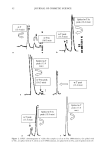
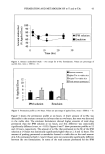
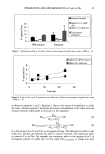
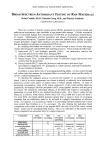
2000 ANNUAL SCIENTIFIC MEETING 77 DOES RETINOL DECOMPOSE IN COSMETIC PRODUCTS? Retinol's Stability and Decomposition Pathways Asira Ostrovskaya, Peter A. Landa, Anthony D. Rosalia, MaryAnn McKeever, Tom Mammone and Daniel Maes Estee Lauder Inc., Research and Development, 125 Pinelawn Road, Melville, NY 11747 Introduction: Retinol is well known to support cell growth promotion, maintenance and differentiation of epithelial tissues. To deliver these and other benefits to the skin, retinol is currently used in cosmetic formulations and products. However, Retinol is also known to be unstable and, therefore, remains of great concern to the cosmetic industry. The decomposition pathways of the retinoids in general have been previously postulated and investigated mostly by HPLC with UV/Vis Spectroscopy (1-4). In our studies, we examined specific conditions at which retinol degrades, and subsequently identified and confirmed the products of retinol's decomposition by LC-MS. In order to stabilize retinol in cosmetic products, we also investigated the kinetics and decomposition pathways of retinol 'as is' and in various cosmetic formulations. We then correlated the conditions of retinol's degradation to the decomposition pathways and by-products. This allowed us to attain an overall model for retinol's degradation and to help develop conditions to improve its stability. Methods: The stability of retinol and kinetics of its degradation in solutions and in products were investigated using High Performance Liquid Chromatography (HPLC). Retinol raw materials and formulations were stored at temperatures of 0øC, 37øC, 45øC, and under UV light. The inethod employs a Whatman ODS-2 column with a mobile phase of 0.5% ammonium acetate in methanol / water (85/15). The flow rate used was 1 mL/min with UV/VIS detection at 325nm. The decomposition products of retinol were determined, identified and substantiated using Liquid Chromatography - Mass Spectroscopy (LC-MS). The method conditions were similar to the above, but flow was reduced to 0.SmL/min with an additional post-column methanol flow of 0.1mL/min. A mobile phase gradient, to 100% methanol, was also employed between 50 and 120minutes. The MS collected masses 50-650 AMU and data were subsequently analyzed and interpreted. Results and Discussions: The kinetics of retinol's degradation were studied in solutions exposed to elevated temperatures and UV light. ß When stored at 0øC, solutions of Retinol raw material were found to be stable for two months. Samples stored at 37øC and 45øC were stable up to 1 month's time but showed increased degradation between 1 and 2 months. ß However, samples that were stored under light, showed a rapid degradation in 1 day and degraded completely by I month. Therefore, the rate of retinol's decomposition pathway hy exposure to light is much more rapid than exposure to elevated temperatures (refer to graph below). 120 100 •o 60 i "0øC • 1•]37øC 40 j iZ]45oC 20 J I 3 U V Light 0 1 7 ß Degradation of Retinol Raw Material Exposed to Various Conditions In addition, retinol's rate of degradation in solutions varied as a function of concentration: higher concentrations of retinol degraded more rapidly.

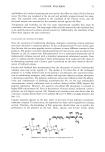
78 JOURNAL OF COSMETIC SCIENCE The HPLC chromatograms of samples exposed either to heat or light showed different chromatographic profiles and as retinol degraded, additional peaks appeared. These peaks had different UV spectra but, could not be positively identified by HPLC. By using LC-MS, we were able to determine and identify these peaks and confirmed retinol's degradation pathways. ß The MS data indicates that all trans Retinol by itself seems to degrade in one of two ways: either by degradation through oxidation or by conversion to cis stereoisomers. ß Exposure to UV light causes the isomerization of all trans retinol into cis forms. Mass and UV spectra obtained for these peaks were identical to retinol's. indicating that they can only be stereoisomers of retinol. ß When Retinol is exposed to heat it degrades to form oxidation products and epoxides. The Mass spectra of the major peaks have a large 287 fragment and a molecular mass of 302. These peaks were identified as epoxides of retinol and most probably form across the double bond within the nng structure (5,6 epoxy retinol). Since the 5,6 epoxy retinol and other degradation compounds are reactive, they may rearrange, combine with other molecules, isomerize or fnrther degrade. These degradation products may include epoxides at the other double bonds, epoxides of the cis isomers, esters and dimers. ß Further analysis of other peaks revealed that they contained a molecular mass of 268 and are most probably anhydroretinol. This anhydroretinol is found in the literature (5) and is believed to occur when retinol is dehydrated. In order to study retinol's degradation in products, this approach was applied to different types of cosmetic formulations. ß We were able to observe that certain cosmetic formulations prevent retinol from degradation. We did not detect the decomposition products •n these stable formulations even at elevated temperatures (37øC and 45øC) and we found retinol to be intact during elevated temperature stability. ß In all the retinol solutions and costaeric formulations tested, neither Retinoic Acid nor Retinal (aidehyde) was found. ß Finally, we observed a correlation bet•veen retinol's degradation and a decline in biological activity. This indicates that the by-products of retinol's decomposition are not bioactive and the desired effects can only be obtained when retinol is present. Conclusions: We confirmed that retinol degrades more rapidly under UV light exposure than under heat exposure. Additionally, light-exposed retinol is no longer detected in a matter of weeks. Analytical experiments via LC/MS successfully confirmed that retinol degrades by two different pathways: exposure to UV light which leads to cis isomers and exposure to elevated temperatures which leads to various oxidation products. Retinol also does not readily degrade to retinoic acid or retinaldehyde in any of the samples studied. The stability of Retinol and its rate of degradation depends on the concentration of retinol used, the cosmetic matrix, and the storage conditions. 1. Tsunoda, T. et al ,.L Soc. Cosmetic Chemtsts, 46, 191-198, 1995. 2 Manan, F. et. al..d. MtcronutrtentAnal)st& 7, 349-155, 1990. 3. Yosh•da, K., et. al., d. A. O. C S., 76, 195-200, 1999. 4. Su, Q. et al., d. of Chromatography B, 729, 191-198, 1999. 5. Tsukida, K. et. al., Internat. d. Vit. Nutr Res., 41, 158-170, 1971.
Purchased for the exclusive use of nofirst nolast (unknown)
From: SCC Media Library & Resource Center (library.scconline.org)