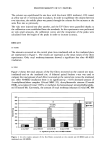
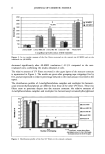
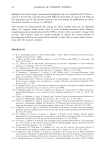
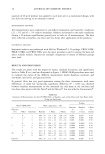
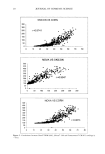
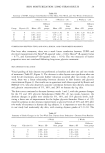
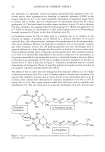
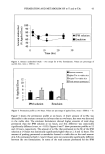
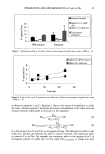
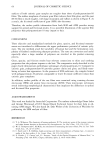
2000 ANNUAL SCIENTIFIC MEETING 85 one showing the highest degree of self-preservation, in particular at the earlier time-point as well as skin penetration enhancement (approx. 8-fold). When sorting the activities from high to low for all three activities, the resemblance between the three sequences was remarkable. -9 6 3 -3 Microbial Challenge Test 10 20 SLR u• [ ß Penetratior • Irritancy Figure I: Skin Penetration Enhancement Ratio's (SPER) and Skin Irritation Scores (SI$• as a function of the Self Preservation capacity of a personal care ingredient, expressed as the Sigma log cfu reduction (SLR). Eleven personal care ingredients were tested for all three activities. This suggests that one mechanism of action may be the basis for all three effects. Increased fluidisation of the skin lipids surrounding the comeocytes is known to cause skin penetration enhancement. But as a consequence, the irritancy of such a chemical will also increase. Anti-microbial activity can be achieved in a variety of ways, one of which is that the preservative penetrates and disturbs the cell membrane of the micro-organism that- apart from its phospholipids - is made up of many of the same components that make up the material surrounding the human comeocyte. If perturbation of biological membranes is the common factor in all three effects, this poses the question whether it is at all possible to achieve non-irritating skin penetration enhancers or preservatives. For practical reasons, many more ingredients were investigated for skin irritancy and self-preservation than for skin penetration enhancement. Figure 2 illustrates the relationship between skin irritation and self- preservation of the other tested ingredients. It clearly shows that ingredients do exist that are scoring well on their self preservation properties but are devoid of inducing skin irritancy. 10 20 30 SLR -tO * ,( One can only conclude that these personal care ingredients must be working by another general mechanism of action of preservatives: denaturing cellular proteins. This includes interactions with receptors on the micro- organism's cell membrane (resulting in secondary messengers release), interaction with enzymes expressed on the outer cell membrane or interruption ofphagocytosis. It can therefore be concluded that despite the similarities between the various mechanisms, the existence of non-irritating skin penetration enhancers and preservatives is made possible by a multitude of mechanisms of actions. Figure 2: Skin irritancy expressed as SIS' as a function of the self preservation capability of personal care ingredients, expressed as the SLR. Cosmetic scientists should be aware of these different mechanisms to avoid undesired activities of their materials. In particular experiments that investigate the effect of putative preservatives on the phase transition temperature of (bio)membranes should be useful in this respect. For skin penetration enhancement, the situation is more difficult as one also enhances the penetration of other formulation components that would otherwise be considered to be obnoxious.

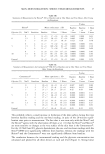
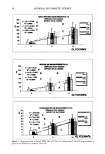
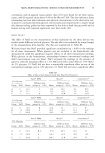
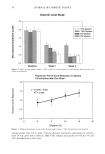
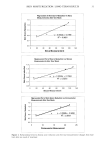
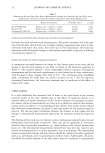
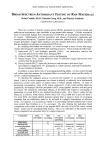
86 JOURNAL OF COSMETIC SCIENCE ABILITY OF CREAMS TO REDUCE ERYTHEMA, STRATUM CORNEUM BARRIER DAMAGE• AND SUBJECTIVE ITCHING Eric Abrutyn, Anthony Sireion, Ph.D. and Zoe Draclos, Ph.D. The Andrew Jergens Company, Cincinnath Ohio 45214 ABSTRACT Hand eczema, especially due to exposure to detergents and water, has a prevalence that exceeds 5% in the general population. Frequently, signs include erythema, scaling, and subjective itching. The integrity of the stratum corneum barrier may also be compromised. A systematic approach in developing creams to address these problems, is to use clinical models to assess the ability of creams to: ß Alleviate pre-existing dryness and irritation ß Prevent the return of dryness and irritation then validate using a clinical home-use study. The In Vivo model systems used to assess the efficacy of the lotions were: In Vivo Model Systems Measurable Benefit Regression test Alleviate dryness Pre-irritate the skin, then patch non occlusively with test product Hand wash and Reqression tests Pretreatment with lotion then occlusive patching with surfactant Reduced redness and TEWL rate Prevent induction of dryness Prevent induction of irritation In vivo laboratory results show that moisturizers containing high levels of glycerin are effective at alleviating dryness and irritation, as well as preventing their occurrence. The predictiveness of the clinical laboratory models was validated through a 14-day home usage clinical evaluation. Three (3) experimental approaches were used to develop effective skincare treatment products: 1. Alleviate irritation and dryness once it has occured. 2. Prevent irritation and dryness from reappearing by building strong skin barrier. 3. Develop products that have consumer pleasing aesthetics to ensure compliance.
Purchased for the exclusive use of nofirst nolast (unknown)
From: SCC Media Library & Resource Center (library.scconline.org)