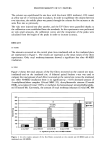
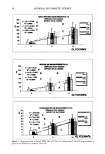
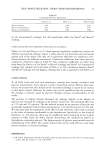
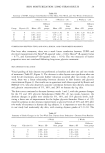
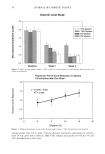
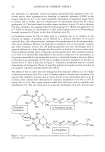
2000 ANNUAL SCIENTIFIC MEETING 83 We were able to show that diffusion into the skin is negligible with an unmodified peptide, whereas the palmitoylated peptide enters epidermis and dermis to significant extents and thus is able to deliver biological activity at physiological concentrations (2). Preliminary data on the Pal-KTrKS peptide confirm this observation. Collagen IV and GAG synthesis in vitro Pal-KTTKS was tested on normal human fibroblasts plated from a 63 year old skin biopsy. We were looking specifically for stimulation of the synthesis of Collagen IV, a major protein involved in the maintenance of epidermal-dermal junction. At the concentration levels of 104M/I (i.e. 2 to 4 ppm of peptide,) we observe a 2 to 4 fold increase in collagen IV synthesis as measured by immunoblot techniques. A 50% increase in GAG synthesis is also observed. In both studies, TGF 1• was used as positive control. Ex vivo Collagen I •nthesis In an ex vivo model (full thickness human skin biopsies of a 43 year old patient), strong collagen I synthesis is obtained at concentration levels of 2 and 4 ppm of Pal-KTTKS peptide in solution. Vitamin C at 1000 ppm increases collagen synthesis in this protocol by 42%, TGFg at 10 ppb by 33% 4 ppm of the Pal-KTTKS peptide achieve 117% increase in 3H-Proline incorporation, thus more than double the Vitarmn C activi,ty at 250 fold lower concentration. In vlvo studies Following thorough investigation of the non-toxicity and cutaneous tolerance of the palmitoylated peptide, three in vivo studies were carried out: ß one vehicle controlled half face study on 25 panellists, ß one half face study comparing the peptide containing cream against a 5% vitamin C cream on 10 panellists (both studies over 2, 4 and 6 months), and ß one 2 and 4 month study on 20 panellists comparing two identical base creams, one containing 3ppm of Pal-KTTKS peptide, the other containing 700 ppm of retinol. Parameters investigated by image analysis of skin replicas were wrinkle profile (depth, length, density, volume .... ), skin thickness and density as measured by 2D and 3D ultrasound echography, visual dermatological scoring and self assessment. All three studies concur: the peptide has skin tissue repair activi• of high potency. The first study showed that the vehicle cream (although moistunsing) showed no wrinkle reduction at all over 2, 4 or 6 months. Surprisingly, the commercial cream with Vitamin C did not improve the investigated skin parameters in any significant manner. The pepfide containing cream, however, leads to spectacular skin profile improvement in this time span that is evident from the study of skin replicas and from visual assessment by the dermatologist, the panellists and close-up photography. lIT 2 months mT 4 months Wrinkle Parameters Depth Length Volume Surface The third study, conducted a year later on a different panel and with a different vehicle cream confirmed the initial results. The peptide containing cream (3 ppm of Pal-KTTKS) leads to significant wrinkle reduction (figure 1), skin thickening and densification - in agreement with the expected collagen and GAG synthesis - over a period of 2 and 4 months. Visually detectable effects were observed by the attending dermatologist. The high dose of 700 ppm of retinol showed similar effects after 4 months and served as a positive control, as its effect on wrinkles is well known Conclusion Clearly the concept of using natural, biologically active peptides for cosmetic applications is a viable strategy leading to perceivable skin benefits. Specifically chosen peptides, acting as messenger molecules in normal biological processes such as growth and tissue repair are safe, natural, innovative molecules well adapted to the role of cosmetic active ingredients and thus an emerging alternative to unstable or (sometimes) overrated vitamins. [1] A. Sim6on et al. in: Current Topics in Pathology, Vol. 93, 95-101(1999), A. Desmouli•re et B. Tuchweber, eds. (•Springer Berlin Heidelberg [2] K. Linther and O. Peschard, Int. J. Cosrn. $ci. 22, 207-218, (2000) [3] P. Mondon et al. in preparation

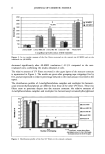
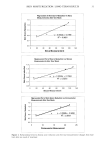
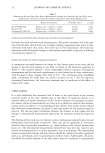
84 JOURNAL OF COSMETIC SCIENCE LOOKING BEYOND THE MECHANISMS OF SKIN IRRITANCY• SKIN PENETRATION ENHANCEMENT AND PRESERVATION Johann W. Wiechers, Ph.D. Uniqema, Gouda, The Netherlands Personal care ingredients were subjected to three different types of cosmetic testing in three unrelated studies. These included: (i) a three-application patch test to measure their potential skin irritancy (ii) a microbial challenge test to assess their potential to enhance the self-preservation of formulations (iii) an in-vitro skin penetration assay to assess their capability to e•xhance skin penetration The three-application patch test: This test was performed on 30 healthy subjects of either sex aged 18 to 65 years. Most products were applied as 25% solutions in isopropyl myristate that was also included in the test series as the neat ingredient. Some ingredients that are typically used at lower concentrations in cosmetic formulations, were tested at those concentrations. Products (400[tl) were tested on the upper left arm by applying them under occlusion on l cm x lcm Webril © squares that were fixed to strips of occlusive Blenderm © tape. They were left in place for 24 hours after which the patches were removed. At two days after the initial product application, the degree of irritancy was assessed using the well-known 4-point scale. Following this evaluation, patches were re-applied in such a way that exactly the same product was re-applied onto the same site of skin. In this way, patches were applied for three periods of 24 hours at day 1,3 and 5, whereas irritancy assessments took place on days 3, 5 and 8. Each test run contained two control samples: distilled water as the negative control to check for irritancy against the patch system and 0.3% sodium lauryl sulphate (SLS) to check for the elicitation of an erythematous reaction. The self-preservation assay: The microbial challenge test was performed using Escherichia coli, Staphylococcus aureus, Pseudomonas aeruginosa, Candida albicans, and Aspergillus niger based on the methods of the USPXXIII, BP 1995 and EP 1994. Of each ingredient, an 'adequately' and an 'inadequately' preserved cream were prepared containing an inert oil at a level of 35%. As the same emulsifier was used throughout the whole study, the experimental samples differed only from the 'inadequate' control samples only in the composition of the 35% oil phase. Twenty millilitres aliquots were challenged with approximately 107 colony forming units/ml (cfu/ml) and thoroughly mixed. They were stored at 25 øC in the dark and the viable count of surviving micro-organisms determined at 24 hours and 2 weeks after inoculation for the bacteria and after 1 and 4 weeks for the fungi and yeast using the microtitre plate Minimum Probable Number (MPN) method. Results were expressed as the log reductions obtained for each strain at the first and second sampling points. The 'adequate' and inadequate' samples were run to check the methodology. The first time-point yielded more discriminative results and was therefore used for further analysis. The in-vitro skin penetration assay: This assay used human abdominal skin that was dermatomed to a thickness of 300-500[tm. The diffusion system consisted of Teflon © flow-through cells. As these are very laborious experiments, only eleven personal care ingredients were tested, based on their performance in the previous two tests. In short, the flux of 5-fluorouracil at steady state was determined t¾om a 40-hour skin penetration experiment. After removal of non-penetrated material, each cell was treated with 250gl of the personal care product under investigation for 6 hours, during which time the completion of the wash-out was monitored by collecting the receptor solution every 2 hours. Thereafter, the ingredient was removed and the 5-fluorouracil solution re-applied for another 40 hours. The enhancement ratio (ER) was expressed as the permeability coefficient of 5-fluorouracil penetration after treatment divided by that before treatment. Water was run as a control ingredient to compensate for the increase in skin permeability due to gradual deterioration of the skin, whereas the skin penetration enhancer Azone, 10% in propylene glycol, was run as a positive control to check for the occurrence of skin penetration enhancement. Data calculation: The activity of the personal care ingredients towards the various activities was expressed as follows: In the three-application patch test, the mean skin irritation score (SIS) on day 8 was taken. The microbial activity was expressed as the Sigma Log Reduction (SLR), which is the combined log reduction in cfu at the first measuring point of all strains. In the in-vitro skin penetration test, the Skin Penetration Enhancement Ratio (SPER) was calculated by subtracting the ER of the control from that of the measured ER for the personal care ingredient. Results of chemicals tested for all activities are shown in Figure 1. Results: By far the majority of the tested ingredients had no efficacy whatsoever in any of the three mentioned activities and those showing some activity had only minor activity. Glyceryl monocaprylate/ caprate, tested at 25% w/w demonstrated, was not only the relatively most irritating product, but also the
Purchased for the exclusive use of nofirst nolast (unknown)
From: SCC Media Library & Resource Center (library.scconline.org)