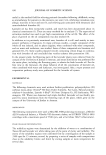
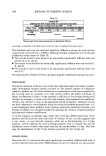
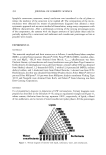
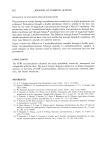
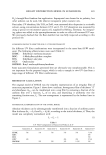
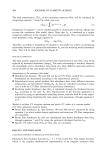
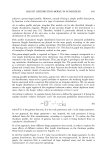
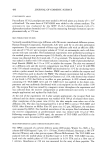
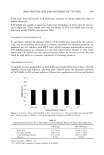
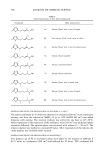
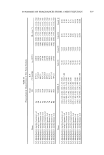
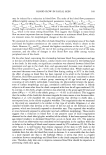
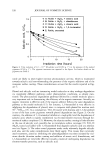
448 JOURNAL OF COSMETIC SCIENCE Table VI Analysis #6 Utilizing the first 4 days of the 21 consecutive days data Significant Comparisons (p0.05) N=41 Mean Total [ B [ F Reaction Score [• 0.5i ] LSD Grouping • •Means joined by the same grouping are not significantly different. ANALYSIS 6 (UTILIZING THE FIRST FOUR DAYS OF THE 21-CONSECUTIVE-DAYS DATA) The Friedman rank sum test indicated significant differences among the total reaction scores for the test articles (p = 0.0001). Followup multiple comparison tests of the data yielded the results shown in Table VI: © Test articles B and F were found to be statistically significantly different from test articles A, C, E, and D. © Test article A was found to be statistically significantly different from test articles C, E, and D. © Test articles C and E were found to be statistically significantly different from test article D. The means shown in Tables I-VI were calculated using the transformed total reaction scores. DISCUSSION Testing for cutaneous irritation is one of the most important aspects of cosmetic product safety development because irritancy accounts for the greatest number of complaints related to product use. Yet little verification or improvement of the most accepted test has occurred since its inception (1-3). Our results confirm the earlier conclusion of Berger and Bowman (1) that a 14-day exposure is sufficient to discriminate among mild irritants. In retrospect, it is not at all clear why Lanman, who originated the cumulative irritancy test, selected 21 days as the appropriate period of exposure. Lanman's test has not been subjected to critical analysis using the statistical methods presented here. It is a sad commentary that a model as severe, onerous, and costly should have become, over decades of reflexive use, the gold standard for assessing the irritancy of topical products and chemicals without modification. A 14-day exposure, on alternate days, rather than every day, differentiated most of the products and did yield the same rank order of irritancy. In fact, our data suggests that a ten-, seven-, or even four-day exposure, while not as discriminating as a 14-day exposure, will be sufficient for most screening purposes. This is certainly the case for moderately severe irritants where peak reactions are reached before 14 days. Our data urge the abandonment of the 21-day Lanman procedure for the 14-day test. CONCLUSIONS Data from the 21-consecutive-day patch application successfully differentiated each of six test materials from each other. Differentiation of each test material was also possible

HUMAN CUMULATIVE IRRITATION TEST 449 utilizing data from the first 14 days of the 21-consecutive-day patch data. Analyses performed using data from the first four days, the first seven days, and the first ten days of the 21-consecutive-day patch data and the data obtained from the every-other-day patching, while not differentiating each and every test material, did rank order the test materials in the same manner. The ability of data obtained through the 14-consecutive- day patch design to differentiate each test material as successfully as data obtained from the 21-consecutive-day patch design confirms the earlier results of Berger and Bowman (1). The conclusions arrived at in this study reconfirm that a reduction in the expense, time, and trauma associated with conducting cumulative irritation studies is possible and is strongly recommended for future studies. REFERENCES (1) R.S. Berger and J.P. Bowman, A reappraisal of the 21-day cumulative irritation test in man, J. ToxicoL Cut. Ocular ToxicoL, 1, 109-115 (1982). (2) B. M. Lanman, E. B. Elvers, and C.J. Howard, The role of human patch testing in a product devel- opment program, Joint Conference on Cosmetic Sciences, The Toilet Goods Association (currently The Cosmetic, Toiletry and Fragrance Association), Washington, DC, April 21-23, 1968. (3) L. Philips, M. Steinberg, H. I. Maibach, and W. A. Akers, Comparison of rabbit and human skin response to certain irritants, Toxicol. AppL PharmacoL, 21, 369 (1972). (4) W.J. Conover, Practica/Nonparametric Statistics (John Wiley & Sons, New York, 1980), pp. 299-305.
Purchased for the exclusive use of nofirst nolast (unknown)
From: SCC Media Library & Resource Center (library.scconline.org)