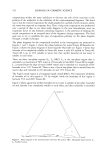
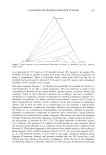
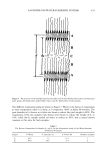
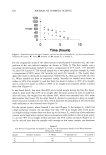
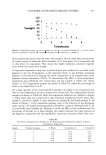
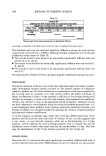
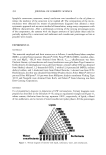
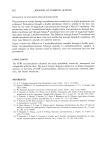
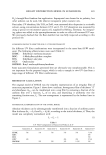
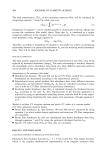
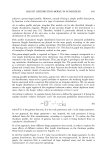
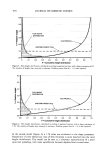
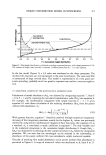
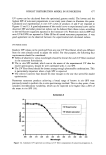
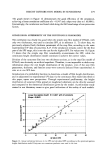
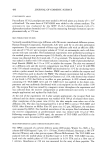
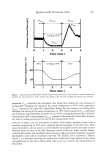
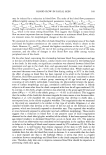
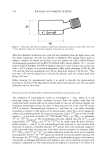
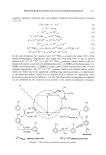
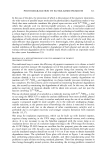
HEIGHT DISTRIBUTION MODEL IN SUNSCREENS 471 5,0 • FILM HEIGHT It/ DISTRIBUTION FILM PROFILE 2,0 .................................................................. 1,0 0,0 0,1 0,2 0,3 0,4 0,õ 0,6 0,7 0,8 0,9 1,0 F = ½u•ul,,ti•e height distribution In the last model (Figure 5), a 3.0 value was attributed to the shape parameter. The thickest film fractions are overrepresented in the total distribution. The sunscreen film is constituted of large covered areas. This model is representative of a very good sun- screen spreading, probably much too good to represent any realistic sunscreen applica- tion. UV ABSORPTION ACHIEVED BY THE MATHEMATICAL SUNSCREEN FILMS Calculation of model absorbance (As•x was achieved by integrating equation 7, from F = 0 to F = 1, and by reporting the calculated transmittance value (Ts)x into equation 8. For example, the mathematical integration with simple function h = 2 x F gives equation 10, with direct calculation of the resulting absorbance (As)x from the parent uniform film absorbance Ax: (As)x=_log( 1--10-2xAx '• 2 -• •47 • 1-•0 ] (10) With gamma function, equation 7 should be resolved through numerical integration. Accuracy of the integration procedure, mainly for the highest Ax values, was previously checked by using known mathematical integrals of basic functions, like equation 10, as a standard. Ax is considered a simple coefficient in equation 7. The only variable used in the numerical integration is the cumulative height distribution F. Graph (As)x = f(Ax) was obtained by attributing discrete numerical values to Ax before the integration procedure. We can note that the wavelength can be omitted in the relationship, as absorbance of the parent uniform film was considered a simple numerical variable. The plot of resulting film model absorbance versus parent uniform film absorbance is presented in Figure 6. A range of numerical values was attributed to A, from 0 to 25.

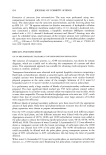
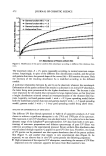
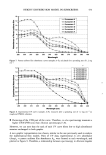
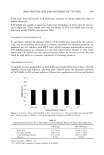
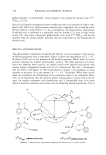
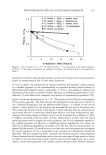
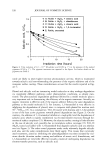
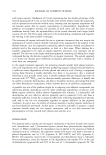
472 JOURNAL OF COSMETIC SCIENCE 4,5 ß 4 • 3,5 o .m 3 -• 2.,5 o E o• 2 '5 1,5 iz 1 II 0.5 + Gamma function with c = 3.0 -e- Gamma function with c = 1.5 t ........................................ j_______._____.. -m- Gamma function with c = 0.5 5 10 15 20 25 A = Absorbance of Parent uniform film Figure 6. Modification of the parent uniform film absorbance according to different film thickness func- tions. The maximum value, A = 25, seems reasonable according to normal sunscreen compo- sitions. Surprisingly, in spite of the different film distributions studied, and the prism and gamma functions, the general shape of the curves (As) = f(A) remains the same. Only the intensity of the resulting absorbance As is modified according to the different models. A nonlinear relationship between As and A can be observed, whatever the wavelength. Deformation of the parent uniform film results in a decrease in its initial UV absorbance, the latter being more pronounced for the higher absorbance values. The decrease is also more important for the models that correspond to large depleted areas, so that they have a height distribution oriented toward an overrepresentation of the thinnest film frac- tions. Logically, we found gamma model 1 with c = 0.5 (poor spreading model) below both the mathematical prism function and gamma model 2 with c = 1.5 (good spreading model), gamma model 3 with c = 3 (very good spreading model) being above them. ANALYSIS OF EXPERIMENTAL IN VITRO DATA The different UV filter blends (presented in Table I) of sunscreen products A-F were chosen to achieve a significant absorption in the UVA and UVB part of the spectrum. The maximum in vitro UV absorbance was also kept below 1.8 in order to be in the linear dynamic range of the Labsphere © spectrophotometer. UV data from both in vitro spec- troscopy of sunscreen preparations and dilution spectroscopy of pure UV filters was collected, according to the experimental protocol. Parent uniform film absorbance data was calculated through equation 4, applied to pure UV filter data. Therefore, two kinds of UV spectra can be presented: one that reports absorbance data of the parent uniform film (Figure 7), and another that reports in vitro experimental data (Figure 8). As expected, we can observe that in vitro UV curves present the following properties: ß High attenuation of the expected UV absorption, considering the amount of UV filter deposited onto the substrate apparent deviation from Beer-Lambert's law.
Purchased for the exclusive use of nofirst nolast (unknown)
From: SCC Media Library & Resource Center (library.scconline.org)