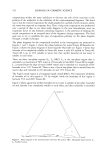
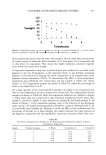
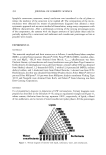
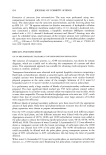
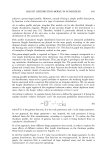
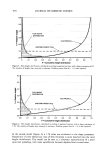
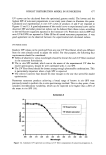
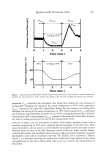
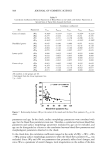
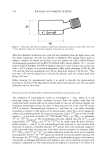
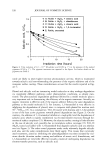
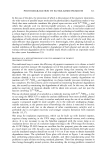
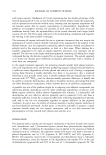
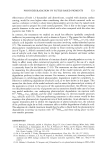
HEIGHT DISTRIBUTION MODEL IN SUNSCREENS 467 where KMn ) is the absortivity of the number n UV filter at wavelength X and a(n ) is its percentage in the sunscreen preparation. UV filter absortivities were determined once and for all, accoMing to the experimental protocol previously described. THEORETICAL CONTINUOUS MODELS OF IRREGULAR SUNSCREEN FILMS AccoMing to the simplifications previously defined, a more complex model of sunscreen film could be calculated, with an infinite number of individual thickness fractions. Therefore, previous equations 2 and 3 should be transformed into integrals. First, a "film thickness" function, h(v), should be proposed: h = function (F) (5) Variable F is the cumulative fraction of the unit area, which is a number between 0 and 1. Therefore, variable F can also be interpreted as being the cumulative height distri- bution of the sunscreen film. Function h is the local film thickness, calculated as a fraction of the uniform parent film thickness, accoMing to the variable F. A basic example of a continuous sunscreen distribution is the simple function h = a x F, which achieves a prism-shaped profile (presented in Figure 2). As previously, the model re- ß quires keeping the quantity of applied sunscreen constant: f •h(F) x dF = 1 (6) Resolution of equation 6 should be done to calculate function parameters. With the simple thickness function h = a x F, integration of 6 results in a = 2. HEIGHT DISTRIBUTION OF PRiS'M ........................................................ FUNCTION PRISM FUNCTION PROF ................ ................ .......... 7 .... 0,0 0,1 0,2 0,3 0,4 0,5 0,6 0,7 0,8 0,9 1,0 F = Cumulative height distribution Figure 2. Height distribution, according to the prism function. The number of height class intervals is arbitrary. Uniform parent film (h = 1) is also reported.

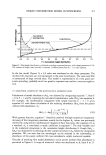
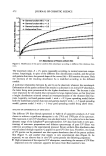
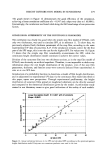
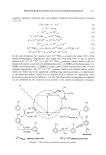
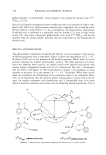
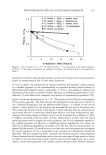
468 JOURNAL OF COSMETIC SCIENCE The total transmittance, (Ts)x, of the continuous sunscreen film, will be calculated by integrating equation 7 along the whole unit area: (Ts)x = 10 -h(v)XAx x dF (7) Integration of equation 7 can be mathematically or numerically achieved, taking into account the continuous film model choice. Note that Ax is considered as a simple numerical coefficient in the integral. The total transmittance (Ts)x is transformed into total absorbance (As)x through equation 8: (As)x = -log (Ts)x (8) Therefore, according to integration of equation 7, the model can achieve an interesting relationship between the parent film absorbance Ax and the resulting model absorbance (As)x. This will be shown further (see Figure 6). PRACTICAL APPROACH The same graphic approach can be realized with experimental in vitro data, (As)x being replaced by measured absorbance (Aexp)x. The same relationship is involved, whatever the wavelength, and so absorbance data (Aexp, A)x, from different sunscreen products, can be.plotted on the same graph (see Figures 9 and 10). Optimization of the continuous film model ß Absorbtivities between 290 and 400 nm for all UV filters suitable for a sunscreen formulation are determined accoMing to the experimental protocol. ß Experimental versus parent uniform film absorbance data, from different sunscreen preparations, are first plotted: (Aexp)x/Ax. Ax data are calculated according to equa- tion 4 with the UV filter absorbtivities previously determined. ß Resulting model absorbance data (As)x is calculated through the thickness function h(v), according to the same Ax data. Optimization of the function parameters is achieved by using an optimization modeling system, with the final fit to the experi- mental data being determined by least-square error assessment, through equations 5 to 8. Method to calculate UV absorption spectrum and specific UV indices of a sunscreen product (UV filter composition should be known) ß Parent film absorbance Ax data between 290 and 400 nm are calculated by using equation 4, in which surface density application and sunscreen UV filter composition are considered. ß Parent film absorbance Ax data are transformed into model absorbance data (As)x through equations 7 and 8 by using the optimized thickness function h(v ). ß Specific UV indices from (Ts)x or (As)x data are calculated. RESULTS AND DISCUSSION CONTINUOUS MODELS OF IRREGULAR SUNSCREEN FILMS Elementary film thickness function h F = 2 x F was tested first. This simple function, which is the simplest mathematical representation of an irregular sunscreen film,
Purchased for the exclusive use of nofirst nolast (unknown)
From: SCC Media Library & Resource Center (library.scconline.org)