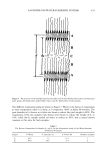
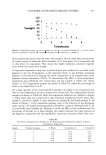
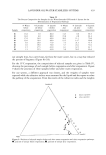
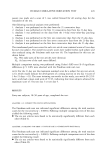
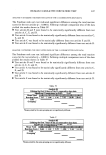
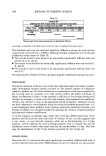
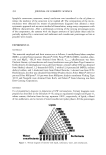
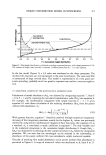
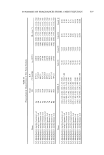
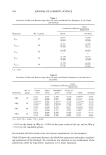
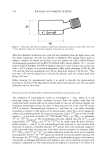
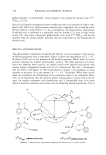
HEIGHT DISTRIBUTION MODEL IN SUNSCREENS 465 K x) through Beer-Lambert law application. Isopropanol was chosen for its polarity, but other solvents can be used, like relative transparent polar cosmetic oils. Particulate UV absorbers, like TiO 2 or ZnO, were measured after dispersion in a suitable solvent, using concentrations between 0.5 % and 3.5 %. UV absorption was measured by using a special ten-micrometer quartz cell, supplied by Hellma, Germany. An integrat- ing sphere was added to the spectrophotometer in order to collect all scattered UV rays. We previously checked that the Beer-Lambert law was fully respected according to this protocol (8). SUNSCREEN PRODUCTS SELECTED FOR IN VITRO SPECTROSCOPY Six different UV filter combinations were incorporated in the same base (O/W emul- sion). The following abbreviations were used (Table I): EHMC: Ethylhexyl methoxycinnamate MBC: 4-Methylbenzylidene camphor EHS: Ethylhexyl salicylate OXY: Oxybenzone BMDBM: Butyl methoxydibenzoylmethane Some sunscreen formulations presented here are obviously very nonphotostable. This is not important for the proposed target, which is only to sample in vitro UV data from a large range of different UV filter combinations. METHOD OF CALCULATION The original model of O'Neill was the simplest representation of an irregular film of sunscreen preparation. Figure 1 shows how a uniform, homogenous film of thickness "d" and absorbance A(x ), can be transformed into a step film by removing a fraction of the uniform film over a fraction, f•, of its area, and depositing it uniformly over the remaining fraction area, f2. The new arrangement is represented by the broken lines in Figure 1. MATHEMATICAL SIMPLIFICATION OF THE O'NEILL MODEL Absolute thickness can be advantageously transformed into a fraction of uniform parent film thickness (h• = d•/d and h 2 = d2/d), according to the initial thickness, d. Thus, the model was completely normalized, with: f•+f2= 1 (1) Table I UV Filter Composition of Sunscreen Products A-F Sunscreen A Sunscreen B Sunscreen C Sunscreen D Sunscreen E Sunscreen F EHMC 7% 7% 7% 7% 7% 7.5% MBC 4% EHS 5% OXY 3% 4% 2% 2.5% BMDBM 2% 5% 3% 1.5% 2%

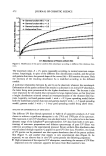
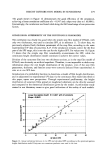
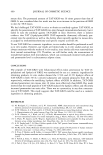
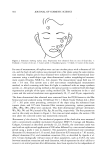
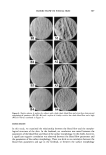
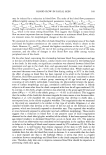
466 JOURNAL OF COSMETIC SCIENCE I-- I I I I t I i T• = I• / I 0 T 2 = 12 / I 0 Figure 1. Cross section of a step film geometry from O'Neill. Parent uniform film thickness: d Absorbance: A(x ) with f•, f2, fractions of unit area --0, and, as the model should preserve the quantity of applied sunscreen preparation, f• x h• + f2 x h 2 = 1 (2) with h•, h2, fractions of uniform parent film thickness --0. At each wavelength, the transmittance of a single homogeneous fraction, f• or f2, can be deduced through Beer-Lambert law application. The total transmittance of the basic O'Neill model is then given by the sum of the transmissions through the two fractions: (Ts)x: fl x 10 -h•xAX + f2 x 10 -hzxAX (3) Ax is the parent uniform film absorbance, and h•, h 2 are the residual thickness fractions of both deformed film sections, with unit area f• and f2. Absorbance Ax can be consid- ered as a simple variable (in the relationship with Tsx), or can be calculated according to UV filter composition of a sunscreen product. CALCULATION OF PARENT i•ILM ABSORBANCE Ax The irregular film model was originated from the deformation of a homogeneous film of sunscreen material of a certain thickness (d) and a horizontal extension, fl + f2, both data being normalized at 1 in our analysis. Although being only a speculative idea, such a perfect homogeneous film remains a useful tool, allowing one to establish a relationship between UV absorption of diluted UV filters on one hand and the final UV absorption of a sunscreen spread on an irregular substrate on the other. Absorbance Ax of this theoretical regular parent film can be calculated according to the Beer-Lambert law applied to the amount of UV filters deposited onto the unit area. If a formulation contains p UV filters, numbered from n = 1 to n = p, the parent uniform film absorbance resulting from a surface density application of w (in mg cm -2) is: n=2 Ax = w/100 x ZKK(n) x •/(r/) (4)
Purchased for the exclusive use of nofirst nolast (unknown)
From: SCC Media Library & Resource Center (library.scconline.org)