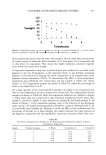
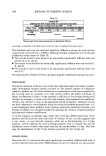
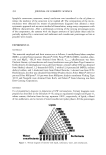
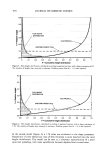
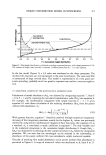
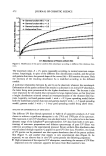
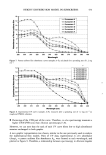
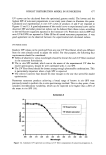
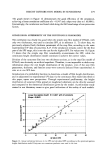
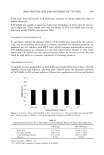
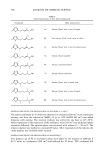
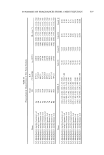
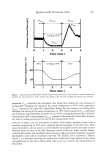
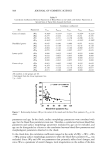
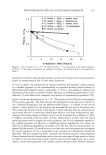
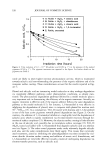
OW MICROEMULSION IN SUNSCREENS 461 of the microemulsions prepared with 3.0% of 4-methylbenzylidene camphor: G: octylmethoxycinnamate 2.72%, cyclomethicone 1.22%, ethanol 0.57%, C•2_•5 al- kylbenzoate 2.29%, decylpolyglucose 11.73%, 1,2-hexanediol 8.25%, allantoin 0.09%, water 66.66%. CHARACTERIZATION OF MICROEMULSIONS Microscopy and laser light scattering. Optical microscopy, either simple or equipped with polarized light, did not show crystals or droplets in microemulsions immediately after preparation or over time at 37% relative humidity. With laser light scattering, micro- emulsions with 4-methylbenzylidene camphor and octylmethoxycinnamate showed mean diameters, respectively, of 15 nm (polydispersity index of 0.171) and 17 nm (polydispersity index of 0.183 nm). The diameters of the microemulsion containing 4-methylbenzilidene camphor, diluted 1:3, and of the microemulsion with octylmethoxy- cinnamate, diluted 1:1.66, increased slightly. These dilutions gave transparent systems, which were still microemulsions or swollen micelies and produced systems containing less diol and emulsifier than the concentrated ones, and they can be expected to be better tolerated by the skin. Rheology studies. The rheograms of the microemulsions containing 4-methylbenzilidene camphor (E) and octylmethoxycinnamate (F), immediately after preparation and equili- brated at 37% relative humidity for 30, 60, and 90 minutes, denoted a Newtonian flux, as also shown by the trend of viscosity over time at increasing shear rates. The viscosity of the systems was independent of evaporation and denoted the absence of crystal formation or flocculation. After 90 minutes equilibration at 37% relative humidity, the microemulsions had a weight loss of 5%, and no crystals or phase separation or droplets could be seen under microscopic observation. Water resistance. Collagen felts coated with the microemulsions containing sunscreen agents did not release oil or particles of product over twelve to twenty-four hours. Such felts are usually employed to reconstitute the skin, and were therefore used as a substrate comparable to the skin. Diffusion of 4-methyl benzylidene camphor through double membrane 0.12 = 0.1 .• o 0.08 ß = '•' 0.06 • 0 o.o4 .•. 0.02 0 50 1 O0 150 200 minutes Figure 9. Diffusion of methylbenzylidene camphor from microemulsion through hydrophilic/lipophilic membrane.

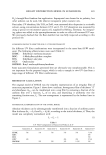
462 JOURNAL OF COSMETIC SCIENCE PERMEATION OF SUNSCREENS FROM MICROEMULSIONS The permeation studies through membranes were satisfactory, as slight permeation was evidenced. Permeation through a double membrane, which is similar to the skin, was lower by one order of magnitude than permeation through a Silastic © membrane. The permeation rates of 4-methylbenzilidene camphor from microemulsions through lipo- philic membrane and through Silastic © membrane were one order of magnitude higher than those through a double membrane. The diffusion through Silastic © membrane and double membrane did not have a lag time, unlike that through lipophilic membrane. All these runs followed a pseudo zero-ordered kinetics. Figure 9 shows the diffusion of 4-methylbenzilidene camphor through a double mem- brane. Octylmethoxycinnamate behaved similarly to methylbenzilidene camphor. A good tolerance of these systems could be deduced, since the sunscreens had very low permeation. CONCLUSIONS The O/W microemulsions obtained are easily spreadable, nonsticky, waterproof, and compatible with the skin. The use of ternary diagrams allowed us to obtain transparent systems, in the form of O/W microemulsions, vehicles for sunscreens, menthol, allan- toin, and stearyl methicone. REFERENCES (1) A.V. Calogero, Sunscreen final monograph, Cosmet. Toiletr., 114, 5-72 (1999). (2) Quires UNIPRO n ø 29: Coordinated test of the low (articles and annexes), n ø 713, 11 October 1986 (April 1999). (3) W. Jhonlock, Sunscreen interaction in formulations, Cosmet. Toiletr., 114, 75-82 (1999). (4) F. Comelies, J. Caelles, J. L. Parres, and J. Sanches, Transparent gels: Study of their formation and assimilation of active ingredients through phase diagrams, Int. J. Cosmet. Sci., 14, 183-195 (1992). (5) F. Comelies, V. Magias, J. Sanches, J. L. Parra, F. Balanguer, and C. Pelejero, Application of ternary systems in specific cosmetic formulations, Int. J. Cosmet. Sci., 11, 5-19 (1989). (6) F. Puisieux and M. Sillar, Galenica 5: Agent de surface et Emulsions (les systemes dispers6s), Technique et Documentation (Lavoisier), 1983. (7) G. Marti Mestres, J.P. Lagit, H. Mallois, and G. Fernendez, Solubilizations des tiltres UV dans des melanges ternaires de phase apolaires: Optimization par utilization de reseaux centrEes, Int. J. Cosmet. Sci., 20, 19-30 (1998). (8) T. Moaddel, T. Huang, and S. E. Friberg, Sunscreen microemulsions, J. Dispers. Sci. Technol., 17, 459-475 (1998). (9) F. Comelies, J. L. Parra, C. Ferrando, J. Caelles, and J. Sanches, Transparent formulations of a lipo- soluble sunscreen agent in aqueous medium, Int. J. Cosmet. Sci., 12, 185-196 (1990).
Purchased for the exclusive use of nofirst nolast (unknown)
From: SCC Media Library & Resource Center (library.scconline.org)