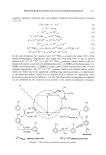
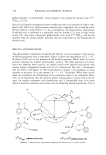
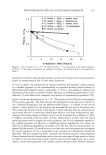
526 JOURNAL OF COSMETIC SCIENCE on the torsional stress of whole hair was also evaluated. The contribution of the cuticle on the torsional stress of whole hair was found to be as much as 60%. Since the cuticle contributes to a large part of torsional stress as well as bending stress, it is assumed that the cuticle plays an important role in the thick or stiff feeling of hair. The ratio of Young's modulus versus the modulus of rigidity of hair was calculated to be 11.94, which is larger than that of uniform material. Since the cuticle and cortex can play the part of composite material, it is quite reasonable that the larger value of the ratio of Young's modulus versus the modulus of rigidity of hair was found in hair, which is a complicated structure combining both cuticle and cortex. Properties of New Acrylate - Silicone Graft Copolymer as a Dispersing Agent Kenji Takarada, Toshio Nomura, Toshihiro Ishimori, Ichiro Oho Research and Development Division, KOSE Corporation, Silicone- Electronics Materials Research Center, Shin- Etsu Chemical Co., Ltd. A new dispersing agent was synthesized by introducing a vinyl pyrrolidone group into the acrylateJdimethicone acrylate copolymer. The graft copolymer formed a layer throughout surface of each particle. As a dispersing agent, it showed unique and excellent properties when it is used to disperse inorganic free powder in volatile silicone oil. Introducing the adsorption segment improved its dispersion ability to be stable not only in silicone oil but also in mixtures containing ester oil or UV absorbent. Since the application film containing the new graft copolymer was superior in water resistance, it was found that it maintains a UV protection effect and high transparency through waterproof examination. Accordingly, a sunscreen product that has both high transparency and water resistance can be successfully formulated using the new graft copolymer as a dispersing agent. Relationship between Facial Configuration and Age- Induced Changes in Facial Morphology Kazuhiro Yamazaki, Mieko Yamamoto, Sakura Inoue, Kazuko Ogino, Kimiko Irisawa POLA Laboratories, POLA Chemical Industries, Inc., POLACosmetics, Inc. Wrinkles and sagging are types of age - induced changes in facial morphology, and these changes become more noticeable with age. Due to individual differences, age - induced changes progress at different rates, and thus the degree of wrinkles and sagging varies among people in the same age group. Various factors contribute to individual differences, and we hypothesized that facial configuration, namely facial contour and the size and location of the eyes, nose and mouth, is one such factor. Therefore, the present study investigated whether or not individual differences in age- induced changes in facial morphology, such as wrinkles and sagging, could be explained in terms of individual differences in facial configuration. The facial configurations of subjects were determined by examining photographs taken of subjects approximately 20 years of age, and then wrinkles and sagging were assessed for the same people after they had aged several decades. The results of a discriminate analysis showed that laugh lines are more noticeable for people with large eyes, thus suggesting that age - induced changes in facial morphology are related to certain aspects of facial configuration, namely to certain facial dimensions. Usefulness of Skin Hydration for Skin Care and Development of Cosmetics Yoshiyuki Kohno Material Science Research Center, Shiseido Research Center Maintaining suitable skin hydration is very effective for preventing dry skin. This is the most basic and important function of cosmetics. Various types of emollients and humectants are used in skincare products to prevent water loss from the skin and retain water. In the stratum comeum, the importance of natural moisturizing factor (NMF), sebum and intercellular lipids has been demonstrated. From a dermatological approach, we have already reconstructed an analogy of the skin hydration mechanism. For dry skin, we have demonstrated the usefulness of "moisture balance " that is, to supply equivalent substances of water, humectants and oils in cosmetics. It is also important to develop cosmetics from a pharmacological approach. This is very helpful in the development of new, more effective components for cosmetics. Recently we have clarified the important role of epidermal protease activity in dry skin. Inhibition of its activity accelerates intercellular repair response. We have developed trans- 4- aminomethyl cyclohexane carboxylic acid (t - AMCHA) , which has an anti - plasmin (a epidermal protease) activity and can cure dry skin. This article reviews the skin hydration mechanism and development of skin care cosmetics utilizing dermatological and pharmacological approaches.
Purchased for the exclusive use of nofirst nolast (unknown)
From: SCC Media Library & Resource Center (library.scconline.org)