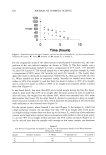
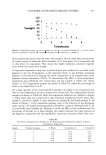
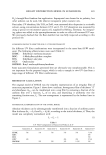
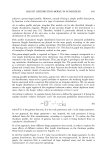
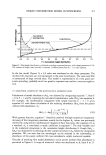
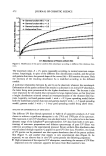
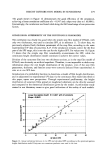
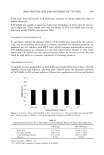
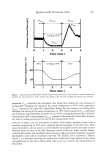
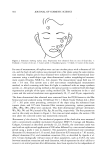
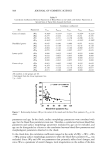
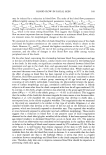
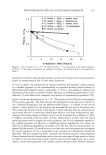
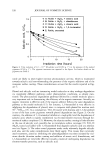
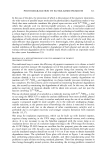
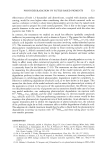
HEIGHT DISTRIBUTION MODEL IN SUNSCREENS 479 The graph shown in Figure 14 demonstrates the good efficiency of the simulation, achieving a linear correlation coefficient of r = 0.947 and a slope very close to 1 (0.9841). Interestingly, the correlation was found valid along the full broad range of sun protection factors. CONCLUSION: SUPERIORITY OF THE CONTINUOUS FILM MODEL The correlation was clearly less good when the simple step film model of O'Neill, with only two thicknesses, was used to simulate SPF, as in reference 11. To show that, we previously adjusted both thickness parameters of the step film, accoMing to the same experimental UV data of sunscreens A-F. If the simulation remains correct for the first part of the SPF range, this is not the case for the highest SPF. For values over 30, Figure 15 shows that the simple step film considerably overestimates the SPF, while the continuous height distribution model continues to achieve the correct values. Division of the sunscreen film into two thickness sections, as in the step film model of O'Neill, was obviously an artificial expedient. Therefore, it was impossible to deduce any information about the real height distribution of the product, even if the step film parameters, thickness, and fraction areas were correctly deduced from experimental in vitro or in vivo SPF data. Introduction of a probability function to determine a model of film height distribution, and its adjustment to experimental UV data via the continuous film model described in this paper, opens new perspectives. Through experimental profilometry, the height distribution of sunscreen films spread on roughened substrates can be directly assessed and compared to the theoretical distribution given by the model. A preliminary study started in our laboratory seems to give good indications of the reality of such models. 60 Linear Correlation Coeff. R = 0,947 with 41 products Slope = 0,9841 50 ....................................................................... -•'- '"t .... -'- 30 ............................... -•- ........... ,• ............................ 0 0 10 20 30 40 50 60 IN VIVO SPF Figure 14. Linear correlation between in vivo SPF and calculated SPF, according to the optimized gamma height distribution model. Forty-one new sunscreen products were used in the test.

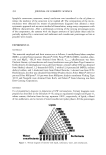
480 JOURNAL OF COSMETIC SCIENCE 120 i ß Calculated SPF with Gamma height distribution model 1øø 11 ii O Calculated SPF with the step film model -- Linear Correlation 80 -' 40. ß ß ß ß ß 10 20 30 40 50 60 20. 0 0 In Vivo SPF Figure 15. Comparison between in vivo SPF and calculated SPF through the two different models: the continuous film model (black triangles) and the simple step film model (empty squares). ACKNOWLEDGMENTS The authors thank Christine Bezot (Lab. Physique Mati•re Condens,e, UNSA-CNRS UMR 6622, Parc Valrose, Nice, France) and Olivier Brack (K.S.I.C. Statistique Indus- trielle, Neuvitec 95, 1 mail Gay Lussac, Neuville, 95015 Cergy Pontoise Cedex), for their excellent support in preparing this publication. REFERENCES (1) (2) (3) (4) (5) (6) (7) (8) (9) (10) (11) S. Brown and B. L. Diffey, The effect of applied thickness on sunscreen protection: In vivo and in vitro studies, Photothem. PhotobioL, 44, 509-513 (1986). A.D. Pearse and C. Edwards, Human stratum corneum as a substrate for in vitro sunscreen testing, Int. J, Cosmet. Sci., 15, 234-244 (1993). K.A. Kelley, P.A. Laskar, G. D. Ewing, S. H. Dromgoole, J. L. Lichtin, and A.A. Sakr, In vitro protection factor evaluation of sunscreen products, J. Sot: Cosmet. Chem., 44, 139-151 (1993). M. Stockdale, Sun protection factors, Int. J. Cosmet. Sci., 7, 235-246 (1985). R. M. Sayre, In vitro sunscreen testing: The vehicle effect, Cosmet. Toiletr., 107, 105-112 (1992). J. O'Neill, Effect of film irregularities on sunscreen efficacy, J. Pharm. Sci., 7, 888-891 (1983). L. Ferrero, A.M. Orcet, and L. Zastrow, Spectroscopy of sunscreen products: How to explain the special shape of UV curves obtained from in vitro SPF tests, Proceedings of the 20th IFSCC Congress, Cannes, France, Poster P028 (1998). L. Ferrero, M. Pissavini, and L. Zastrow, Spectroscopy of sunscreen products: How to use basic absorbance data, European UV Sun Filters Con•brence, Paris, November 3-4, 1999, pp. 52-64. B. L. Diffey and J. Robson, A new substrate to measure sunscreen protection factors throughout the ultraviolet spectrum, J. Sot: Cosmet. Chem., 40, 127-133 (1989). D. F. Tunstall, A mathematical approach for the analysis of in vitro sun protection factor measurements, J. Cosmet. Sci., 51,303-315 (2000). B. Herzog, Prediction of sun protection factors by calculation of transmissions with a calibrated step film model, J. Cosmet. Sci., 53, 11-26 (2002).
Purchased for the exclusive use of nofirst nolast (unknown)
From: SCC Media Library & Resource Center (library.scconline.org)