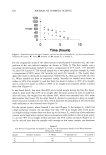
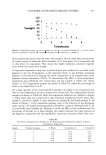
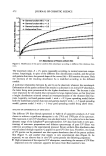
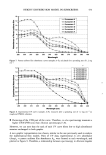
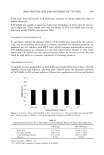
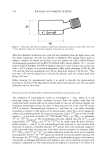
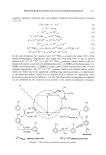
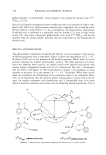
LAVENDER OIL/WATER/STABILIZER SYSTEMS 431 The liquid crystal phases were identified through visual observation of the light trans- mitted through them. A series of samples was prepared, then stored at room temperature for several days and identified by the visual observation of light transmitted through them, with the additional help of polarized microscopy. The tie lines were determined by preparing a series of samples using different ratios of the three compounds in the one-phase region close to the boundary, measuring their refractive indices by using a refractometer, and then making a calibration curve from the refractive index vs weight % of water. Another series of samples was prepared in the two-phase region, and a separation of their phases was performed by centrifugation to get two separate layers to be measured for their refractive indices. From the calibration curve of the refractive index vs weight % of water for the boundary sample, the tie lines for the two-phase region were determined. EVAPORATION The evaporation of water, lavender oil, and two samples (for each system) was studied at room temperature, and the samples were then spread on a glass slide and placed on an analytical digital balance to determine the weight lost with time. For the water/Laureth 4/lavender oil system, the evaporation path was studied for one week at room tempera- ture. A series of samples was prepared in one-phase and two-phase regions, with pure water and pure lavender oil in large-scale samples (exactly 5 g of each sample). The samples were placed in small beakers and placed in thermosrate to ensure no temperature change. The weight differences were then recorded for one week. EVAPORATION PATHWAY STUDY The instrument used was a simple design instrument that consisted of a 5-ml round- bottom flask, a small test tube (radius = 5 mm), a hot plate, and a water bath. The following method was used for evaporation pathway determination: The selected samples were prepared and placed in the small round-bottom flask, which was inserted in a hot water bath at 35øC. A small test tube, which was filled with cold water, was inserted into the flask up to the edge of the sample, and the condensing vapor was collected around the outside walls of the test tube. The residue sample was weighed to calculate the weight lost from the sample as vapor, and then the refractive indices for the collected vapor and for the residue were measured. In addition, the refractive index was measured for the calibrated samples, which were located in the boundaries of the one-phase region, to determine the structural change in the vapor and the exact structure of the vapor and the residue. This was a simple way to evaluate the evaporation pathway during evaporation for selected samples and to compare the results with the predicted ones from the phase diagrams. RESULTS AND DISCUSSION The investigation was made with four goals. The first was to compare the behavior of the phase diagram when dealing with a multicompound fragrance oil with that of a single- compound fragrance oil. The second was to compare the two surfactants and different

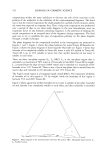
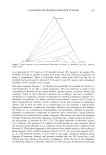
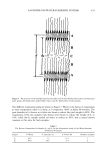
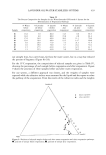
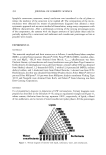
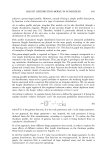
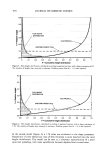
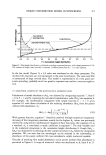
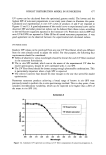
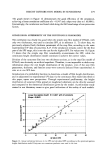
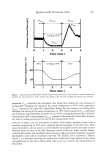
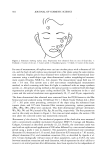
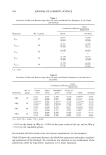
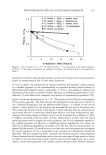
432 JOURNAL OF COSMETIC SCIENCE compositions within the same stabilizers to discover the role of the structure or the polarity of the surfactant in the solubility of the multicompound fragrance. The third was to run the control evaporation for small samples for a period of a few minutes, where the water was expected to evaporate first. Then a long-term evaporation was performed over a period of days to see what really happens in the true formulations, since an important factor in any formula containing fragrance is the potential of keeping the initial composition in an accepted ratio of the fragrance during evaporation. The final goal was to try to establish the type of evaporation pathway on the phase diagram through a simple technique. The phase diagrams for the compounds involved in the investigation are presented in Figures 1 and 2. Figure 1 shows the phase behavior for water/Tween 80/lavender oil. Figure 2 shows the phase diagram of water/Laureth 4/lavender oil. Figure 1 shows that lavender oil is completely soluble in Tween 80, water is only 9% soluble in Tween 80, Tween 80 is up to 25% soluble in water, but that neither lavender oil nor water is soluble in each other. There are three one-phase regions (L1, L2, HLC). L 2 is the one-phase region that is extended to a maximum of 28% water at 4% lavender oil and 68% Tween 80 by weight. L• is started from the edge of water (100% water) and is extended to a maximum of 6% lavender oil at 51% Tween 80. There is also a line of one-phase that is started from the water edge and extended to 6% lavender oil and 15% Tween 80. The liquid crystal region is a hexagonal liquid crystal (HLC). The maximum solubility of lavender oil in this region is 1% by weight, while the boundary of this region is between 55% and 68% Tween 80. Figure 2 shows again that neither lavender oil nor water is soluble in the other. Lavender oil and Laureth 4 are completely soluble in each other, and their solubility is extended Lavender Oil Water Tween80 Figure 1. Phase diagram of the water/lavender oil/Tween 80 system. HLC: Hexagonal liquid crystal. L•, L2: Solubility areas.
Purchased for the exclusive use of nofirst nolast (unknown)
From: SCC Media Library & Resource Center (library.scconline.org)