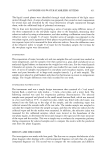
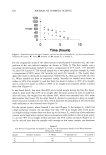
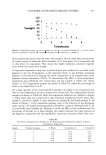
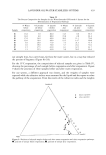
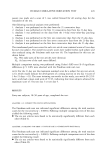
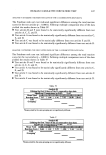
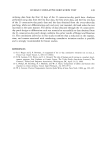
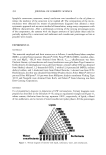
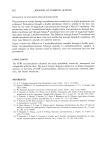
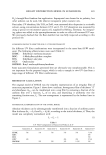
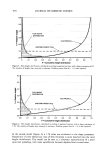
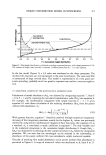
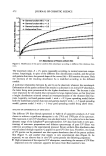
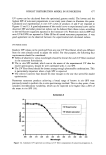
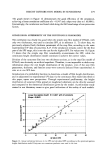
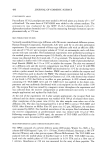
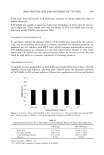
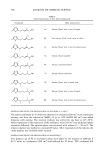
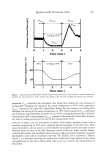
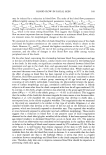
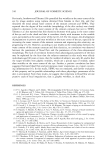
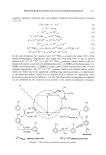
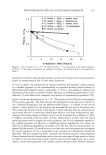
LAVENDER OIL/WATER/STABILIZER SYSTEMS 437 120 100 80 %weight 60 40 20 0 X X X X X X [] 0 2 4 6 8 Time(hours) Figure 6. Evaporation paths for water, lavender oil, and the two selected samples (S3, S4) of the water/ lavender oil/Laureth 4 system. •, water I, lavender oil ', sample S4 x, sample S 3. their compositions better than the water-rich samples. On the other hand, the presence of a high content of surfactant allows lavender oil to keep many of its compounds and to slow down its evaporation. That means that higher surfactant solutions evaporate more slowly and retain their weight. A long-term evaporation study over a period of days was conducted to see what really happens in the true formulations, as the important factor in any formula containing fragrance is the potential of keeping the initial composition in an accepted ratio of the fragrance during evaporation (20,21). To demonstrate this effect, a room-temperature evaporation was performed over several days and the Laureth 4 system was chosen (Figure 2). The composition samples are shown in Table III, where the percentage of water is increased from A to E. For a large quantity of the water/Laureth 4/lavender oil system (5 g), evaporation was done at room temperature for some samples over several days. The compositions of these samples are shown in Table III, while the evaporation behaviors are clarified in Figure 7, which shows that over a period of ten days the fastest evaporation was for water, then sample E, sample D, sample C, pure lavender oil, sample B, and finally sample A. As shown in Figure 7, if the evaporation pathway went in the direction of the decreasing water content, the weight-decreasing pattern should be: sample E, followed by D, C, B, A, and finally pure lavender oil. Keeping in mind the effect of the surfactant and the percentage of lavender oil in these samples, this relation between the vapor pressure of the fragrance compounds and the amphiphilic association structures where these corn- Table Ill The Percent Composition for Samples for the Water/Lavender Oil/Laureth 4 System at Room Temperature Evaporation Sample Number of phases % Water % Lavender oil % Laureth 4 A 1 2.0 32.5 65.5 B 1 8.0 20.0 72.0 C 1 17.0 14.0 69.0 D 2 30.0 40.0 30.0 E 2 45.0 45.0 10.0

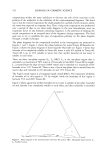
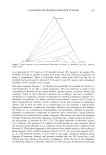
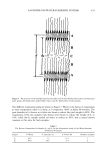
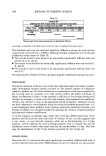
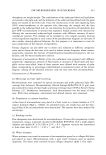
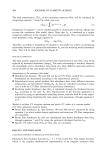
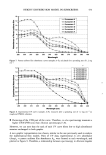
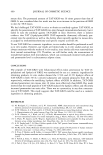
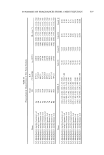
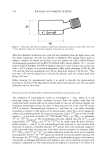
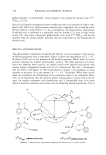
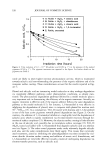
438 JOURNAL OF COSMETIC SCIENCE 120 100 80 %weight 60 40 20 0 • A A A 0 2 4 6 8 10 Time(days) Figure 7. Evaporation paths for samples with selected composition for the water/lavender oJl/Laureth 4 system during one week. ', sample E I, sample D &, sample C x, sample B *, sample A O, water +, lavender oil. pounds are located has been well established in previous works (16,19-21) (Figure 8). The unexpected result was for the pure lavender oil, where it evaporated before the low-water-content samples, where low water content enhances keeping the oil for a longer time. This means again that higher-surfactant solutions evaporate more slowly and retain their weight or both fast and slow evaporations. Finally, the results from the evaporation pathways for the selected samples (Table IV) and their evaporation paths are clarified in Figure 9. The pathways are not straight lines but curves. From previous studies (12,18) there are two expected pathways: a straight line or a curve, depending on the vapor pressure of the fragrance relative to water (Figure 3) (12). For the evaporation path of phenethyl alcohol (vapor pressure 0.11 mmHg at 25øC, Figure 8), the pathway was a straight line where water evaporated first for three reasons: the vapor pressure value of water (vapor pressure 20 mmHg at 25øC), the stability of the initial emulsion, and the density difference of the continuous phase and the disperse phase. For linalool and limenone systems, their evaporation pathways were Phenethyl Alcohol Water A B Limonene Benzaldehyde "• Laureth 4 c Figure 8. The evaporation pathways of different systems: (A) phenethyl alcohol/water/Laureth 4, (B) limonene/water/Laureth 4, and (C) benzaldehyde/water/Laureth 4. • curved pathway. --- straight-line pathway.
Purchased for the exclusive use of nofirst nolast (unknown)
From: SCC Media Library & Resource Center (library.scconline.org)