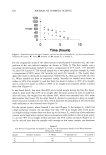
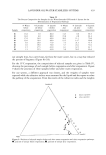
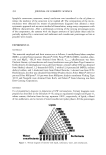
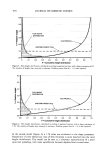
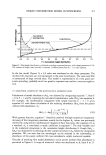
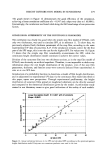
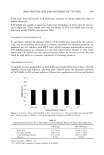
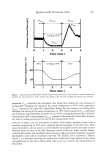
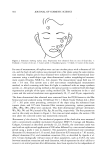
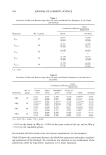
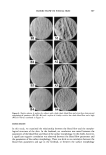
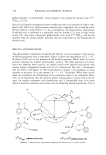
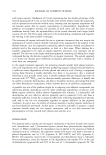
BLOOD FLOW IN FACIAL SKIN 501 Frest Finter-L Fpost-L cooling 10øG o o o 0 I 2 3 4 5 Time Imin.} 30øc cooling 10øC free m 30 o • 10 0 1 2 3 4 5 Time (min.} Figure 1. Typical chart of blood flow. The blood flow was measured for 30 seconds at a sensor temperature of 30øC, for two minutes at 10øC, and for two minutes after the low temperature setting was canceled. parameter Fmi n represents the minimum skin blood flow during the two minutes of cooling after changing the setting of the sensor temperature to 10øC (mV), parameter Finter_ L represents the mean skin blood flow during the two minutes of cooling after changing the setting of the sensor temperature to 10øC (mV), parameter Fma X represents the maximum skin blood flow between the end of the cooling period and the end of the measurement (mV), and parameter Fpost_ L represents the mean skin blood flow between the end of cooling period and the end of the measurement (mV). Collection of replicas and 3D measurement of replicas. Each subject entered a room with a constant temperature of 20øC and a constant relative humidity of 40-50% (10). After about 60 minutes, she lay down on a bed with her eyes lightly closed, and replicas were obtained from six areas of the face (forehead, corner of the eye, lower eyelids, cheeks, corner of the mouth, and nasolabial groove) using a rubber precision impression material (hydrophilic vinyl silicon impression material: GC Exafine, GC Corporation, Tokyo). Figure 2 is a schematic showing the replica sites. Collection of the replica on the cheek was performed on the lower cheek rather than at the site used for the measurement of blood flow.

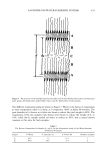
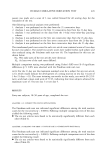
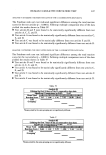
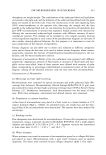
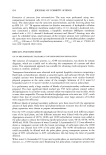
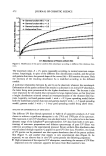
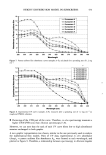
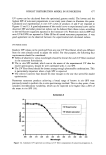
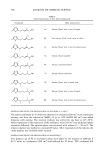
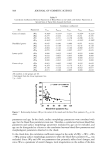
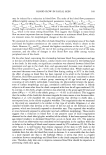
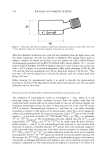
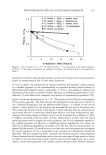
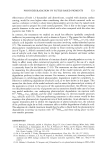
502 JOURNAL OF COSMETIC SCIENCE Figure 2. Schematic showing replica areas. Impressions were obtained from six sites of facial skin. 1: Forehead. 2: Corner of the eye. 3: Lower eyelid. 4: Nasolabial groove. 5: Cheek. 6: Corner of the mouth. For ease of measurement, all replicas were cut into circular pieces with a diameter of 1.8 cm, and the back of each replica was processed into a flat plane using the same impres- sion material. Replica pieces thus obtained were subjected to three-dimensional mea- surement using a small-object-type three-dimensional surface morphological measure- ment system (Voxelan, NKK Co., Ltd., Japan). The measurement visual field was 10 mm x 9.4 mm. This system uses a new non-contact morphological measurement method, in which scanning with laser slit light is combined with an image synthesis system, i.e., the optical cutting method as the optical system is combined with the shape regeneration principle of the space coding method (20). The resolutions in the x- and y-axes and the vertical resolution were approximately 20, 37, and 20 lnm, respectively. The three-dimensional data obtained were converted from the PC98 format to the Mac format and were analyzed using 3D Software Ver 1.3 (Rank Taylor Hobson Ltd.). After 217 x 203 point zoom processing, correction of the slope using the subtracted least squares plane, and 0.25-mm Gaussian filter waviness processing, various parameters (sWa, sWp, sWt, sWq) were calculated. This three-dimensional software determines Wa, Wp, Wt and Wq instead of Ra, Rp, Rt and Rq, respectively. The four parameters used in this study are shown in Figure 3. For cross-sectional analysis, the section 2.06 mm above the corrected screen was transversely extracted. Measurement of skin elasticity. The mechanical properties of the cheek skin were measured with a commercially available instrument (Cutometer SEM575, Courage and Khazaka, Cologne, Germany) as described previously (21,22). Briefly, the time/strain mode was used with an eight-second application of 200 mbar followed by a two-second relaxation period using a probe 2 mm in diameter. The parameters determined were immediate distention (Ue) measured at 0.15 second, final distention (Uf) measured at 7.85 seconds, delayed distention (Uv), and immediate retraction (Ur), as described by Agache eta/. (23). Certain biologically relevant ratios of these parameters, such as Ur/Uf, the ratio between immediate retraction and total distension, which represents the skin's ability to recover to its initial position after deformation, have been reported to be independent of
Purchased for the exclusive use of nofirst nolast (unknown)
From: SCC Media Library & Resource Center (library.scconline.org)