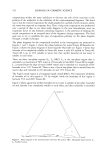
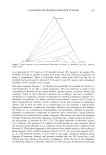
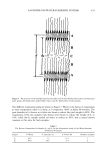
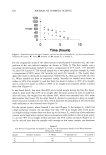
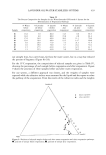
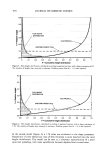
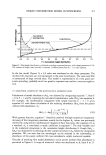
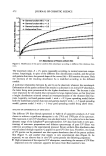
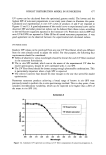
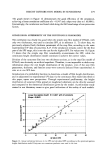
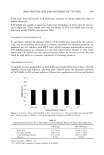
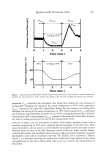
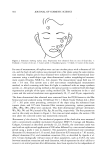
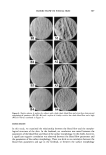
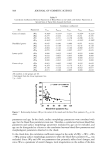
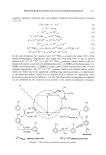
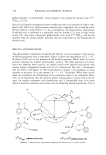
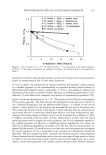
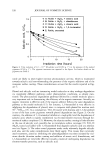
HEIGHT DISTRIBUTION MODEL IN SUNSCREENS 469 achieves a prism-shaped profile. However, instead of being a simple profile description, h v function is also characteristic of a type of sunscreen distribution. As in surface profile analysis, irregular film models can be also described through a height distribution diagram. Weight of any peculiar height in the distribution is a function of its total area (13). Therefore, variable F, previously defined as being a cumulative fraction of the unit area, is also representative of the cumulative height distribution of the sunscreen film. Film profile (cumulative height distribution function) and its associated probability function (height distribution) are plotted on the same graph, according to the same disposal already adopted in surface metrology. The film profile becomes equivalent to the bearing area curve of Abbot and Firestone (13). This kind of graph was adopted for all examples of height distribution studied in that paper. The prism-shaped profile is reported in Figure 2. This basic example corresponds to a very simple distribution where every elementary class of film thickness is equally rep- resented in the total height distribution. Thus, any height is privileged, and the result- ing cumulative distribution is a continuous straight line. The prism model can be seen as a schematic representation of a sunscreen spreading, with equilibrium between de- pleted and covered areas. However, such basic function has obviously little relevance in achieving a realistic model of sunscreen film. Therefore, function hv would be better deduced using classical statistical laws. Among possible probability functions, gamma law, which is associated with asymmetri- cal distributions, seems to be a good candidate to represent the resulting height distri- bution associated with a sunscreen film spread on an irregular substrate. We can assume the height distribution to be skewed (13), friction strain being expected to be more intense in the upper regions of the roughened substrate surface, where depletion domi- nates, than in the deeper valleys, where accumulation is free to occur. According to reference 14, gamma density function is defined by equation 9, h being the random variable "relative thickness" and f the associated probability density function: f= x x 3 x F(c) (9) where I•(c) is the gamma function, b is the scale parameter, and c is the shape parameter. In our approach, the shape parameter c was imposed, the scale parameter b being deduced from the film normalization, according to equation 6. To realize the film thickness profile, the inverse of gamma function is used, h being deduced from its cumulative distribution F. In a first approach, three different-shape parameters were tested, in order to explore the main effects of different realistic film height distributions on the thickness profiles. These kind of graphs are reported in Figures 3-5. In the first model (Figure 3), a 0.5 value was attributed to the shape parameter. In this gamma distribution, the thinnest film fractions are overrepresented. As shown in the graph, the sunscreen film is constituted of large depleted areas, and the model is representative of a bad sunscreen spreading.

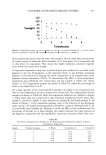
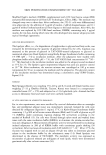
470 JOURNAL OF COSMETIC SCIENCE 6,0 :•4,0 ................ FILM HEIGHT i• / DISTRIBUTION /I 3,0 . . -. - ... - - -/- - _ _/_ 2,0 ................................... 0 0,1 0,2 0,3 0,4 0,5 0,6 0,7 0,8 0,9 1 F = Cumulative height distribution Figure 3. Film height distribution, calculated according to gamma function, with a shape parameter of 0.5. The number of height class intervals is arbitrary. Uniform parent film (h = 1) is also reported. 6,0 5,0 - 3,0 II FILM HEIGHT DISTRIBUTION UNIFORM PARENT FILM FILM 0,0 0,0 0,1 0,2 0,3 0,4 0,5 0,6 0,7 0,8 0,9 F = Cumulative height distribution Figure 4. Film height distribution, calculated according to gamma function, with a shape parameter of 1.50. The number of height class intervals is arbitrary. Uniform parent film (h = 1) is also reported. In the second model (Figure 4), a 1.50 value was attributed to the shape parameter. Repartition of every elementary class of film thickness is more matched into the total height distribution. This model can be seen as a schematic representation of a good sunscreen spreading, with some equilibrium between depleted and covered areas.
Purchased for the exclusive use of nofirst nolast (unknown)
From: SCC Media Library & Resource Center (library.scconline.org)