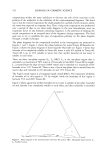
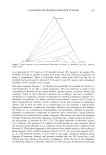
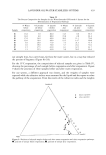
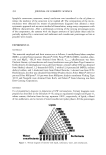
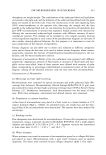
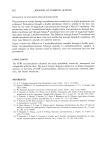
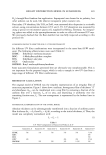
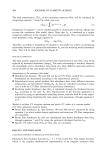
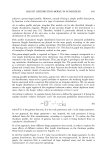
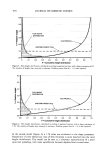
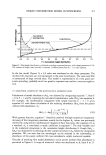
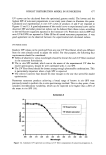
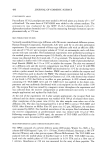
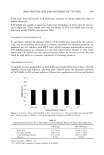
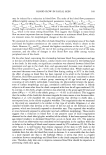
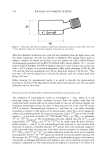
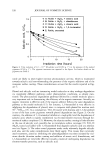
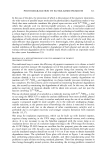
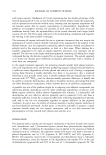
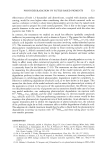
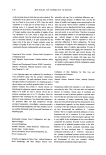
LAVENDER OIL/WATER/STABILIZER SYSTEMS 433 Lavender Off Water Laureth 4 Figure 2. Phase diagram of the water/Laureth 4/lavender oil system. L2: Solubility area. LLC: Lamellar liquid crystal. to a maximum of 17% water at 13% lavender oil and 70% Laureth 4 by weight. The solubility of water in Laureth 4 reaches 12% water, while the solubility of Laureth 4 in water is insignificant. There is a lameliar liquid crystal phase (LLC) on the line of distilled water and Laureth 4 between 51% Laureth 4 and 25 % water, with a maximum solubility of 8% lavender oil by weight. The phase diagrams (Figures 1, 2) illustrate the possibility for lavender oil, which is a multicompound, to act like a single compound. This was expected, as some of the constituents of lavender oil are cineol, linalool, geraniol, pinene, limonene, bornel, and coumarin. Some of their chemical structures are as follows: myrcene (7-methyl-3- methylene-l,6 octadiene), limonen (4-isopropenyl-l-methylcyclohexene), linalool (3,7- dimethyl 1,6-octadiene 3-ol, linalo), and amyl-vinylcarbinol (1-octen-3-ol) (1). Some of these compounds are alcohols, acetate, carboxylic acids, and saturated or unsaturated alkenes, and so they can easily act as cosurfactants and can resemble a typical phase diagram of surfactant, cosurfactant, and water. However, the real question was whether the whole oil, as a combination of hydrophobic and hydrophilic, aliphatic or aromatic, saturated or unsaturated compounds of unknown ratio, would have a phase behavior resembling the normal one for a single compound. The answer came from the literature through comparing some phase diagrams containing only a single compound similar to the one present in lavender oil (10-12,15). The phase behaviors of phenethyl alcohol (11), limonene (10), geraniol (15), linaloo (12) and lavender oil were compared. All of the previous contain Laureth 4 as a surfactant, except for geraniol when combined with Steareth 10. Their phase diagrams in the literature were mostly similar to the traditional phase diagram of the synthetic fragrance (Figure 3) (12-14), which had regions of LC, L2, L1, and emulsion regions. A closer look at the single compound fragrance phase diagram of limonene, linalool, and geraniol revealed that the LLC region has a well defined area that enhances the presence of fragrance, while the area in the phenethyl alcohol phase diagram is relatively reduced (11). The variation of commercial surfactant

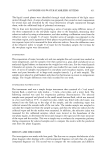
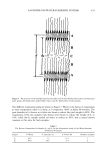
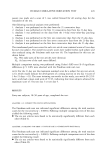
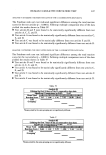
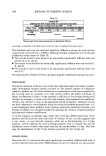
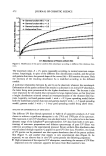
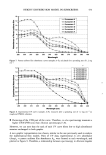
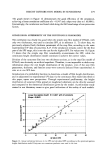
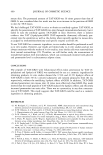
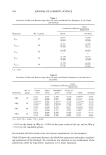
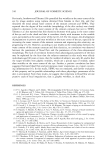
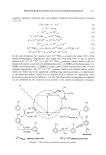
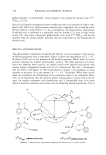
434 JOURNAL OF COSMETIC SCIENCE Fragrance Water Surfactant Figure 3. Phase diagram of surfacranr/water/syntheric fragrance and the different evaporation pathways. chain length creates a disorder of the end part of the hydrocarbon. Limonene and linalool fill this disorder, and so the LLC is clearly present in their phase behavior (10,12,15). This does not happen for phenethyl alcohol (11). For this contribution of the whole lavender oil, a similar condition takes place, as the oil contains a variety of many hydrocarbons, and so its phase diagram contains LC. The structure of LLC allows the presence of both the hydrocarbons and the polar components to fit, while in the HLC, the structure does not allow for that. On the other hand, the phase diagram consists of typical L 2 and L• and all the emulsion areas (Figures 1, 2). The results show how fragrance ingredients are solubilized in surfactant solution (L2) , and such a system serves as a fragrance reservoir. The results of comparing the two surfactants and different compositions were to see the role of the structure and the polarity of the surfactant in the solubility of the multi- compound fragrance. The relative hydrophilicity of Laureth 4 and Tween 80 allows the LC region to extend further and to hold many similar hydrophilic compounds inside it. With the Laureth 4 system, the LLC region is larger due to a linear system of LLC that allows more fragrance to get in (Figure 4). With the Tween system, the HLC is reduced, compared to the other system with lavender oil, which indicates the instability of a hexagonal liquid crystal structure that contains fragrance compounds (18). A room-temperature evaporation study was performed for two selected samples on a small scale (glass slides). For the first system (water/Tween 80/lavender oil), the com- positions of selected samples are shown in Table I: The first sample was a one-phase microemulsion (sample S•) with a composition of 83.5% water, 1.3% lavender oil, and 15.2% Tween 80 by weight. The second sample was a two-phase emulsion (sample S2) with a composition of 64% water, 29.5% lavender oil, and 6.5% Tween 80 by weight.
Purchased for the exclusive use of nofirst nolast (unknown)
From: SCC Media Library & Resource Center (library.scconline.org)