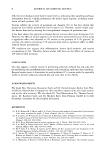
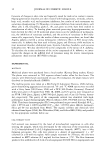
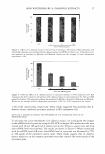
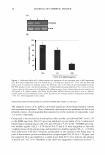
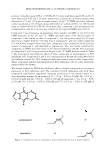
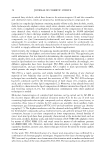
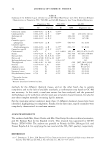
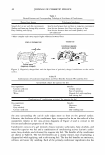
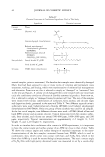
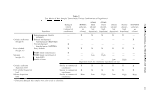
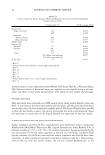
34 JOURNAL OF COSMETIC SCIENCE Table II Summary of the Different Lipids Identified in an SFE Wool-Wax Extract with Their Retention-Behavior Characteristics in Preparative TLC, TLC-FID, and GC-MS Diagnostic Ions Using Silylated Derivatives Lipids Cholesteryl sulfate Cholestanediols Hydroxyacids Diols Ceramide type II: sphyngosine Ceramide type II: dihydrosphyngosine Ceramides type VI Cholestanones Sterols Fatty alcohols Fatty acids Hydroxycholesteryl esters Triacylglycerol Diesters Aliphatic esters Cholesteryl esters Lanosteryl esters Dihydrolanosteryl esters * Non- polar elution. ** Polar elution. Preparative TLC Rf Fraction 0.000-0.072 A,B,C 0.000-0.033 A,B 0.000-0.072 A,B,C 0.000-0.072 A,B,C 0. 000-0.033 A,B 0.000-0.033 A,B 0.000-0.072 A,B,C 0.072 C 0.072-0.191 C,D,E 0.132-0.283 D, E, F, G 0.191-0.368 E, F, G, H 0.237-0.283 F, G 0.283-0.467 G, H, I 0.553-0.730 J, K 0.730 K 0.730 K 0.730 K 0.730 K 1 Relative abundance between brackets. TLC-FID GC-MS Rf MW Diagnostic ions I 0.04** 0.68** 546 456 (100), 546 (1) 388-528 147 (28) 374-514 147 (28) 0.76** 681-793 311(100) 0.76** 683-795 313 (100) 0.32** 0.72-0.88** 382,472 382 (53), 472 (30-67) 0.28* 456,458 366 (100), 368 (80) 0.36* 258-566 103 (35) 0.46* 216-566 117 (81) 0.46-0.54* 456 0.54* 638 [M"}, [M-CnCOO}' 0.66* 524 [M+NH4+} 0.76* 550-788 85 (10-25) 0.76* 554-722 368 (100) 0.76* 580-762 393 (100) 0.76* 582-764 395 (100) methods for the different chemical classes, and on the other hand, due to sample complexity and to the lack of available standards, a confirmation step based on GC-MS was necessary. In this work, a wool-wax extract has been analyzed, and the presented methodology can be useful not only for wool-wax or lanolin characterization, but also for any other complex naturally occurring lipidic mixture. For the wool-wax extract analyzed, more than 15 different chemical classes have been identified, highlighting its complexity. Finally, for the first time, type II ceramides were completely characterized in wool-wax extracts. ACKNOWLEDGMENTS The authors thank Mrs. Roser Chaler and Mrs. Dori Fanjul for their technical assistance, and Dr. Roshan Paul for his English review. This research was supported by CICYT Project 2FD97-0509. The authors are grateful to Peinaje del Rfo Llobregat S.A. and Praxair Espana S.A. for supplying the raw wool and the CO2 (SFC quality), respectively. REFERENCES (1) C. Domfoguez, E. Jover, J.M. Bayona, P. Erra, Characterization of supercritical fluid extracts from raw wool by TLC-FID and GC-MS,.J. Am. Oil Chem. Soc., 80, 717-724 (2003).

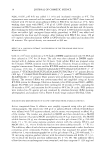
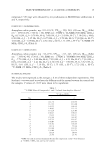
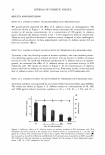
ANALYSIS OF WOOL-WAX EXTRACT 35 (2) J. Thewlis, Lanolin for cosmetic applications, Agro-Food-Industry Hi-Tech, 8, 10-15 (1997). (3) A. M. Rabasca and M. L. Gonzalez, Lipids in pharmaceutical and cosmetic preparations, Grasas y Aceites, 51, 7 4-96 (2000). (4) N. Miwa, S. Nakamura, N. Nagao, S. Naruse, H. Ito, Y. Takada, and K. Kageyama, Wool grease- derived alpha-monohydric fatty alcohols are carcinostatic depending on their branched alkyl moiety bulkiness, Anticancer Res., 16, 2479-2484 (1996). (5) D. C. Carrer, S. Hartel, H. L. Monaco, and B. Maggio, Ceramide modulates the lipid membrane organization at molecular and supramolecular levels, Chem. Phys. Lipids, 122, 147-152 (2003). (6) J. Thewlis, Lanolin: New horizons, Cosmetic News, 106, 27-30 (1996). (7) G. Barnett, Cosmet. Toiletr., 101, 23-44 (1986). (8) J. Thewlis, Lanolin for cosmetic applications, Agro-Food-Industry Hi-Tech, 8, 14-20 (1997). (9) K. Motiuk, Wool wax alcohols: A review,]. Am. Oil Chem. Soc., 56, 651-658 (1979). (10) H. Lamparczyk and M. Miszkiel, Gas-chromatographic evaluation of wool wax alcohols supported by principal component analysis, Chromatographia, 31, 243-246 (1991). (11) K. D. Mukherjee, "Application of Flame Ionization Detectors in Thin-Layer Chromatography," in Handbook of Thin Layer Chromatography. J. Sherma and B. Fried, Eds. (Marcel Dekker, New York, 1991), pp. 339-350. (12) R. G. Ackman, "Flame Ionization Detection Applied to Thin-Layer Chromatography on Coated Quartz Rods," in Methods in Enzymology, Part D, Lipids (Academic Press, New York, 1981), pp. 205-252. (13) I. H. Leaver, D. M. Lewis, and D. J. Westmoreland, Analysis of wool lipids using thin-layer chro- matography with flame ionization detection, Textile Res, .J., 58, 593-600 (1988). (14) L. Coderch, A. de la Maza, C. Soriano, P. Erra, and J. L. Parra, Chromatographic characterization of internal polar lipids from wool,]. Am. Chem. Oil Soc., 72, 715-720 (1995). (15) C. Dominguez, L. Coderch, P. Erra, J.M. Bayona, and D. Palet, Mineral oil detection in spinning oil formulation and wool top dichloromethane extracts by TLC/FID, AATCC Review, 7, 6-8 (2001). (16) R. Aichholz and E. Lorbeer, Investigation of combwax of honeybees with high-temperature gas chromatography and high-temperature gas chromatography-chemical ionization mass spectrometry. II. High-temperature gas chromatography-chemical ionization mass spectrometry, .J. Chromatogr. A, 883, 75-88 (2000). (17) C. A. Cramers, H. G. Janssen, and M. M. van Deursen, High-speed gas chromatography: An overview of various concepts, .J. Chromatogr. A, 856, 315-329 (l 999). (18) Z. Moldovan, E. Jover, and J. M. Bayona, Gas chromatographic and mass spectrometric methods for the characterization of long-chain fatty acids-Application of wool wax extracts, Anal. Chim. Acta, 465, 3 59-3 78 (2002). (19) Z. Moldovan, E. Jover, and J. M. Bayona, Systematic characterisation of long-chain aliphatic esters of wool wax by gas chromatography-electron impact ionization mass spectrometry,]. Chromatogr. A, 952, 193-204 (2002). (20) E. Jover, Z. Moldovan, and J. M. Bayona, Complete characterization of lanolin steryl esters by sub-ambient pressure gas chromatography-mass spectrometry in the electron impact and chemical ionization modes, .J. Chromatogr. A, 970, 249-258 (2002). (21) K. Raith, H. Farwanah, S. Wartewig, and R. H. H. Neubert, Progress in the analysis of stratum corneum ceramides, Eur . .J. Lipid Sci. Technol., 106, 561-571 (2004). (22) J. Fonollosa, M. Marti, A. de la Maza, J. L. Parra, and L. Coderch, TLC-FID analysis of the ceramide content of internal wool lipids,]. Planar Chromat., 13, 119-122 (2000). (23) C. Dominguez, E. Jover, J. M. Bayona, and P. Erra, Effect of the carbon dioxide modifier on the lipid composition of wool wax extracted from raw wool, Anal. Chim. Acta, 477, 233-242 (2003). (24) J. Bleton, K. Gaudin, P. Chaminade, S. Goursaud, A. Baillet, and A. Tchapla, Structural analysis of commercial ceramides by gas chromatography-mass spectrometry, .J. Chromatogr. A, 917, 251-260 (2001). (25) K. Y. Tserng and R. Griffin, Quantitation and molecular species determination of diacylglycerols, phosphatidycholines, ceramides, and sphingomyelins with gas chromatography, Anal. Biochem., 323, 84-93 (2003). (26) P. E. Kolattukudy, Chemistry and Biochemistry of Natural Waxes (Elsevier, Amsterdam, 1976).
Purchased for the exclusive use of nofirst nolast (unknown)
From: SCC Media Library & Resource Center (library.scconline.org)