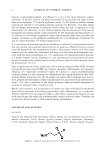
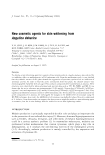
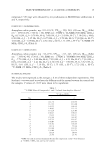
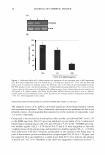
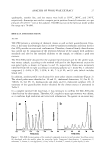
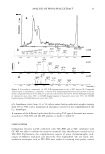
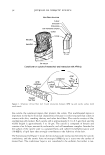
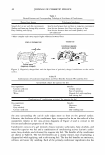
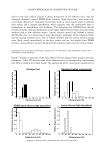
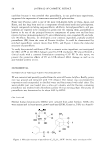
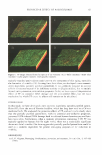
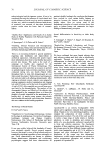
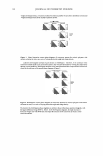
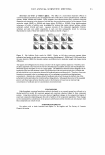
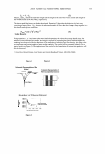
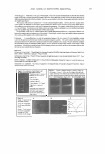
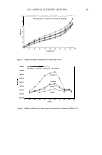
2005 ANNUAL SCIENTIFIC MEETING wrinkle (Figw-e 3). Furthermore, in the case of wrinkle depth, it was more accw-ate and reproducible to obtain the max and min height values from a computer generated histogram of the cross section rather than visually selecting the points and using the depth calculation function built into the software. Since they are too lengthy to detail here, image capture and analysis protocols are available lljX)l1 request. The accuracy of the system is reported to be+/- 3urn for a technical standard surfuce. However, the "true" accw-acy of the system needs to be addressed for each analysis protoco� taking into account subject movement during image capture and the various filtering steps applied to arrive at the specified rneasw-ement parameter. For example, wrinkle depth values have about a +/- l 5um error range. Sensitivity levels for wrinkle volume and swface roughness were also detennined and appear to be in an acceptable range for skin research and cosmetic claims srudies. The preliminary results from ow- wrinkle treannent srudy indicate that detectable differences in topographical features exist between the treatment and non-treatment eyes of the subjects. Wrinkle depth, wrinkle volume and surface roughness parameters show a decrease from baseline on the wrinkle treatment side. Conclusion A meaningful process to study the topographical features of the skin using a 3-D microtopography imaging system has the potential to provide many benefits to product development scientists. The system contains several pros, cons, and nuances that need to be addres.5ed or optimized in order to be fuUy confident in one's results. We have started this validation and optimization process for periorbital wrinkle analysis, but new protocols and other body locations would require similar investigations. It should also be noted that larger field size imaging systems are available and recent documentation indicates that they may be more suited for this type of analysis. References ll]F�G.OmM,. Hiih, T.. '�Ri{iilnVMJ�ofl-hnmSdn(l'RMIG,1�Digilal��¼ilhMbunirrcr�fum J:MD.'' SPI&Prrr. '�..U:�".4778i:p.�73(lll2) [2j F� G.,Om, M Hllh,T 'fual.lirre3D�Mt:lwt:mnwilhDigital 9¢e� �Teasl�MICl\lTIDIO'l.hi-fsDMD." Prrx:rf SPIE39.Slw. 9J. llli(.fil)) []] HJ( C, 1-q.xmri H., ''Cmµrim ofRqlica :nl In Vi\O Meminmrt oftt � ofHunm Skin.'' Ripa1 cu Umusitat cu� /-/amuglnwitfr� (.ID)) [4]1-kµmtni H.&l...tmmrl R., ··Areal�inT�lnV"Ml�Sa'i5ofHunm9i;iJ��Vea:rFiekk'' Instituter/ Mairtial GemvnAmnffocesl.Jni..-etsity •� I: The combinalion oftacwrs Iha pro"Klcd lhc !'I'm image capcun: ta:hruquc. •Standing (uprtg)ll. no leaning or bmdmg) w11h �hoes removed •Annsal mies •Eyes shut hghtl)J •Amb1en1 Lights off •s-poml hc:adrcs1. 50-55" angle •L1gh1 Source Apcnurc D. 3200K •Thorough rnbJccl mslr\Jct1ons. "mlemlptcd" repos111onmg on lirsl v1s11 10 ensure subJccl reproducib1h1y bdorc baseline 11nagc capture Figure J: A lmuge A· Camera file of pcriorbital wrinkles Image B. Topography file of same pcriorbital image Image C: Cross-section of wrinkle topography beneath chc 2 lines insencd into the images Fiaure 2: Column/: b�linc images Column Z: follow-up visil image� 10/umn 3 follow-up visil images after applying "c:la.�tic matching" tool. Black areas around the border represent mvalid dat.a and should be cropped out before further processing. Row J.· macrotopography ima&e Row 2: microtopolP"Phy image B C •t....M· '"' ,._,./ ,·,.r ·�---- •: ' -- • " .:. • u M 87

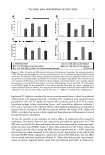
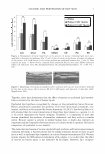
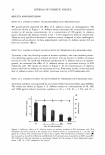
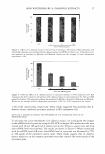
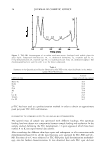
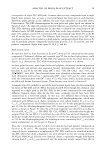
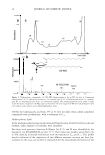
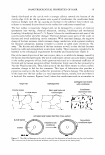
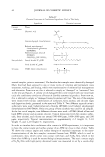
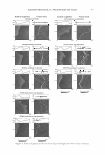
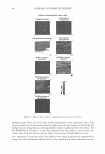
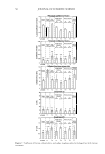
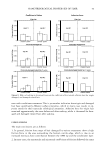
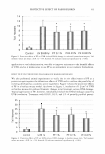
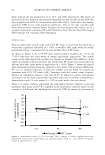
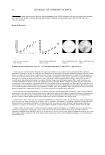
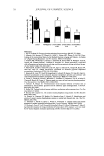
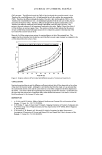
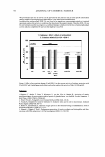
88 JOURNAL OF COSMETIC SCIENCE EFFECT OF OIL FILMS ON WATER VAPOR TRANSPORT INTO HUMAN HAIR ABSTRACT Yash K. Karnath, Ph.D., Karin Keis, Ph.D., and Craig L. Heummer TRI/Princeton, Princeton, NJ 08542 Sorption-desorption behavior of water vapor in human hair treated with various oils has been investigated using the Dynamic Vapor Sorption (DYS) Analyzer. Results show that the equilibrium water uptake is lowered significantly (-3-5%) on oil-treated hair. Diffusion coefficients calculated from the data go through a maximum in 40-60% RH range, Diffusion coefficients are also lowered significantly on oil- treated hair, suggesting that the oil films offer additional resistance to diffusion. Hair treated with larger amounts of oil ( with thicker oil films) absorbs lower amounts of water at equilibrium and has lower diffusion coefficients compared to hair treated with smaller amounts of oil. Removal of oil film reinstates the original sorption behavior, suggesting that the transport of water vapor is affected by the oil film on the surface of hair rather than the oil absorbed into the hair. INTRODUCTION Oils are extensively used as hair dressings in many parts of the world. Vegetable oils such as coconut oil has been shown to have a beneficial effect in protecting hair from grooming damage. Oils are known to be good plasticizers and lubricants which can reduce abrasive damage in combing [l]. They can also reduce penetration of damaging surfactants into the hair. Earlier studies have shown that vegetable oils with saturated or mono-olefinic fatty acids penetrate in hair to a greater extent compared to oils with polyunsaturated fatty acids [2]. Hydrocarbon oils such as mineral oils do not penetrate into hair [3]. We were interested in investigating how penetrability of an oil is related to moisturizing of hair. For this purpose we have chosen three different oils, e.g., coconut, sunflower and mineral oils for this study. EXPERIMENT AL All treatments were performed on dark brown European hair from DeMeo Brothers Inc. of New York, N. Y. The oils used in this study were commercially obtained low viscosity mineral oil and coconut and sunflower oils. The oil loadings on hair were typically 0.1 mL per gram of hair, massaged into the hair tress to attain a uniform distribution. The tresses were allowed to remin at roopm temperature for 24 h prior to starting the sorption-desorption experiment with the DYS. In some cases the tress was heated with a blow dryer at medium heat to promote the penetration of oil into the hair. In one specific experiment oil loading was increased to 1.2 mL per gram to deposit thick films of oil on the hair surface. Whenever necessary, oil films were removed from the hair by wiping with an acetone saturated wipe. Sorption-desorption experiments were conducted with the DYS instrument (Surface Measurement Sytems) at 25°C. The sample size was about 25 mg of hair cut in the form of snippets. Sorption-desorption cycle was confined to 0-95%RH in steps of 10% in the 0-90%range. The moisture regain was expressed as percent based on the dry weight of hair. RESULTS AND DISCUSSION Typical sorption --desorption isotherms are shown in Figure 1. It is clear that the equilibrium uptake of oil is significantly lowered by the application of oil. The differences between the oils were relatively small. This shows that deposition and penetration of oil into hair affects the accessibility of hair to water vapor. Although the differences between the oils are small, mineral oil seems to sorb the least amount of water compared to, for example, the coconut oil. The non-penetrating mineral oil is likely to have thicker films on the surface compared to coconut oil which is absorbed into the hair. The diffusion coefficients calculated from the sorption experiment are shown in Figure 2. Diffusion coefficients for all the samples go through a maximum, suggesting that the diffusion is likely to be proceeding through the cell membrane complexes between the cortical cells. Water molecules diffuse into the matrix of the cortical cells through the CMCs. The overall diffusion coefficient depends on whether the diffusion is controlled by the matrix or the CMCs. At low humidity, because the cells are not swollen, the
Purchased for the exclusive use of nofirst nolast (unknown)
From: SCC Media Library & Resource Center (library.scconline.org)