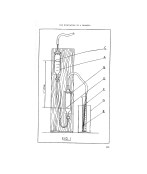
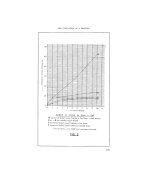
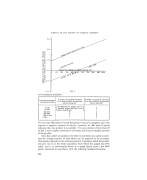
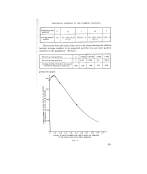
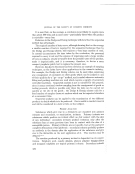
JOURNAL OF THE SOCIETY OF COSMETIC CHEMISTS . disc must be placed diagonally in the cylinder, otherwise a collapse of foam may occur between the tube and the cylinder. All parts of the apparatus com- ing into contact with the foam- ing liquid must be well washed with 5-10 per cent hydro- chloric acid and then two or three times with distilled water after each alternate estimation. The water levels in the cylin- ders A and B must be main- tained by adding water as evaporation takes place. Under these conditions: (1) Foam is produced in every case from essentially the same volume of air. (2)The air is broken up into bubbles of fairly uniform size. (3) The time of formation of the foams is substantially the same in all cases. (4) The foam comes into contact with surfaces free from uncon- trolled insoluble films which tend to destroy foam. (5) The comparative evaluation of a number of shampoos on a basis of foaminess is repeat- able for one operator and apparatus and reproducible for other operators and apparatus. Some results of tests are shown in Fig. 2, where it will be seen that the addition of butyl alcohol to the tap water causes a more rapid decline in the volume of foam and that the addition of unsulphated lauryl alcohol to the shampoo substantially arrests the decline. In saloon tests the shampoo which gave curve Q formed a more watery lather than that from which curve R was derived, and required for its production on an average approxi- mately 10 per cent more solution at the concentration defined in Fig. 2. A steeper curve than Q connotes a watery lather which breaks down rapidly on the head and may lead to absolute failure to lather on the first application. Although the shampoo user normally applies a much higher concentration of shampoo than that employed in the saloon tests de- scribed, the difference in quality between, for example, the shampoos Q and R is quite distinct on some heads. However important the practical shampoo test in the saloon may be, it is quite clear that a tekt on a single he/td can be misleading because different heads are not shampooed with equal facility. On the other hand, a single foaminess test carried out in the apparatus described will indicate a good shampoo which is above suspicion or a poor one which it is useless to consider further, or it will bring out the intermediate case in which further examination by saloon test on several heads is highly desirable. ACKNOWLEDGMENT The author wishes to express his thanks to the Directors of County Perfumery Co., Ltd., for permission to publish this paper. 156

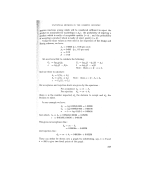
HAIR* By J. L. STOVES, Ph.D., M.Sc., F.R.I.C. M^•M^LS ARE distinguished from all other vertebrates by the posses- sion of hair, which chemically belongs to the keratin group of scleroproteins. Among lower animals hair has a definite function in relation to heat regulation. It may also serve as a protection against the abrasive action of an animal's en- vironment or against the 'action of light. An example from the latter class is the Pennsylvanian fox- squirrel (Sciurus niger). The bones of this animal contain a bright red pigment, Uroporphyrin I, and if the animal coat was not heavily pig- mented, S. niger would probably suffer from photosensitivity as do human porphyrinurics. Hairs may also function as tactile organs, since the hair follicles have at their base a network of nerves which is stimulated by quite slight movements of the free part of the hair shaft. In cer- tain cases hair has been modified into a weapon of defence or attack, as, for example, in the spines of the hedgehog or the quills of the porcu- pine. Morphologically, it is of interest to note that in the evolution of mammals, hair appears to have re- * Presented at Scientific Meeting. November 12th, 1952. London. placed the scaly covering of reptilian precursors, and the grouping of hair follicles found on the skin of a typical mammal would seem to be deter- mined by the original development of hairs in relation to epidermal scales. X-ray analysis of epidermal structures has thrown considerable. light on the possible homology of mammalian hair and reptilian scales. HAIR GROWTH Hair development is initiated by the appearance of a group of closely adjoining, cylindrical, dividing cells deep in the epidermis. By growth into the underlying connective tissue these cells produce a gradually elongating, epithelial cylinder. This constitutes the so-called "hair germ," and is rounded and slightly flattened at the end, under which there soon appears an accumulation of con- densed connective tissue. From the latter arises the hair papilla. The epithelial cells immediately above the connective tissue papilla are the basis of the future hair, while connective tissue surrounding the hair germ (or bulb) later forms the connective tissue portions of the hair sac. A detailed account of the complex processes of histogenesis resulting in the fully developed hair 157
Purchased for the exclusive use of nofirst nolast (unknown)
From: SCC Media Library & Resource Center (library.scconline.org)