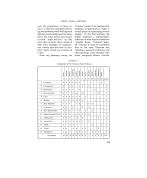
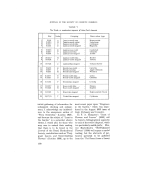
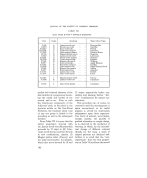
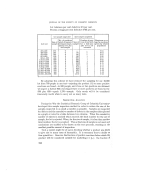
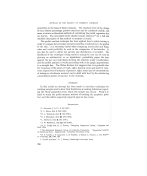
JOURNAL OF THE SOCIETY OF COSMETIC CHEMISTS dream-books, silk handkerchiefs and scarves were illustrated, embellished or embroidered with chosen floral motifs. Furthermore, with the items comprising the "typical" as well as the "by special request" bouquets from the florist--all these affairs, including the "ladylike" accomplish- ment of painting on glass and china --were virtually governed by the prescribed ritual of t lora Symbolica or the "Language and Sentiment of Flowers," which exercised a really serious influence upon the social activities of the town-and-country ladies of that period. Some idea of the importance of these observances can be gleaned from the fack that the "Floral Vocabulary" was represented by over a hundred domestic and wild flowers, •ragrant or odourless, each with a specific "meaning," while the com- bination of flowers and leaves, shaped into suitable emblematic garlands, required a code-book of over eight hundred entries to as- semble, and also to enable the recipient to interpret the meaning. It is noticeable (oddly enough) that among these perfume recipes there are certain glaring omissions, notably syringa, lavender, hyacinth, clematis, etc., as these would appear to have been "unpopulaF' because of their association with dolefulness, melancholy, grief and other unhappy conditions. T.qE ROS•/JASmN/NEROLI This seems a convenient place •o introduce what I should like to see described as Perfumery Postulate No. 1: this comes from The Givau- danjan, for in an issue dated May 1938, under the heading of the "Role of the Orange-blossom odour in Perfumery," it is stated that "there is hardly a perfume in which the combination of Rose, Jasmin and Orange-blossom, in some fo-m or other, is not either basic or a necessary adjunct." On referring to the listing of the selected fifteen popular perfumes it may be remarked that the dictum of Marcel Billot regarding the five or six elementary floral units necessary for the construction of a wider gamut, is justified, and furthermore, from the frequency factor, it is seen that the position of the rose, jasmin, orange-blossom trinity is maintained, supplemented by the' introduction of the new tonal values of tuberose, cassie and violet. Viewed from another angle, it is observed that the change-ringing for the evolution of these fifteen florals depends upon seven extraits, three tinctures and three essential oils-- the tinctures being selected for odour value--disregarding (for the purpose of this table) such fixative tinctures as benzoin, civet or musk. Piesse's remarks upon the close resemblance of certain flower odours to one another also finds acceptance when we compare the fundamentals, for instance, of honeysuckle and narcissus of lilac and muguet or of night-scented stock and wall- flower and it is particularly at this point that the skill of the perfumer is applied to the component propor- tions, increasing or decreasing each 184

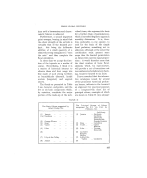
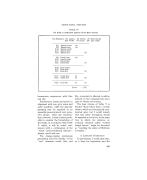
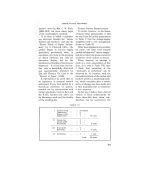
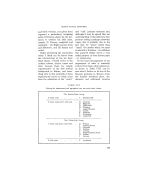
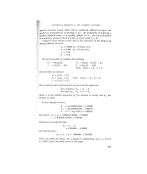
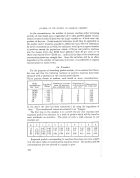
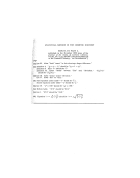
SIMPLE FLORAL PERFUMES item until a harmonious and charac- teristic balance is achieved. Furthermore, a second important point emerges, bearing in mind that the odour strength of the extraits is virtually that of the finished pro- duct this being the deliberate addition of a small quantity of a relatively strong osmophore to "turn the note" and thus complete the floral simulation. In these days we accept the func- tion of the topnote as a matter of course. Nevertheless, I think it is a matter of historical interest to observe when and how usage was first made of such strong fortifiers as benzaldehyde (almond), linalyl acetate (bergamot) and eugenol (dove). The florals as presented in Table I are, however, end-points, and the five or six basic components which, by variation, constitute the major portion of the make-up of the indi- vidual items, also represent the basis for a further chain of permutations, which if extended begins to approach unwieldy dimensions. It is, there- fore, preferable, in my opinion, to seek for the basis of the simple floral perfumes, something not so elaborate, although at the outset the combination must present more scope than the limited permutation on three items used in equal propor- tions: it would therefore seem that the ideal number of basic floral- elements which, by equi-mixture, will provide a set of transitions not too cumbersome for laboratory check- ing, would be limited to six units. I have remarked that the informa• tive catalogues issued by several of the prominent American perfum- ery houses, indicate in the foreword an alignment for practical purposes of a comparatively short list of principal odours, examples of which are shown in Table II (my arrange- TABLE II The Basic Odours suggested by Albert Verley, Inc (1) Jasmin ............ (la) Oardema ............ (2/ Orange Flower (3) Rose ... (4) Violet ... (5) Lilac ...... (6) (7) Lily-of-the-Valley (8) Ambre ...... The }'rircipal Groups of Odours recognised by E.I du Font de Nemours, Inc. S•b-Group. (1) Jasmin ... Gardenia Gardenia Sweet-pea Honeysuckle Orange blossom (3) Rose ...... Carnation (4) Violet ...... Cassie Mimosa {5) Lilac ...... Syrmga Hyacinth (6) (7) Lavender Foug•re Chypre Lily-of-the- Y alley ... Cyclamen 185
Purchased for the exclusive use of nofirst nolast (unknown)
From: SCC Media Library & Resource Center (library.scconline.org)