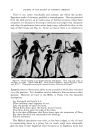
THE COSMETIC ARTS IN ANCIENT EGYPT 163 wanted to make sure that it went on in the next world in the same manner but only better if possible. Vanity alone does not, however, account for the very large use of cos- metics even in later times in ancient Egypt. Certainly the climate itself makes the use of some kind of oils and unguents on the skin, for example, a necessity. In a land of extreme dry heat in summer and without adequate means of insuring cleanliness a person is liable to irritations of all sorts, superficial if not serious and contagious. In Upper Egypt where it never rains, for example, and where the winter air is electrically dry and cool we who live there in the winters accept it as inevitable that we must apply something softening to hands and face frequently. Also in antiquity in the absence of soap or any other effective cleansing agent, oils and unguents were equally important for cleansing purposes. There is no reference to soap or anything we can identify as soap in the ancient Egyptian language and texts. I believe one of the Latin writers refers to the making of soap by the boiling of goat's tallow with causticised wood ash, but the manufacture of soap was not introduced into France and Germany from Italy until the 13th century A.D. It has been said that the ancient Egyptians used natron as a cleansing agent in the bath but I do not know on what authority or evidence. Natron, much used by the Egyptians especially in the mummification of bodies, is a natura•iy occur- ring compound of sodium carbonate and sodium bicarbonate With much impurity, particularly sodium chloride, in it. I do not know wliether this would have been of any particular value as a cleansing agent or not. I think it is no rationalization from vanity to utility which made the ancient Egyptians so exceedingly fond of green and especially black eye- paint or eye-shadow and to believe that they served as aids against the glare of the sun and as prophylactics against the ever present and ever dangerous eye diseases of a subtropic country. Whether the materials they used on lids and lashes had any actual prophylactic value or not I am not enough of a chemist to say. The point is that they believed in them and adopted them for that ostensible purpose. Of course, that they were said to make the eyes "large and bright" and actually do lend an exotic and arresting caste to the face eventually predominated perhaps as a motive for their use. I am not sure either how much a felt necessity played a part in the re- moval of bodily hair and the shaving of the head. Certainly, in the case of the priests it was considered a matter of absolute necessity for bodily cleanliness and ritual purity. The development of the most elaborate large curled and braided wigs to take the place of natural hair would, on the other hand, appear to have been dictated solely by vanity, for if anything ever presented a problem in cleanliness those wigs must have. I have wondered whether the numerous recipes from the old texts for preparations

164 JOURNAL OF THE SOCIETY OF COSMETIC CHEMISTS to overcome spotted baldness and graying hair indicate a prevalence of these troubles among the ancient Egyptians or an extreme dislike of the results with a resort to shaving the head and wearing a wig. Certainly wigs developed into a long-enduring fad of their own once they got under way. But now let us turn more specifically to some of the materials and prac- tices that may reasonably be described by the word "cosmetic." You will understand that in the case of materials which are thousands of years old chemical analysis is something of a problem, for there may be many un- controlled factors. To begin with ointments and unguents, the ancients had vegetable oils and animal fats from cows, sheep and goats. Later you will see that some of their recipes call for the fat of creatures far from domesticated as well. The poor people had probably only cheap oils such as that of the castor bean, for that plant grew abundantly in antiquity as it does now in Egypt. We know the names also of plants like sesame, croton, saffron, pumpkin seed and linseed (flax) from which they must have obtained oil. But there was little if any olive oil! That may sound strange as a statement about a country at the eastern end of the Mediterranean. We know that there were olive trees in ancient Egypt, but we also know from the revenue payri of Ptolemaic times (3rd century B.C.) that there was no government monop- oly on olive oil, as there was on so many other things, because it was almost completely negligible even that late as a commodity. As a witness to the ancient EgyptJan's feeling that oils and ointments for the body were an absolute essential of living, let us look at a couple of more or less incidental references in the literature. There was a high official named Sinuhe who was on a military campaign with the Crown Prince Sesostris against the Libyans when word came that King Amenemhet I had died and, of course, Sesostris would succeed him (about 1962 B.C.). For some reason that is not told us in his story, Sinuhe anticipated trouble, at least for himself, in this change and he chose to flee his native land. He fled to the highlands of Palestine-Syria, married a native woman, had a family, became wealthy, was host to Egyptian officials and traders when they passed his adopted home, and lived there until he was an old man. Eventually upon issuance of a royal decree he was brought home to Egypt in great honor. He was given one of the royal houses in which he says pointedly that there was a bath. "Precious things of the treasury were in it," he says, "garments of royal linen, myrrh and fine oil of the king. **** Years were made to pass away from my body I was shaved(?) and my hair was combed(?). **** And I was arrayed in finest linen and anointed with the best oil. I slept in a bed and gave up the sand to those who are in it (i.e., the Asiatics among whom he had lived) and the oil of wood to him who smears himself with it." Similarly in the 29th year of Ramses III's reign (about 1170 B.C.) the
Purchased for the exclusive use of nofirst nolast (unknown)
From: SCC Media Library & Resource Center (library.scconline.org)