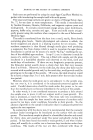
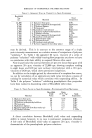
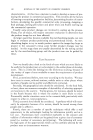
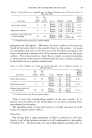
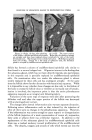
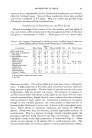
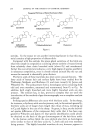
190 JOURNAL OF THE SOCIETY OF COSMETIC CHEMISTS TABLE 3.--SPREADING INDEX OF LIPIDS ON INTACT SURFACE AND AT BARRIER LEVEL OF HEALTHY SKIN No. No. Ratio: of of Barrier Test Area Subj.* Assays Level Median Range Surface Barrier 2.0 0.8-3.5 Lower chest, lateral 16 36 Surface 2.0 1.0-4.9 0.99 Upper back lateral 8 9 Barrier 2.0 1.0-2.5 Surface 2.2 1.7-3.1 0.85 As above, plus calves (all Barrier 2.0 0.8-3.5 sites examined) 19 46 SuTface 2.1 1.0-4.9 0.95 * 1-5 determinations per site in a given subject. the outer skin--one right at the surface, the other (and larger one) at the base, while very little is present in the intermediate layers, the stratum "disjunctum." He was ahead of us also in his conclusion that some of the sebum which we had shown to undergo emulsification with the sweat (12, 18), is carried inward by the sweat--from the surface through the intermediate, poorly coherent or "disjunct" layers--and then accumulates at the barrier level. The fact that the acid number is higher for the intact surface than for the barrier level would be explained by the smaller number of micro Srganisms present at the lower level, should enzymes of microbial origin be largely responsible for the presence of the fatty acids. The observation of Nico- laides and Wells (19), as well as of Montagna (20) and Steigleder (21), that esterase activity is quite intense in the sebaceous ducts, i.e. below the barrier level, would not be inconsistent with this explanation, since ad- ditional activity is demonstrable also on the very surface and in the surface film--Steigleder--which are absent after stripping (22). The failure of the spreading index to behave like the acid number, that is, to be smaller for the barrier zone than for the unstripped surface, suggests that in contrast to the fatty acid distribution, other lipid constit- uents are present in lower concentration on the surface, and in higher concentration at the base of the stratum corneum where they make up for the smaller amount of fatty acids in facilitating the lipid spread on water. One lipid constituent of this kind is free cholesterol, which is known to promote spreading and to undergo physiological esterification in the outer layers of the stratum corneum (23, 24). As an addendum, we wish to point out that all the assays just described have been exten, ded also to the study of pathologic conditions. Thus far, our interest has been focussed in particular on psoriasis. We want to limit the present outlines to a preliminary report that unlike in normals, the acid number in the psoriatics examined to date was higher for the bar-

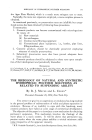
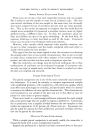
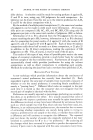
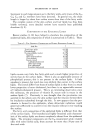
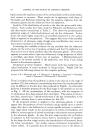
STRIPPED AND UNSTRIPPED HUMAN SKIN 191 rier /eve/ than for the intact surface. In 12 series of assays performed in seven psoriatics, the ratio of the medians for the stripped to the medians for the unstripped areas was greater than one and a half. There was no difference in the findings obtained in sites with psoriatic plaques (seven series) and those obtained in grossly unaffected skin areas (five series) of these patients. A median-ratio greater than one for "stripped to un- stripped" was observed also in a subject suffering from a skin ailment other than psoriasis, namely from congenital ichthyosiform erythroderma both ailments, however, have extensive parakeratosis in common. Another subject, suffering from extensive hyperkeratosis caused by a nevoid condi- tion, did not show a comparable ratio above one. As to the question of factors possibly underlying this reversal of the ratio of the acid numbers for barrier and intact surface, we might allude to the alternate possibilities of the existence of a microbial peculiarity on the one hand, an assumption favored by Rothman and his group, and of an intrinsic metabolic disorder on the other. We are inclined to speculate in the latter direction--in particular to attribute importance to several findings adding up to the hypothesis that there may be increased utiliza- tion of fatty acids for sterol synthesis in the outer horny layers. Summary 1) The quantity of ether-soluble substances on the skin ("casual level"), the acid number and the spreading index of these lipids were assayed in samples obtained from the intact skin surface and in samples obtained after stripping at the barrier level of the stratum comeurn. 2) The lipid quantity of the barrier level normally amounts to ap- proximately two-thirds to three-quarters of the quantity collected from the intact skin surface. 3) The acid number for the barrier level ranges by about 25 per cent below the acid number for the unstripped surface. 4) There is no difference in the spreading index for the two levels. 5) An acid number higher for the barrier zone than for the unstripped skin surface was found in the psoriatics thus far examined. REFERENCES (1) Herrmann, F., Coon, William, Harber, L., Scher, R. L., and Mandol, L., y. Soc. Cosmetic Chemists, 10, 88 (1959). (2) Szakall, A., Atrch. klin. exptl. Dermatol., 201,331 (1955). (3) Stupel, H., and Szakall, A., "Die Wirkung yon Waschmitteln auf die Haut," Heidelberg, Dr. Alfred H•thig Verlag (1957), p. 40. (4) Szakall, A., Berufsdermatosen, 6, 93 (1958). (5) Blank, I. H., y. Invest. Dermatol., 18, 433 (1952). (6) Blank, I. H.,Ibid., 21,259 (1953). (7) Blank, I. H., and Shappirio, E. B., Ibid., 25, 391 (1955). (8) Grueneberg, T., and Szakall, A., Atrch. klin. exptL DermatoL, 201,361 (1955). (9) Herrmann, F., and Prose, P. H., y. Invest. DermatoL, 16, 217 (1951). (10) Prose, P. H., Baer, R. L., and Herrmann, F., Ibid., 19, 227 (1952).
Purchased for the exclusive use of nofirst nolast (unknown)
From: SCC Media Library & Resource Center (library.scconline.org)