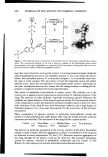
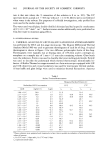
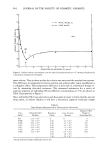
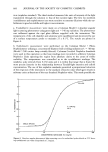
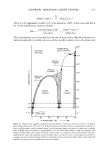
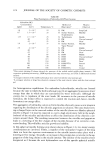
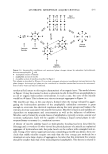
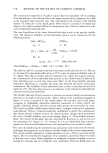
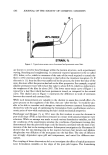
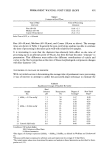
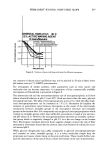
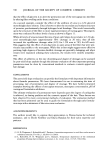
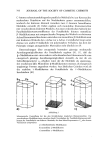
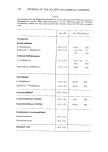
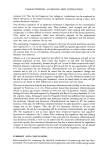
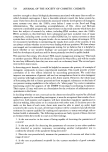
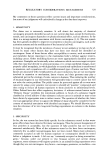
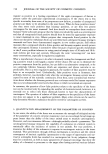
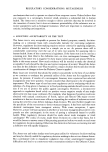
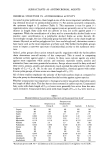
674 JOURNAL OF THE SOCIETY OF COSMETIC CHEMISTS Table III Phase Examinations of Nafoxidine HCl/Water Systems Nafoxidine HCI Concentration Method of Phase(s) mg/ml tool % Temperature, øC Observation • Observed 1.0 2 x 10 -a 12 X PM Soap Curd 0.7 1.5 x 10 -a 25 O Surface Tension, MiceIlar Nephelometry 1.35 2.7 x 10 -a 25 X Turbidimetry Middle 60 25 O PM Viscous Isotropic b 65 25 O PM Neat" 1.0 2 x 10 -a 37 O Surface Tension, Miceliar Vapor Pressure 2.0 4 x 10 -• 37 X PM Middle 60 37 O PM Viscous Isotropic b 65 37 O PM Neat c 18 85 X HSM Middle 60 88 X HSM Viscous Isotropic b 40 113 X HSM Middle 70 134 O HSM Neat c 100 176 O HSM, DTA Smectic 90 178 O HSM Neat 100 186 O HSM, DTA Crystal •Data points showing X always showed the presence of the mobile turbid middle phase (nematic). PM represents polarizing microscopy, HSM represents hot stage microscopy, and DTA is differential thermal analysis. 2, Conjugate solutions of the middle turbid phase were observed with the clear isotropic gel. "A conjugate solution or lyogel was observed composed of the neat (smectic) phase with the clear isotropic gel. for heterogeneous equilibrium. For nafoxidine hydrochloride, micelies are formed because the state in which the hydrocarbon groups (•) are aggregated possesses a lower energy than that in which they are surrounded by water molecules. Although the energy due to repulsion of the ionic heads (W) increases in the process of micelle formation, the former effect is expected to control the reaction and, hence, micelle formation is an energy effect. The aggregation of nafoxidine cations to form micelles obviously causes a new situation regarding the distribution of the chloride gegenions in solution. The ionic heads form- ing a charged layer on the external surface of the micelle (shown as a Hartley spherical micelie in Figure 14) may be expected to exert a high electrostatic field in the neigh- borhood of the micelles and therefore to effect the distribution of the chloride coun- terions around them. The resulting interaction between the micelles and gegenions leads to a lowering of the free charges of the micelles because of an extensive coun- terion binding. This will affect micellar growth and stability. In this spherical micelle forming step (shown above in Figure 14), two major energy considerations are involved. Firstly, a transfer of the non-polar ¾ region of the long chain ion from the aqueous environment to the micelle interior takes place with a lowering in free energy. Secondly, an increase in free energy also occurs due to the ag- gregation of the long chains in the micelle interior. The interior of the micelle is here designated as • because the new hydrocarbon core of this specific spherical micelle

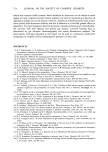
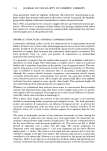
LYOTROPIC MESOPHASE (LIQUID CRYSTAL) 675 (Smectic) Middle (Nemotic) To, k Viscous 'l'sotropic Figure 14. Intermicellar equilibrium and associated phase changes shown by nafoxidine hydrochloride shown as an amphiphile ,• with W hydrophilic section ofmicelle • amphiphilic section ofmicelle 6 oleophilic section ofmicelle as described in Figure 1 This scheme is described by Winsor (2) to include conjugate solutions at equilibrium mixtures between the phase changes. Anisotropic gel phase may be considered as a lamellar intermediate between the microemul- sions of oil-in-water and water-in-oil forms. renders a fluid nature to this region characteristic of an organic layer. The model shown in Figure 14 may be reversed to show a spherical micelle formed from an amphiphile in an oil or organic hydrocarbon environment. In such a case, the core of the micelle would be aT layer. This is shown as a viscous isotropic aggregate in Figure 14. The micelles are thus, in the case shown, formed when the energy released by aggre- gating the hydrocarbon portions of the amphiphilic nafoxidine monomer is great enough to overcome the electrical repulsion among the ionic groups and balance the entropy decrease associated with micelle formation. Micelle formation and stability are dependent on temperature and concentration as well as the influence of additives. Micelles can be formed by several classes of amphiphiles, typically cationic, anionic and nonionic surfactants. Each will be capable of forming a liquid crystal phase in sub- sequent binary or ternary (i.e., emulsion) systems. A theory of micelle stability based on hydrophobic bonding has been described by Scheraga and co-workers (8) who viewed the physical picture of a micelle as a spherical aggregate of hydrocarbon tails, the polar heads on the surface with entangled tails in- side. Using a free valence approach and also considering a micelle as a lattice, they con- clude that stable micelles require not only that the free energy per molecule be a minimum at some large degree of aggregation, but also that this minimum free energy should be smaller than that of the monodispersed amphiphile. The theory is related to
Purchased for the exclusive use of nofirst nolast (unknown)
From: SCC Media Library & Resource Center (library.scconline.org)